If you have any questions, you are always welcome to contact us. We'll get back to you as soon as possible, withing 24 hours on weekdays.
Customer service
All questions about your order, return and delivery must be sent to our customer service team by e-mail at yourstore@yourdomain.com
Sale & Press
If you are interested in selling our products, need more information about our brand or wish to make a collaboration, please contact us at press@yourdomain.com
Help
If you have any questions, you are always welcome to contact us. We'll get back to you as soon as possible, withing 24 hours on weekdays.
Customer service
All questions about your order, return and delivery must be sent to our customer service team by e-mail at yourstore@yourdomain.com
Sale & Press
If you are interested in selling our products, need more information about our brand or wish to make a collaboration, please contact us at press@yourdomain.com
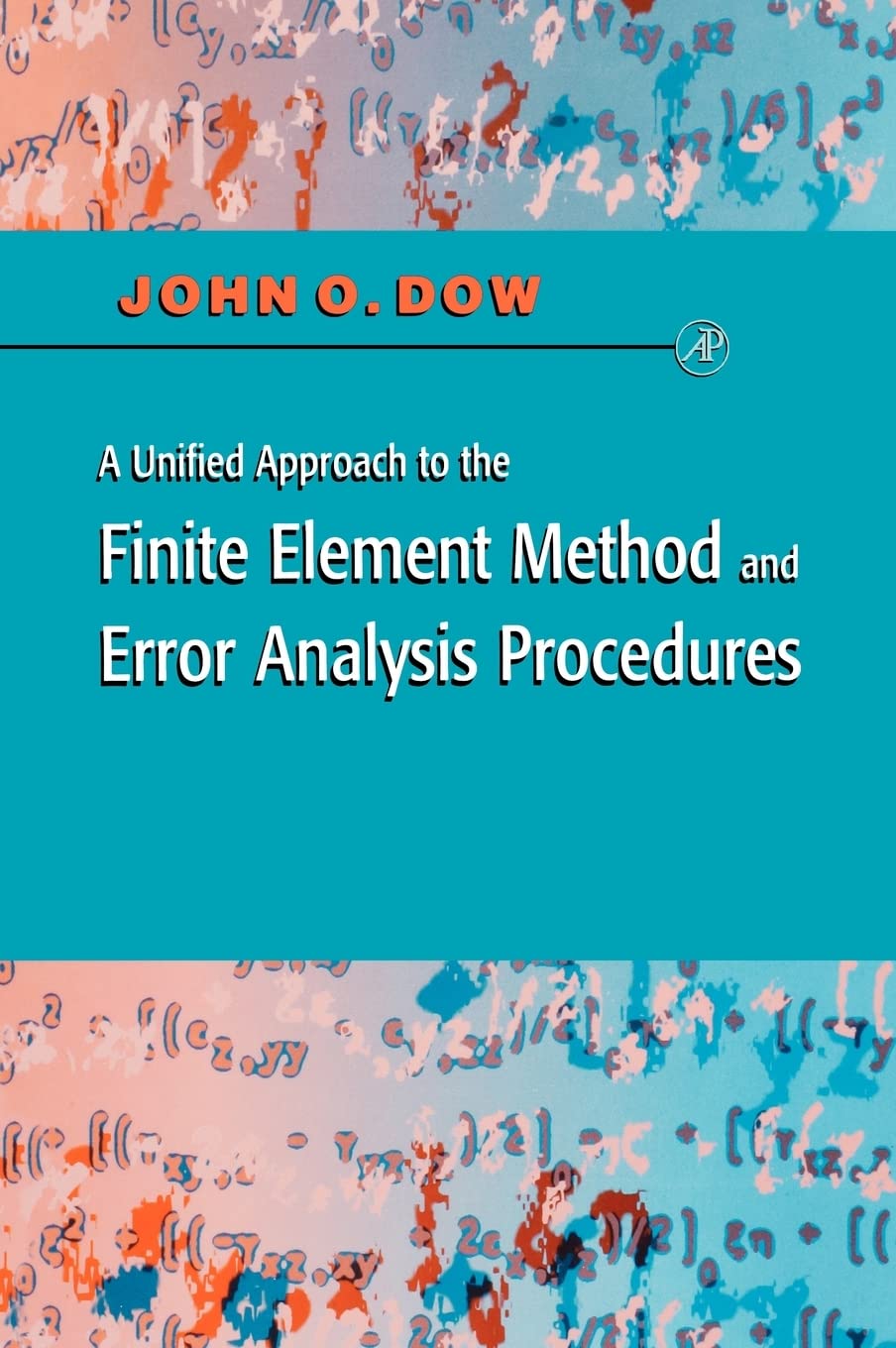
A Unified Approach to the Finite Element Method and Error Analysis Procedures provides an indepth background to better understanding of finite element results and techniques for improving accuracy of finite element methods. Thus, the reader is able to identify and eliminate errors contained in finite element models. Three different error analysis techniques are systematically developed from a common theoretical foundation: 1) modeling erros in individual elements; 2) discretization errors in the overall model; 3) pointwise errors in the final stress or strain results.Thoroughly class tested with undergraduate and graduate students.A Unified Approach to the Finite Element Method and Error Analysis Procedures is sure to become an essential resource for students as well as practicing engineers and researchers. New, simpler element formulation techniques, modelindependent results, and error measures New polynomialbased methods for identifying critical points New procedures for evaluating sheer/strain accuracy Accessible to undergraduates, insightful to researchers, and useful to practitioners Taylor series (polynomial) based Intuitive elemental and pointwise error measures Essential background information provided in 12 appendices
⚠️ WARNING (California Proposition 65):
This product may contain chemicals known to the State of California to cause cancer,
birth defects, or other reproductive harm.
For MAP (Minimum Advertised Price) violations and Intellectual Property (IP) or Trademark concerns, please contact:
support@ergodebooks.com
⚠️ California Proposition 65 Warning: Some products sold on this website may expose you to chemicals known to the State of California to cause cancer, birth defects, or other reproductive harm. For more information, visit www.P65Warnings.ca.gov.