If you have any questions, you are always welcome to contact us. We'll get back to you as soon as possible, withing 24 hours on weekdays.
Customer service
All questions about your order, return and delivery must be sent to our customer service team by e-mail at yourstore@yourdomain.com
Sale & Press
If you are interested in selling our products, need more information about our brand or wish to make a collaboration, please contact us at press@yourdomain.com
Help
If you have any questions, you are always welcome to contact us. We'll get back to you as soon as possible, withing 24 hours on weekdays.
Customer service
All questions about your order, return and delivery must be sent to our customer service team by e-mail at yourstore@yourdomain.com
Sale & Press
If you are interested in selling our products, need more information about our brand or wish to make a collaboration, please contact us at press@yourdomain.com
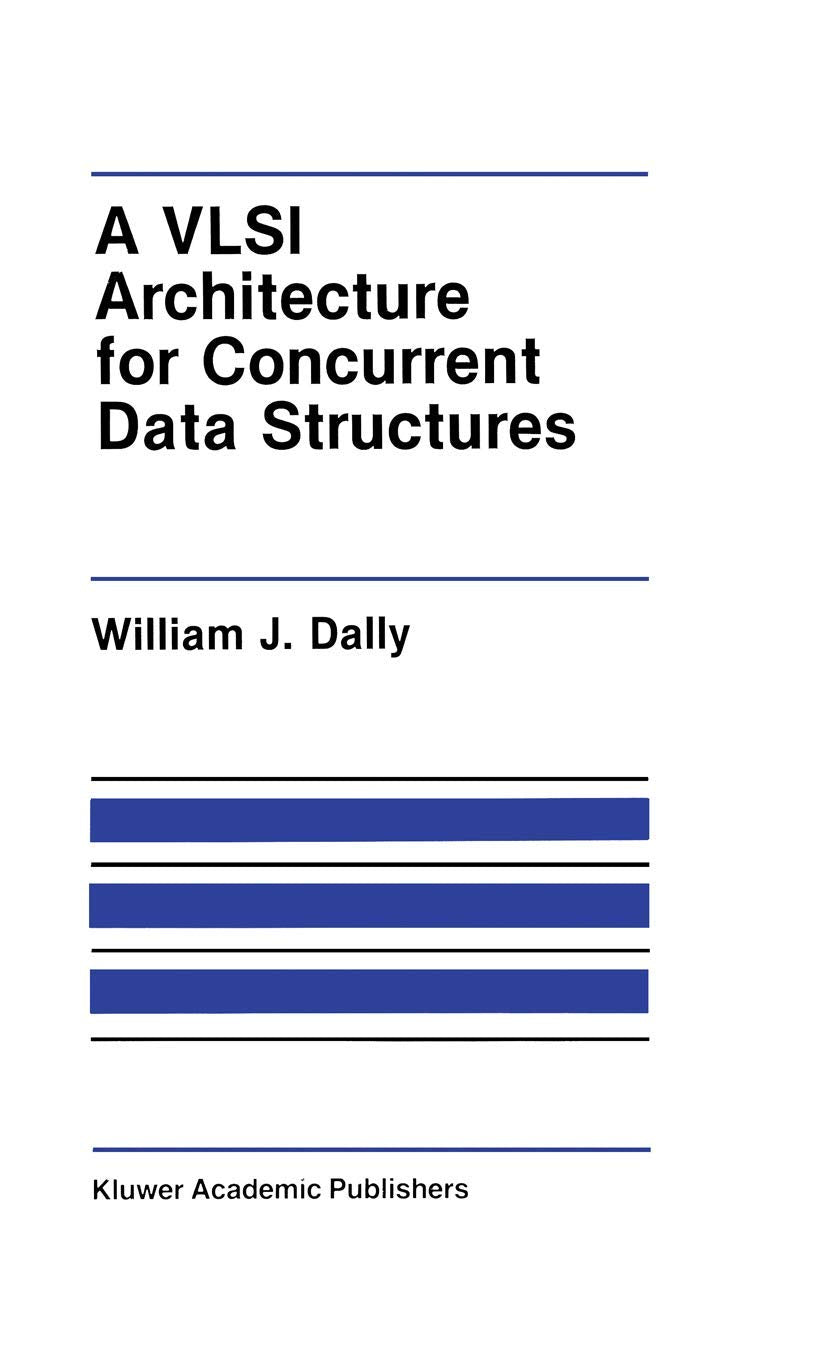
Concurrent data structures simplify the development of concurrent programs by encapsulating commonly used mechanisms for synchronization and commu nication into data structures. This thesis develops a notation for describing concurrent data structures, presents examples of concurrent data structures, and describes an architecture to support concurrent data structures. Concurrent Smalltalk (CST), a derivative of Smalltalk80 with extensions for concurrency, is developed to describe concurrent data structures. CST allows the programmer to specify objects that are distributed over the nodes of a concurrent computer. These distributed objects have many constituent objects and thus can process many messages simultaneously. They are the foundation upon which concurrent data structures are built. The balanced cube is a concurrent data structure for ordered sets. The set is distributed by a balanced recursive partition that maps to the subcubes of a binary 7lrcube using a Gray code. A search algorithm, VW search, based on the distance properties of the Gray code, searches a balanced cube in O(log N) time. Because it does not have the root bottleneck that limits all treebased data structures to 0(1) concurrency, the balanced cube achieves 0C.:N) con currency. Considering graphs as concurrent data structures, graph algorithms are pre sented for the shortest path problem, the maxflow problem, and graph parti tioning. These algorithms introduce new synchronization techniques to achieve better performance than existing algorithms.
⚠️ WARNING (California Proposition 65):
This product may contain chemicals known to the State of California to cause cancer,
birth defects, or other reproductive harm.
For MAP (Minimum Advertised Price) violations and Intellectual Property (IP) or Trademark concerns, please contact:
support@ergodebooks.com
⚠️ California Proposition 65 Warning: Some products sold on this website may expose you to chemicals known to the State of California to cause cancer, birth defects, or other reproductive harm. For more information, visit www.P65Warnings.ca.gov.