If you have any questions, you are always welcome to contact us. We'll get back to you as soon as possible, withing 24 hours on weekdays.
Customer service
All questions about your order, return and delivery must be sent to our customer service team by e-mail at yourstore@yourdomain.com
Sale & Press
If you are interested in selling our products, need more information about our brand or wish to make a collaboration, please contact us at press@yourdomain.com
Help
If you have any questions, you are always welcome to contact us. We'll get back to you as soon as possible, withing 24 hours on weekdays.
Customer service
All questions about your order, return and delivery must be sent to our customer service team by e-mail at yourstore@yourdomain.com
Sale & Press
If you are interested in selling our products, need more information about our brand or wish to make a collaboration, please contact us at press@yourdomain.com
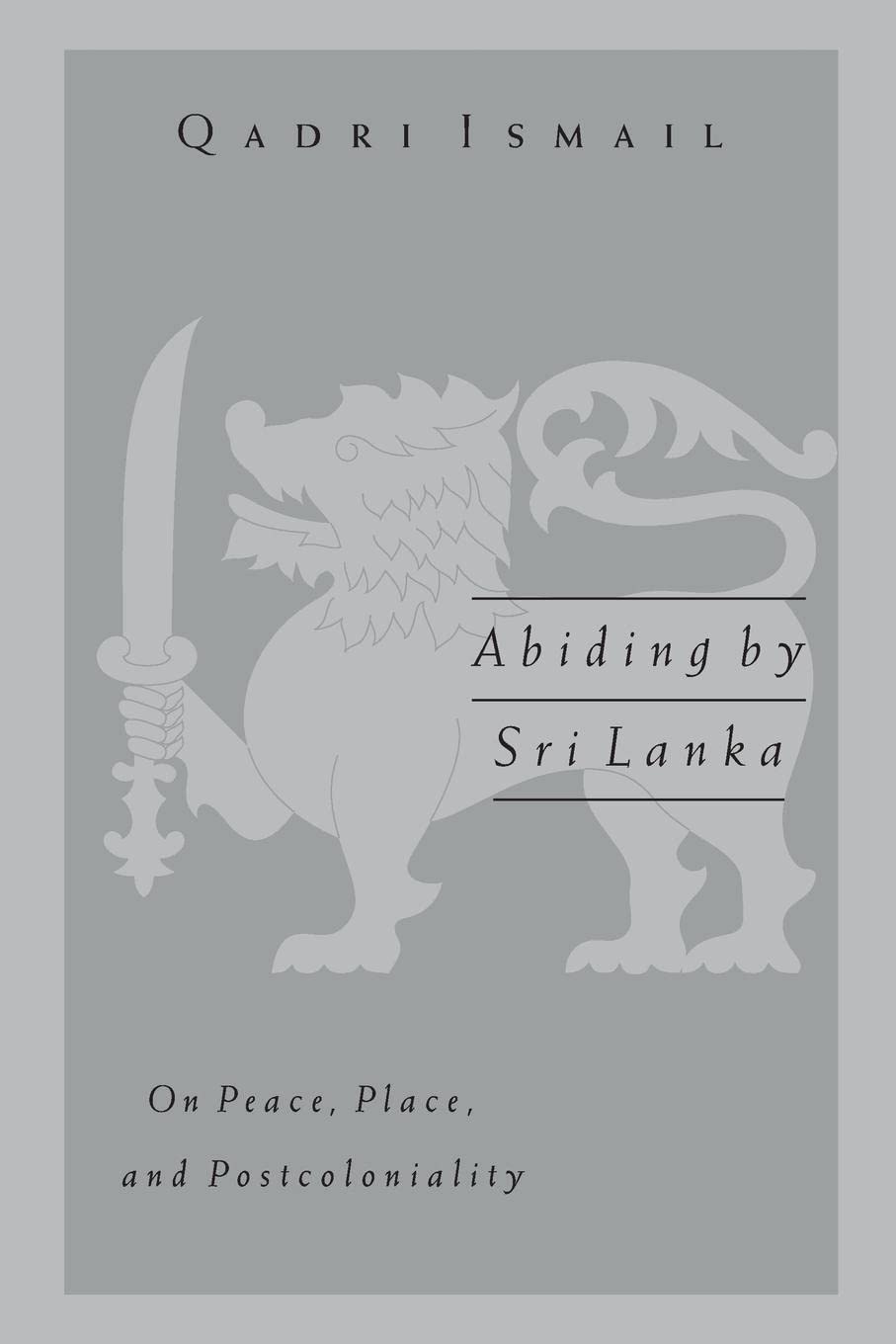
The lack of peace in Sri Lanka is commonly portrayed as a consequence of a violent, ethnonationalist conflict between the Sinhalese majority and the Tamil minority. Viewed in this light, resolution could be attained through conflict management. But, as Qadri Ismail reveals, this is too simplistic an understanding and cannot produce lasting peace.Abiding by Sri Lanka examines how the disciplines of anthropology, history, and literature treat the Sri Lankan ethnic conflict. Anthropology, Ismail contends, approaches Sri Lanka as an object from an outside and western point of view. History, addressing the conflict from the inside, abides by the place and so promotes change that is nationalist and exclusive. Neither of these fields imagines an inclusive community. Literature, Ismail argues, can.With close readings of texts that abide by Sri Lanka, texts that have a commitment to it, Ismail demonstrates that the problems in Sri Lanka raise fundamental concerns for us all regarding the relationship between democracies and minorities. Recognizing the structural as well as political tendencies of representative democracies to suppress minorities, Ismail rethinks democracy by redefining the concept of the minority perspective, not as a subjectposition of numerical insignificance, but as a conceptual space that opens up the possibility for distinction without domination and, ultimately, peace.Qadri Ismail is associate professor of English at the University of Minnesota. He has also been a journalist in Sri Lanka.
⚠️ WARNING (California Proposition 65):
This product may contain chemicals known to the State of California to cause cancer,
birth defects, or other reproductive harm.
For MAP (Minimum Advertised Price) violations and Intellectual Property (IP) or Trademark concerns, please contact:
support@ergodebooks.com
⚠️ California Proposition 65 Warning: Some products sold on this website may expose you to chemicals known to the State of California to cause cancer, birth defects, or other reproductive harm. For more information, visit www.P65Warnings.ca.gov.