
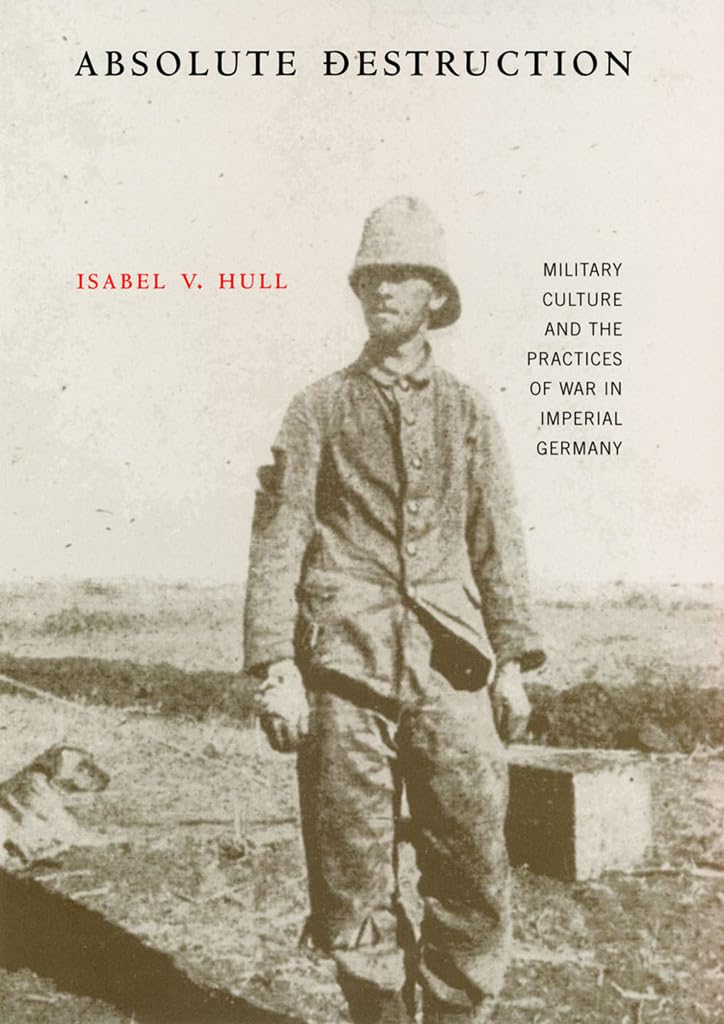
Title
Absolute Destruction: Military Culture And The Practices Of War In Imperial Germany,Used
Sold by Ergodebooks, an authorized reseller.
Returns accepted within 30 days | support@ergodebooks.com
Shipping Information
- Free Standard Shipping — United States only
- Processing Time: 3–5 business days
- Estimated Delivery: 6–10 business days after dispatch
- Double-boxed, fully insured & discreetly packaged
- Tracking number sent via email once dispatched
Returns & Refund
Returns accepted within 30 days of delivery.
Damaged or Defective Item
Free return shipping + replacement or full refund
Wrong Item Received
Free return shipping + replacement or full refund
Change of Mind
Return shipping at customer's expense · 25% restocking fee applies
Payment Option

In A Book That Is At Once A Major Contribution To Modern European History And A Cautionary Tale For Today, Isabel V. Hull Argues That The Routines And Practices Of The Imperial German Army, Unchecked By Effective Civilian Institutions, Increasingly Sought The Absolute Destruction Of Its Enemies As The Only Guarantee Of The Nation'S Security. So Deeply Embedded Were The Assumptions And Procedures Of This Distinctively German Military Culture That The Army, In Its Drive To Annihilate The Enemy Military, Did Not Shrink From The Utter Destruction Of Civilian Property And Lives. Carried To Its Extreme, The Logic Of 'Military Necessity' Found Real Security Only In Extremities Of Destruction, In The 'Silence Of The Graveyard.'Hull Begins With A Dramatic Account, Based On Fresh Archival Work, Of The German Army'S Slide From Administrative Murder To Genocide In German Southwest Africa (19047). The Author Then Moves Back To 1870 And The War That Inaugurated The Imperial Era In German History, And Analyzes The Genesis And Nature Of This Specifically German Military Culture And Its Operations In Colonial Warfare. In The First World War The Routines Perfected In The Colonies Were Visited Upon European Populations. Hull Focuses On One Set Of Cases (Belgium And Northern France) In Which The Transition To Total Destruction Was Checked (If Barely) And On Another (Armenia) In Which 'Military Necessity' Caused Germany To Accept Its Ally'S Genocidal Policies Even After These Became Militarily Counterproductive. She Then Turns To The Endkampf (1918), The German General Staff'S Plan To Achieve Victory In The Great War Even If The Homeland Were Destroyed In The Processa Seemingly Insane Campaign That Completes The Logic Of This Deeply Institutionalized Set Of Military Routines And Practices. Hull Concludes By Speculating On The Role Of This Distinctive Military Culture In National Socialism'S Military And Racial Policies.Absolute Destruction Has Serious Implications For The Nature Of Warmaking In Any Modern Power. At Its Heart Is A Warning About The Blindness Of Bureaucratic Routines, Especially When Those Bureaucracies Command The Instruments Of Mass Death.
⚠️ WARNING (California Proposition 65):
This product may contain chemicals known to the State of California to cause cancer, birth defects, or other reproductive harm.
For more information, please visit www.P65Warnings.ca.gov.
- Q: How many pages does this book have? A: This book has four hundred pages. It provides an in-depth analysis of military culture in Imperial Germany.
- Q: What is the binding type of this book? A: The binding type is paperback. This makes it lightweight and easy to handle.
- Q: What are the dimensions of this book? A: The dimensions are six point six one inches in length, one point one inches in width, and nine point zero nine inches in height.
- Q: Who is the author of this book? A: The author is Isabel V. Hull. She is known for her contributions to modern European history.
- Q: What is the main theme of the book? A: The main theme is the destructive military culture of Imperial Germany. It explores how military necessity led to extreme violence.
- Q: Is this book suitable for academic use? A: Yes, this book is suitable for academic use. It is a significant contribution to the study of military history.
- Q: How should I store this book? A: Store this book in a cool, dry place. Avoid direct sunlight to protect the cover and pages.
- Q: Can this book be used for research? A: Yes, this book is valuable for research on military history. It includes extensive archival work and analysis.
- Q: What is the reading level of this book? A: The reading level is appropriate for adults and advanced high school students. It contains complex themes suitable for mature readers.
- Q: How do I care for this book? A: To care for this book, handle it gently and avoid bending the cover. Keep it on a shelf upright to prevent damage.
- Q: Does this book contain any illustrations or maps? A: No, this book does not contain illustrations or maps. It focuses on textual analysis and historical narratives.
- Q: Is there a specific audience for this book? A: Yes, the book is aimed at historians, students, and anyone interested in military culture and history.
- Q: What distinguishes this book from others in its genre? A: This book distinguishes itself by combining historical analysis with a cautionary perspective on military practices.
- Q: What if I receive a damaged copy of this book? A: If you receive a damaged copy, contact the seller for a return or exchange. Most sellers have customer service for such issues.
- Q: Where can I purchase this book? A: You can purchase this book from various online retailers, including major bookstores and academic publishers.