
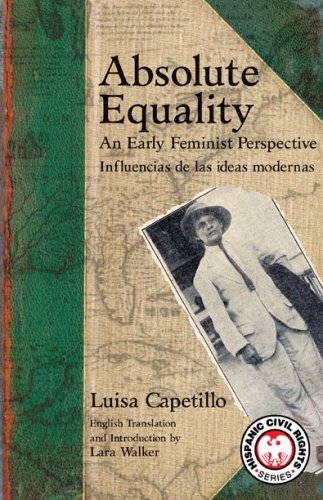
Title
Absolute Equality: An Early Feminist Perspective/ Influencias De Las Ideas Modernas (Recovering the U.S. Hispanic Literary Herit,Used
Sold by Ergodebooks, an authorized reseller.
Returns accepted within 30 days | support@ergodebooks.com
Shipping Information
- Free Standard Shipping — United States only
- Processing Time: 3–5 business days
- Estimated Delivery: 6–10 business days after dispatch
- Double-boxed, fully insured & discreetly packaged
- Tracking number sent via email once dispatched
Returns & Refund
Returns accepted within 30 days of delivery.
Damaged or Defective Item
Free return shipping + replacement or full refund
Wrong Item Received
Free return shipping + replacement or full refund
Change of Mind
Return shipping at customer's expense · 25% restocking fee applies
Payment Option

In Luisa Capetillo's threeact play written in 1907, 'Influences of Modern Ideas,' Angelina, the daughter of a rich Puerto Rican businessman and landowner, educates herself by reading the works of European writers, philosophers, and anarchists. After reading Tolstoy's The Slavery of Our Times, she is convinced that 'the slavery of our times is the inflexible wage law.' As the workers go on strike in her home town of Arecibo, Angelina tries to convince her father to give his propertyhome, factories, landto the working class. And so the stage is set for Capetillo, a militant feminist, anarchist, and labor leader, to inform the public about her passions: the fight for workers' rights; the struggle for justice and equality, for women as well as workers; and the education of all classes and sexes. The themes in this social protest play appear throughout Capetillo's writings.This volume combines long and short plays, fiction, essays, propaganda, letters, poems, philosophical reflections, and journal entries in a neverbeforeavailable English translation by Lara Walker. Also included is a facsimile of the original Spanishlanguage text, Influencias de las ideas modernas, which was first published in San Juan, Puerto Rico, in 1916. Most of the pieces in this collection were written between 1912 and 1916 while Capetillo was living and working as a labor leader in Tampa and Ybor City, Florida; New York City; and Havana, Cuba.Editor Lara Walker's comprehensive introduction surveys Luisa Capetillo's life and work, placing her ideologies in the appropriate social and historical context. At once a sharp critique and a celebration of the gathering fervor of world politics, Capetillo's work examines both her native Puerto Rico and the world outside, providing a sense of the workers' movement and the condition of women at the turn of the century. Capetillo embraces the humanistic thinking of the early twentieth century and envisions a world in which economic and social structures can be broken down, allowing both the worker and the woman to be free.
⚠️ WARNING (California Proposition 65):
This product may contain chemicals known to the State of California to cause cancer, birth defects, or other reproductive harm.
For more information, please visit www.P65Warnings.ca.gov.