If you have any questions, you are always welcome to contact us. We'll get back to you as soon as possible, withing 24 hours on weekdays.
Customer service
All questions about your order, return and delivery must be sent to our customer service team by e-mail at yourstore@yourdomain.com
Sale & Press
If you are interested in selling our products, need more information about our brand or wish to make a collaboration, please contact us at press@yourdomain.com
Help
If you have any questions, you are always welcome to contact us. We'll get back to you as soon as possible, withing 24 hours on weekdays.
Customer service
All questions about your order, return and delivery must be sent to our customer service team by e-mail at yourstore@yourdomain.com
Sale & Press
If you are interested in selling our products, need more information about our brand or wish to make a collaboration, please contact us at press@yourdomain.com
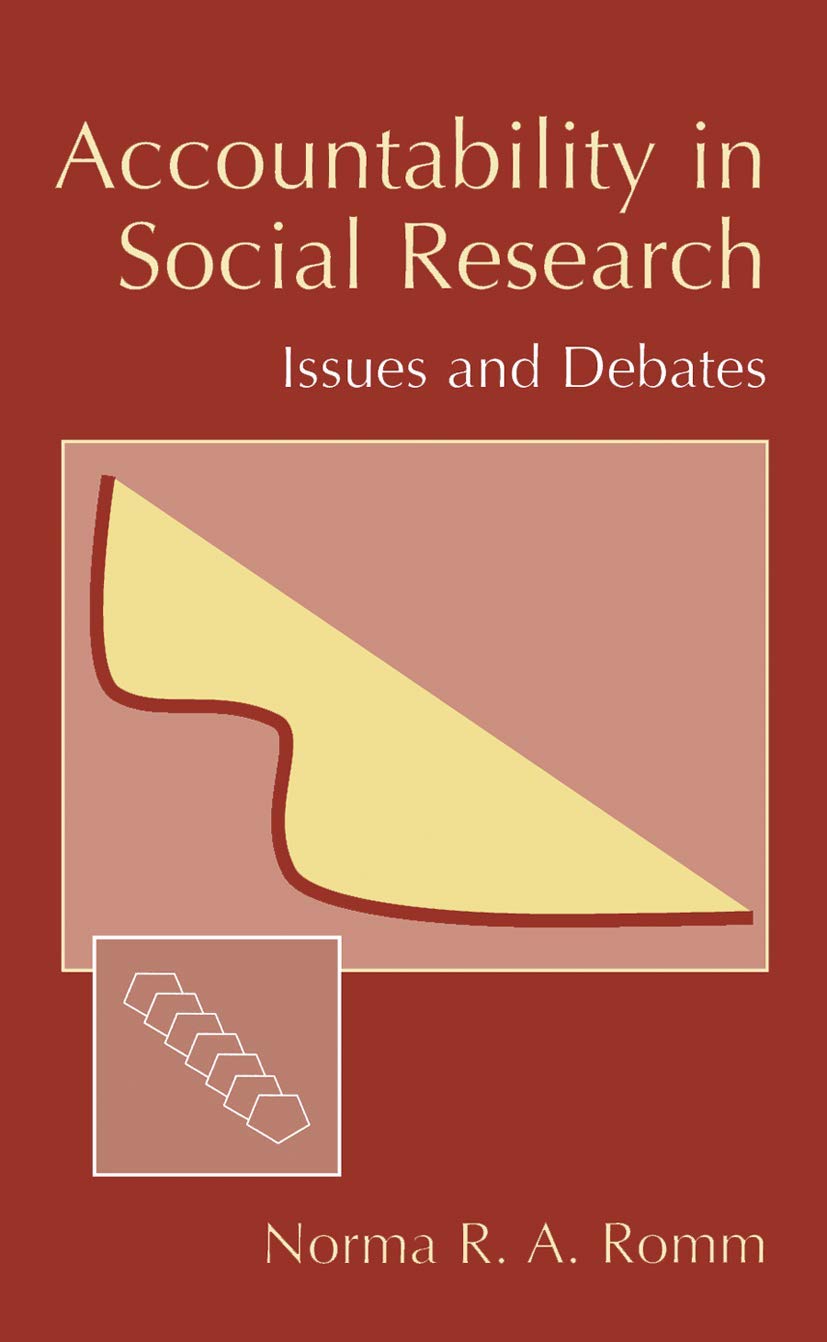
In this book I have concentrated on drawing attention to various conceptions of accountability that might be brought to bear in judging the practice of social research. Much of the book is organized around making explicit the assumptions that influence what counts as proper research in society, including assumptions about how social inquirers might be held accountable. My focus is on reviewing discourses around the practice of professional inquiry, with a view to reconsidering the way in which people create expectations for accountable social inquiry. My focus hereon is related to my concern that the manner in which judgments about researchers accountability are made, is not without social consequences for our way of living in society. I have approached the issues by beginning with a discussion of tenets of the position called positivism (so named by certain proponents), and by considering the view on accountability that is implied by adherence to these tenets. Briefly expressed, positivist argumentation suggests that researchers are required to do science in a manner that warrants their being considered, indeed, scientists. I use my discussion of accountability as seen within positivist argumentation to explicate ways in which alternative positions have arisen as ways of treating accountability issues. Through my way of comparing the various positions, I hope to provide some indication of the complexity ofethical and accountability issues in social inquiry.
⚠️ WARNING (California Proposition 65):
This product may contain chemicals known to the State of California to cause cancer,
birth defects, or other reproductive harm.
For MAP (Minimum Advertised Price) violations and Intellectual Property (IP) or Trademark concerns, please contact:
support@ergodebooks.com
⚠️ California Proposition 65 Warning: Some products sold on this website may expose you to chemicals known to the State of California to cause cancer, birth defects, or other reproductive harm. For more information, visit www.P65Warnings.ca.gov.