
Title
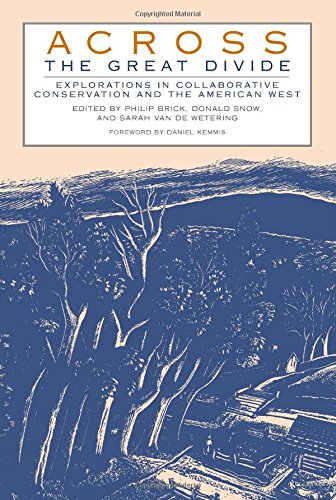
Across the Great Divide: Explorations In Collaborative Conservation And The American West,Used
Sold by Ergodebooks, an authorized reseller.
Returns accepted within 30 days | support@ergodebooks.com
Shipping Information
- Free Standard Shipping — United States only
- Processing Time: 3–5 business days
- Estimated Delivery: 6–10 business days after dispatch
- Double-boxed, fully insured & discreetly packaged
- Tracking number sent via email once dispatched
Returns & Refund
Returns accepted within 30 days of delivery.
Damaged or Defective Item
Free return shipping + replacement or full refund
Wrong Item Received
Free return shipping + replacement or full refund
Change of Mind
Return shipping at customer's expense · 25% restocking fee applies
Payment Option

Amid the policy gridlock that characterizes most environmental debates, a new conservation movement has emerged. Known as collaborative conservation, it emphasizes local participation, sustainability, and inclusion of the disempowered, and focuses on voluntary compliance and consent rather than legal and regulatory enforcement. Encompassing a wide range of local partnerships and initiatives, it is changing the face of resource management throughout the western United States.Across the Great Divide presents a thoughtful exploration of this new movement, bringing together writing, reporting, and analysis of collaborative conservation from those directly involved in developing and implementing the approach. Contributors examine: the failure of traditional policy approaches recent economic and demographic changes that serve as a backdrop for the emergence of the movement the merits of, and drawbacks to, collaborative decisionmaking the challenges involved with integrating diverse voices and bringing all sectors of society into the movement .In addition, the book offers indepth stories of eight noteworthy collaborative initiatives including the Quincy Library Group, Montana's Clark Fork River, the Applegate Partnership, and the Malpai Borderlands that explore how different groups have organized and acted to implement their goals.Among the contributors are Ed Marston, George Cameron Coggins, David Getches, Andy Stahl, Maria Varela, Luther Propst, Shirley Solomon, William Riebsame, Cassandra Moseley, Lynn Jungwirth, and others. Across the Great Divide is an important work for anyone involved with collaborative conservation or the larger environmental movement, and for all those who care about the future of resource management in the West.
⚠️ WARNING (California Proposition 65):
This product may contain chemicals known to the State of California to cause cancer, birth defects, or other reproductive harm.
For more information, please visit www.P65Warnings.ca.gov.
- Q: What is the page count of this book? A: The book has two hundred fifty-six pages. It offers an in-depth exploration of collaborative conservation in the American West.
- Q: What are the dimensions of this book? A: The dimensions of the book are six inches in length, zero point six inches in width, and nine point zero two inches in height.
- Q: What type of binding does this book have? A: This book is published in paperback binding. It is suitable for easy handling and reading.
- Q: Who is the author of this book? A: The author of the book is Philip Brick. He provides insights into collaborative conservation efforts in the American West.
- Q: What is the main theme of the book? A: The main theme is collaborative conservation. It emphasizes local participation and sustainability in environmental management.
- Q: Is this book suitable for beginners in environmental studies? A: Yes, this book is suitable for beginners. It provides foundational insights into collaborative conservation and resource management.
- Q: Can I read this book if I'm not familiar with environmental policies? A: Yes, you can read this book without prior knowledge of environmental policies. It explains concepts in an accessible manner.
- Q: What is the intended audience for this book? A: The intended audience includes environmentalists, policymakers, and anyone interested in resource management. It is also suitable for general readers.
- Q: How should I store this book? A: Store the book in a cool, dry place. Keeping it away from direct sunlight will help maintain its condition.
- Q: How can I clean the book if it gets dirty? A: To clean the book, use a dry cloth to gently wipe the cover. Avoid using water or cleaning solutions.
- Q: What if the book arrives damaged? A: If the book arrives damaged, you should contact customer support for assistance. They can guide you through the return process.
- Q: Is there a return policy for this book? A: Yes, there is a return policy for this book. Check the seller's website for specific return guidelines.
- Q: Are there any notable contributors to the book? A: Yes, notable contributors include Ed Marston, George Cameron Coggins, and David Getches. They provide valuable perspectives on collaborative conservation.
- Q: Does this book include real-life case studies? A: Yes, the book includes stories of eight collaborative initiatives. These case studies illustrate practical applications of the concepts discussed.
- Q: What are collaborative conservation initiatives? A: Collaborative conservation initiatives involve local partnerships for resource management. They focus on participation and voluntary compliance.
- Q: Does this book discuss the challenges of collaborative decision-making? A: Yes, the book examines the challenges of integrating diverse voices in collaborative decision-making. It addresses both merits and drawbacks.