
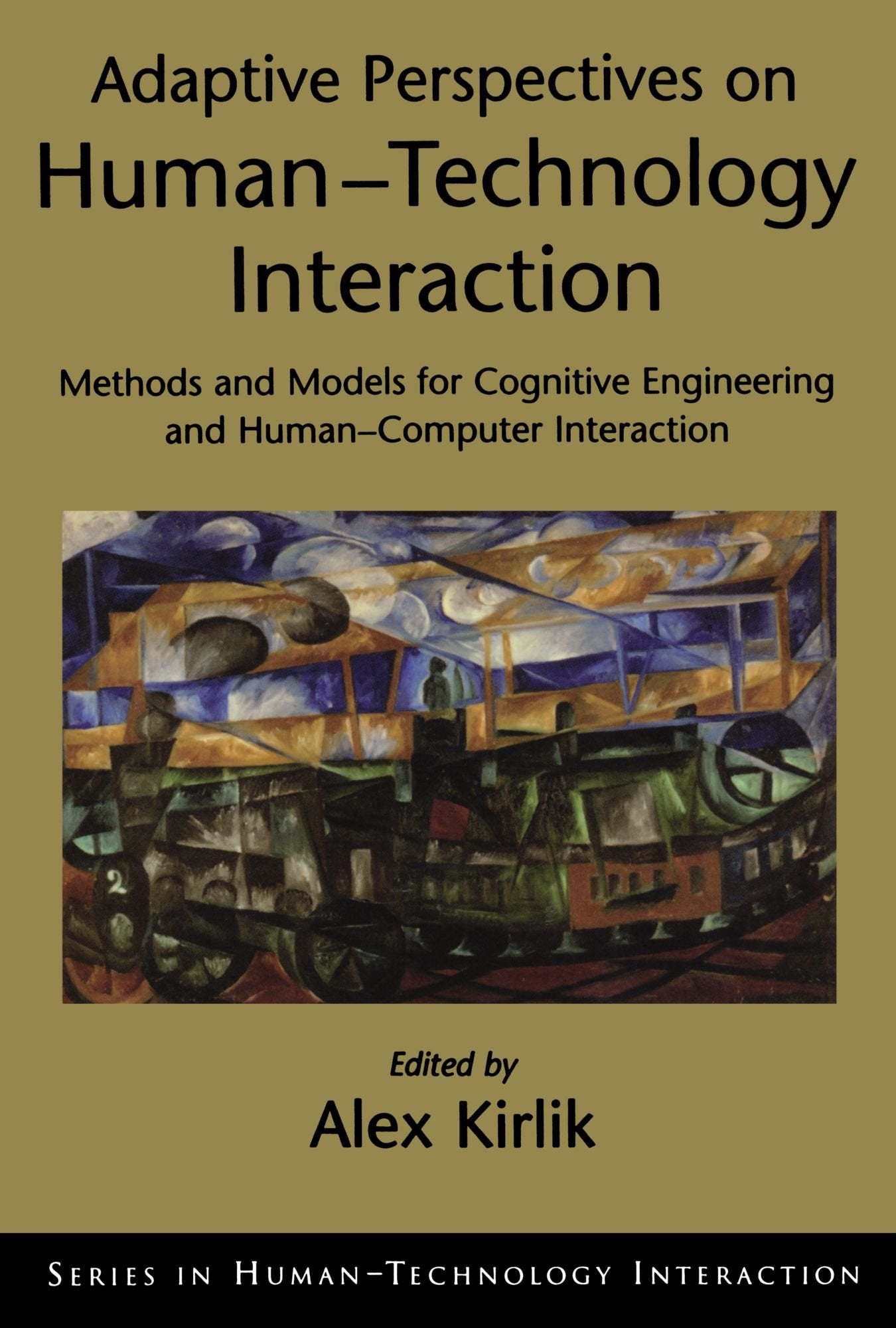
Title
Adaptive Perspectives on HumanTechnology Interaction: Methods and Models for Cognitive Engineering and HumanComputer Interacti,Used
Sold by Ergodebooks, an authorized reseller.
Returns accepted within 30 days | support@ergodebooks.com
Shipping Information
- Free Standard Shipping — United States only
- Processing Time: 3–5 business days
- Estimated Delivery: 6–10 business days after dispatch
- Double-boxed, fully insured & discreetly packaged
- Tracking number sent via email once dispatched
Returns & Refund
Returns accepted within 30 days of delivery.
Damaged or Defective Item
Free return shipping + replacement or full refund
Wrong Item Received
Free return shipping + replacement or full refund
Change of Mind
Return shipping at customer's expense · 25% restocking fee applies
Payment Option

In everyday life, and particularly in the modern workplace, information technology and automation increasingly mediate, augment, and sometimes even interfere with how humans interact with their environment. How to understand and support cognition in humantechnology interaction is both a practically and socially relevant problem. The chapters in this volume frame this problem in adaptive terms: How are behavior and cognition adapted, or perhaps illadapted, to the demands and opportunities of an environment where interaction is mediated by tools and technology? The authors draw heavily on the work of Egon Brunswik, a pioneer in ecological and cognitive psychology, as well as on modern refinements and extensions of Brunswikian ideas, including Hammond's Social Judgment Theory, Gigerenzer's Ecological Rationality and Anderson's Rational Analysis. Inspired by Brunswik's view of cognition as 'coming to terms' with the 'casual texture' of the external world, the chapters in thisvolume provide quantitative and computational models and measures for studying how people come to terms with an increasingly technological ecology, and provide insights for supporting cognition and performance through design, training, and other interventions. The methods, models, and measures presented in this book provide timely and important resources for addressing problems in the rapidly growing field of humantechnology interaction. The book will be of interest to researchers, students, and practitioners in human factors, cognitive engineering, humancomputer interaction, judgment and decision making, and cognitive science.
⚠️ WARNING (California Proposition 65):
This product may contain chemicals known to the State of California to cause cancer, birth defects, or other reproductive harm.
For more information, please visit www.P65Warnings.ca.gov.