If you have any questions, you are always welcome to contact us. We'll get back to you as soon as possible, withing 24 hours on weekdays.
Customer service
All questions about your order, return and delivery must be sent to our customer service team by e-mail at yourstore@yourdomain.com
Sale & Press
If you are interested in selling our products, need more information about our brand or wish to make a collaboration, please contact us at press@yourdomain.com
Help
If you have any questions, you are always welcome to contact us. We'll get back to you as soon as possible, withing 24 hours on weekdays.
Customer service
All questions about your order, return and delivery must be sent to our customer service team by e-mail at yourstore@yourdomain.com
Sale & Press
If you are interested in selling our products, need more information about our brand or wish to make a collaboration, please contact us at press@yourdomain.com
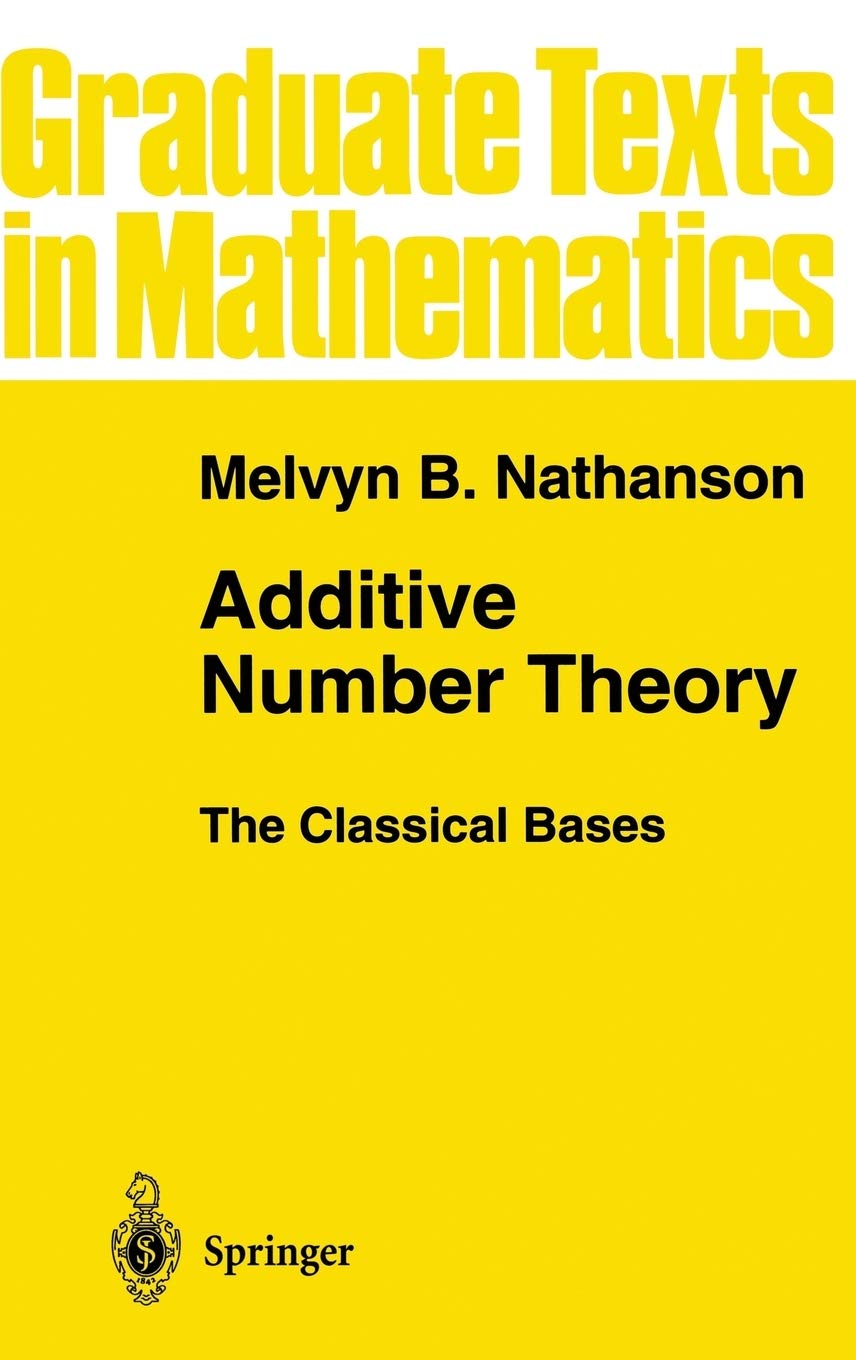
[Hilbert's] style has not the terseness of many of our modem authors in mathematics, which is based on the assumption that printer's labor and paper are costly but the reader's effort and time are not. H. Weyl [143] The purpose of this book is to describe the classical problems in additive number theory and to introduce the circle method and the sieve method, which are the basic analytical and combinatorial tools used to attack these problems. This book is intended for students who want to lel?Ill additive number theory, not for experts who already know it. For this reason, proofs include many 'unnecessary' and 'obvious' steps; this is by design. The archetypical theorem in additive number theory is due to Lagrange: Every nonnegative integer is the sum of four squares. In general, the set A of nonnegative integers is called an additive basis of order h if every nonnegative integer can be written as the sum of h not necessarily distinct elements of A. Lagrange 's theorem is the statement that the squares are a basis of order four. The set A is called a basis offinite order if A is a basis of order h for some positive integer h. Additive number theory is in large part the study of bases of finite order. The classical bases are the squares, cubes, and higher powers; the polygonal numbers; and the prime numbers. The classical questions associated with these bases are Waring's problem and the Goldbach conjecture.
⚠️ WARNING (California Proposition 65):
This product may contain chemicals known to the State of California to cause cancer,
birth defects, or other reproductive harm.
For MAP (Minimum Advertised Price) violations and Intellectual Property (IP) or Trademark concerns, please contact:
support@ergodebooks.com
⚠️ California Proposition 65 Warning: Some products sold on this website may expose you to chemicals known to the State of California to cause cancer, birth defects, or other reproductive harm. For more information, visit www.P65Warnings.ca.gov.