
Title
Administrative Law: Rethinking Judicial Control of Bureaucracy,Used
Sold by Ergodebooks, an authorized reseller.
Returns accepted within 30 days | support@ergodebooks.com
Shipping Information
- Free Standard Shipping — United States only
- Processing Time: 3–5 business days
- Estimated Delivery: 6–10 business days after dispatch
- Double-boxed, fully insured & discreetly packaged
- Tracking number sent via email once dispatched
Returns & Refund
Returns accepted within 30 days of delivery.
Damaged or Defective Item
Free return shipping + replacement or full refund
Wrong Item Received
Free return shipping + replacement or full refund
Change of Mind
Return shipping at customer's expense · 25% restocking fee applies
Payment Option

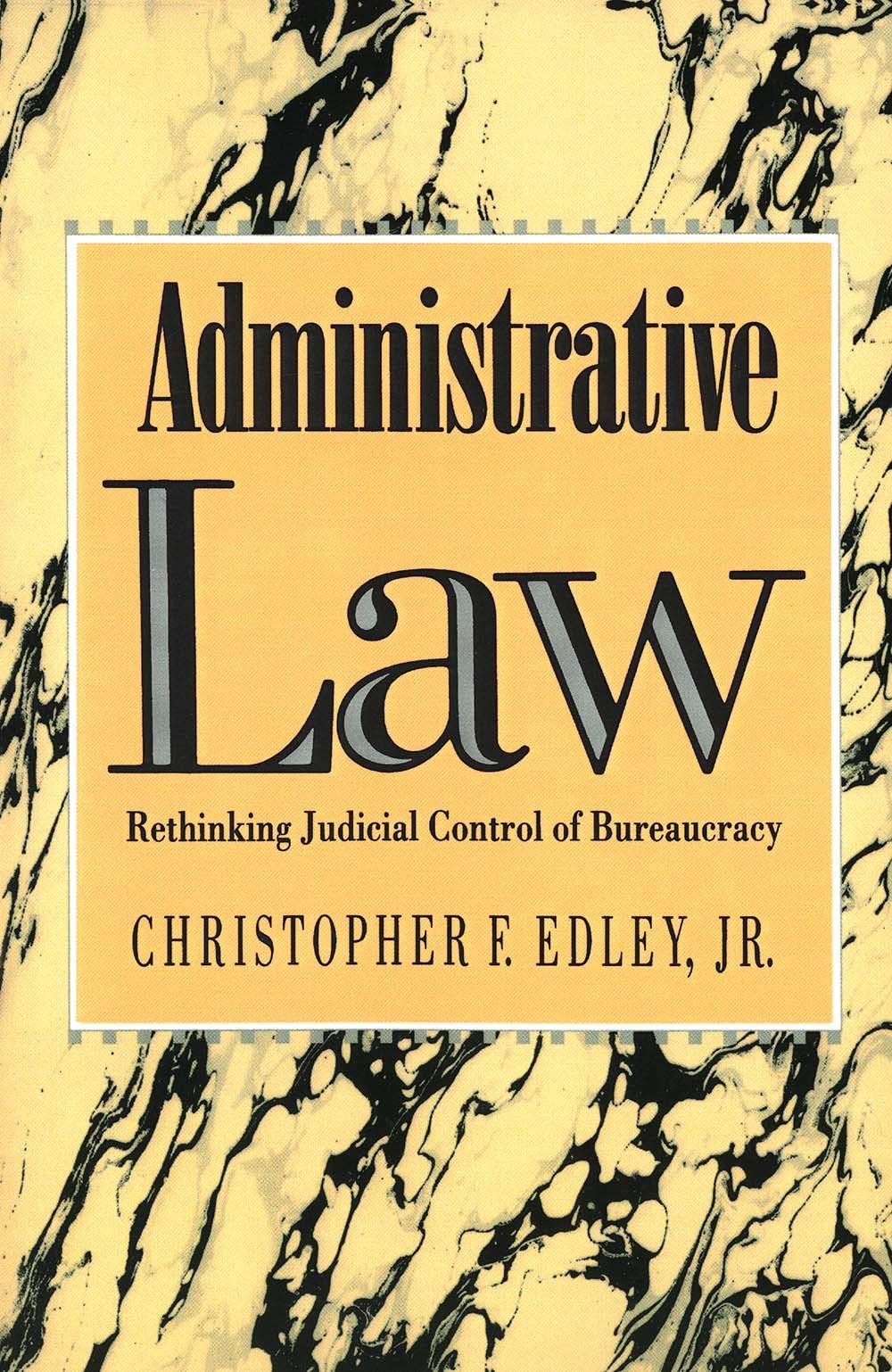
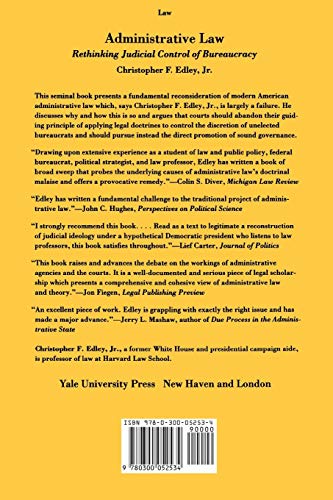
This seminal book presents a fundamental reconsideration of modern American administrative law. According to Christopher Edley, the guiding principle in this field is that courts should apply legal doctrines to control the discretion of unelected bureaucrats. In practice, however, these doctrines simply give unelected judges largely unconstrainedand inescapablediscretion. Assessed on its own terms, says Edley, administrative law is largely a failure. He discussed why and how this is so and argues that law should abandon its obsession with bureaucratic discretion and pursue instead the direct promotion of sound governance. Edley demonstrates that legal analyses of separation of powers and of judicial oversight of agencies implicitly use three decisionmaking paradigms: politics, scientific expertise, and adjudicatory fairness. Conventional wisdom maintains, for example, that judges should hesitate to question the political choices of legislators and the expertise of administrators, but need not be so deferential in addressing questions of law. Such judicial efforts to police governance have largely failed because, as Edley shows in several contexts, they attempt to appraise decisionmaking paradigms as though they were separable when in fact the important decisions of both judges and political officials combine elements of politics, science, and fairness. According to Edley, unsustainable boundaries among these paradigms cannot be a satisfactory basis for deciding when a court should interfere. Law must stop focusing on separation of powers and instead direct attention to such issues as bureaucratic incompetence, systemic agency delay, and political bias.
⚠️ WARNING (California Proposition 65):
This product may contain chemicals known to the State of California to cause cancer, birth defects, or other reproductive harm.
For more information, please visit www.P65Warnings.ca.gov.
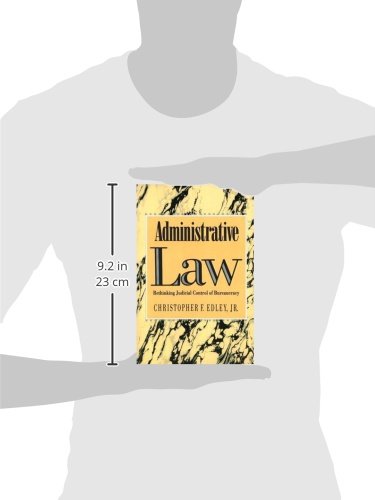
- Q: What is the length and width of this book? A: The book measures six point nineteen inches in length and zero point ninety-one inches in width. Its dimensions make it easily portable and convenient for reading.
- Q: How many pages does 'Administrative Law' have? A: This book contains two hundred eighty-three pages. It provides an in-depth analysis of modern American administrative law.
- Q: What is the binding type of this book? A: The book is bound in paperback. This binding type allows for flexibility and ease of use.
- Q: Who is the author of this book? A: The author of 'Administrative Law' is Christopher Edley Jr. He is known for his critical insights into administrative law.
- Q: What topics does this book cover? A: The book discusses judicial control of bureaucracy and the failures of administrative law in the United States. It offers a fundamental reconsideration of the subject.
- Q: Is this book suitable for beginners in administrative law? A: Yes, it is suitable for beginners. The author presents complex ideas in a way that is accessible to those new to the topic.
- Q: Can this book be used for academic purposes? A: Yes, it is an excellent resource for academic study. Its thorough analysis and critical perspective make it valuable for students and scholars.
- Q: What is the reading level for this book? A: The book is suitable for adult readers, particularly those studying law or public policy. It engages with advanced concepts, making it ideal for a scholarly audience.
- Q: How should I care for this paperback book? A: To keep this book in good condition, store it in a dry place and avoid exposure to direct sunlight. Handle it gently to prevent wear and tear.
- Q: Is there a warranty or return policy for this book? A: Typically, books like this may not come with a warranty. However, check with the retailer for their specific return policy if you encounter issues.
- Q: What if the book arrives damaged? A: If the book arrives damaged, you should contact the seller immediately. Most retailers have policies in place for returns or replacements.
- Q: Does this book discuss the separation of powers? A: Yes, it discusses the separation of powers in relation to judicial oversight of agencies. This is a key theme in Edley's analysis.
- Q: What is the main argument of 'Administrative Law'? A: The main argument is that administrative law focuses too much on bureaucratic discretion, leading to failures in governance. Edley advocates for a reevaluation of these principles.
- Q: Are there any features of the book that enhance understanding? A: While specific features like illustrations are not mentioned, the text provides comprehensive analyses that enhance understanding of complex legal concepts.
- Q: Is this book part of a series? A: No, this book is a standalone work. It does not belong to a specific series but is a significant contribution to the field of administrative law.
- Q: Who publishes 'Administrative Law'? A: The book is published by Yale University Press. It is known for its academic rigor and quality in publishing legal texts.