If you have any questions, you are always welcome to contact us. We'll get back to you as soon as possible, withing 24 hours on weekdays.
Customer service
All questions about your order, return and delivery must be sent to our customer service team by e-mail at yourstore@yourdomain.com
Sale & Press
If you are interested in selling our products, need more information about our brand or wish to make a collaboration, please contact us at press@yourdomain.com
Help
If you have any questions, you are always welcome to contact us. We'll get back to you as soon as possible, withing 24 hours on weekdays.
Customer service
All questions about your order, return and delivery must be sent to our customer service team by e-mail at yourstore@yourdomain.com
Sale & Press
If you are interested in selling our products, need more information about our brand or wish to make a collaboration, please contact us at press@yourdomain.com
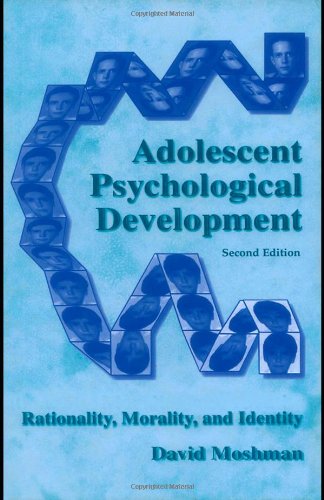
The huge and fractured literature on adolescence challenges both students and scholars. For students there is too much to learn and too little coherence across topics to enable deeper understanding. For scholars, there are few integrative visions to connect minitheories, research programs, and practical concerns.In the first edition of this advanced text, Moshman provided a constructivist synthesis of the literatures of cognitive, moral, and identity development, from the classic universalist theories of Piaget, Kohlberg, and Erikson through the more pluralist research and theorizing of the late 20th century. Without assuming any prior knowledge of psychology, he introduced and coordinated basic concepts to enable students to wrestle with the questions of concern to experts and help experts see those concerns from a larger perspective.In this thoroughly updated second edition, Moshman develops his conceptualization of advanced psychological development in adolescence and early adulthood and proposesin a new chaptera conception of rational moral identity as a developmental ideal. Unlike the prototypical changes of early childhood, advanced psychological development cannot be understood as progress through universal stages to a universally achieved state of maturity. Progress is possible, however, through rational processes of reflection, coordination, and social interaction.
⚠️ WARNING (California Proposition 65):
This product may contain chemicals known to the State of California to cause cancer,
birth defects, or other reproductive harm.
For MAP (Minimum Advertised Price) violations and Intellectual Property (IP) or Trademark concerns, please contact:
support@ergodebooks.com
⚠️ California Proposition 65 Warning: Some products sold on this website may expose you to chemicals known to the State of California to cause cancer, birth defects, or other reproductive harm. For more information, visit www.P65Warnings.ca.gov.