
Title
Advanced Vibration Analysis (Dekker Mechanical Engineering),Used
Sold by Ergodebooks, an authorized reseller.
Returns accepted within 30 days | support@ergodebooks.com
Shipping Information
- Free Standard Shipping — United States only
- Processing Time: 3–5 business days
- Estimated Delivery: 6–10 business days after dispatch
- Double-boxed, fully insured & discreetly packaged
- Tracking number sent via email once dispatched
Returns & Refund
Returns accepted within 30 days of delivery.
Damaged or Defective Item
Free return shipping + replacement or full refund
Wrong Item Received
Free return shipping + replacement or full refund
Change of Mind
Return shipping at customer's expense · 25% restocking fee applies
Payment Option

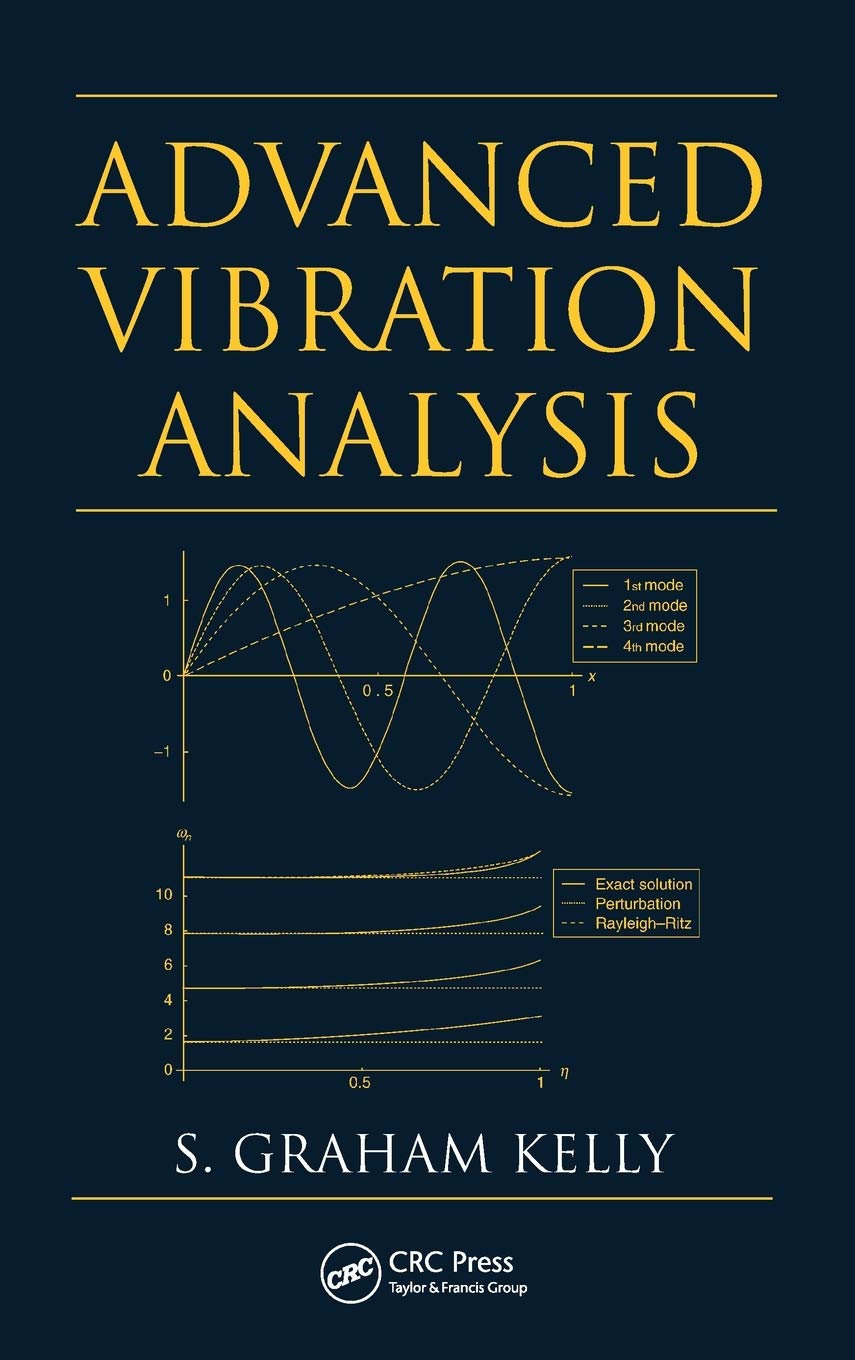
Delineating a comprehensive theory, Advanced Vibration Analysis provides the bedrock for building a general mathematical framework for the analysis of a model of a physical system undergoing vibration. The book illustrates how the physics of a problem is used to develop a more specific framework for the analysis of that problem. The author elucidates a general theory applicable to both discrete and continuous systems and includes proofs of important results, especially proofs that are themselves instructive for a thorough understanding of the result.The book begins with a discussion of the physics of dynamic systems comprised of particles, rigid bodies, and deformable bodies and the physics and mathematics for the analysis of a system with a singledegreeoffreedom. It develops mathematical models using energy methods and presents the mathematical foundation for the framework. The author illustrates the development and analysis of linear operators used in various problems and the formulation of the differential equations governing the response of a conservative linear system in terms of selfadjoint linear operators, the inertia operator, and the stiffness operator. The author focuses on the free response of linear conservative systems and the free response of nonselfadjoint systems. He explores three method for determining the forced response and approximate methods of solution for continuous systems.The use of the mathematical foundation and the application of the physics to build a framework for the modeling and development of the response is emphasized throughout the book. The presence of the framework becomes more important as the complexity of the system increases. The text builds the foundation, formalizes it, and uses it in a consistent fashion including application to contemporary research using linear vibrations.
⚠️ WARNING (California Proposition 65):
This product may contain chemicals known to the State of California to cause cancer, birth defects, or other reproductive harm.
For more information, please visit www.P65Warnings.ca.gov.