
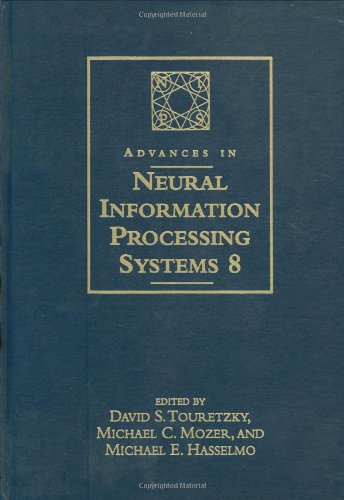
Title
Advances in Neural Information Processing Systems 8: Proceedings of the 1995 Conference,Used
Sold by Ergodebooks, an authorized reseller.
Returns accepted within 30 days | support@ergodebooks.com
Shipping Information
- Free Standard Shipping — United States only
- Processing Time: 3–5 business days
- Estimated Delivery: 6–10 business days after dispatch
- Double-boxed, fully insured & discreetly packaged
- Tracking number sent via email once dispatched
Returns & Refund
Returns accepted within 30 days of delivery.
Damaged or Defective Item
Free return shipping + replacement or full refund
Wrong Item Received
Free return shipping + replacement or full refund
Change of Mind
Return shipping at customer's expense · 25% restocking fee applies
Payment Option

The past decade has seen greatly increased interaction between theoretical work in neuroscience, cognitive science and information processing, and experimental work requiring sophisticated computational modeling. The 152 contributions in NIPS 8 focus on a wide variety of algorithms and architectures for both supervised and unsupervised learning. They are divided into nine parts: Cognitive Science, Neuroscience, Theory, Algorithms and Architectures, Implementations, Speech and Signal Processing, Vision, Applications, and Control. Chapters describe how neuroscientists and cognitive scientists use computational models of neural systems to test hypotheses and generate predictions to guide their work. This work includes models of how networks in the owl brainstem could be trained for complex localization function, how cellular activity may underlie rat navigation, how cholinergic modulation may regulate cortical reorganization, and how damage to parietal cortex may result in neglect. Additional work concerns development of theoretical techniques important for understanding the dynamics of neural systems, including formation of cortical maps, analysis of recurrent networks, and analysis of self supervised learning. Chapters also describe how engineers and computer scientists have approached problems of pattern recognition or speech recognition using computational architectures inspired by the interaction of populations of neurons within the brain. Examples are new neural network models that have been applied to classical problems, including handwritten character recognition and object recognition, and exciting new work that focuses on building electronic hardware modeled after neural systems. A Bradford Book
⚠️ WARNING (California Proposition 65):
This product may contain chemicals known to the State of California to cause cancer, birth defects, or other reproductive harm.
For more information, please visit www.P65Warnings.ca.gov.