
Title
Africa'S Power Infrastructure: Investment, Integration, Efficiency (Directions In Development),New
Sold by Ergodebooks, an authorized reseller.
Returns accepted within 30 days | support@ergodebooks.com
Shipping Information
- Free Standard Shipping — United States only
- Processing Time: 3–5 business days
- Estimated Delivery: 6–10 business days after dispatch
- Double-boxed, fully insured & discreetly packaged
- Tracking number sent via email once dispatched
Returns & Refund
Returns accepted within 30 days of delivery.
Damaged or Defective Item
Free return shipping + replacement or full refund
Wrong Item Received
Free return shipping + replacement or full refund
Change of Mind
Return shipping at customer's expense · 25% restocking fee applies
Payment Option

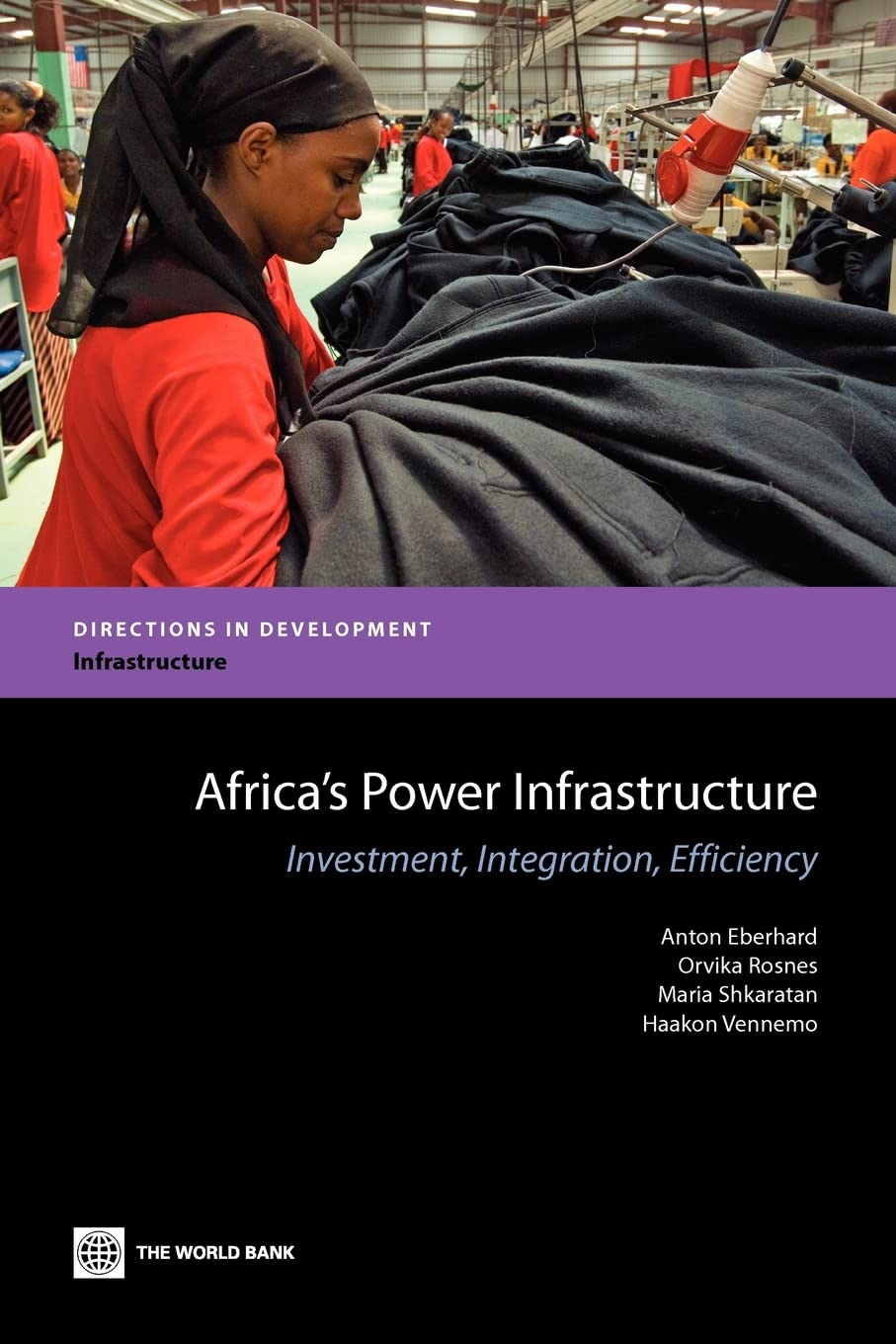
Africa's chronic power problems have escalated in recent years into a crisis affecting 30 countries, taking a heavy toll on economic growth and productivity. The region has inadequate generation capacity, limited electrification, low power consumption, unreliable services, and high costs. It also faces a power sector financing gap on the order of $21 billion a year. It spends only about a quarter of what it needs to spend on power, much of this on operating expenditure required to run the continent's highcost power systems, leaving little for the huge investments needed to provide a longterm solution.Further development of regional power trade would allow Africa to harness larger scale more costeffective energy sources, reducing energy system costs by $2 billion a year and saving 70 million tons of carbon emissions annually. Economic returns to investments in crossborder transmission are particularly high. But reaping the promise of regional trade depends on a handful of major exporting countries raising the large volumes of finance needed to develop generation capacity for export. It would also require political will in a large number of importing countries that could potentially meet more than half their power demand through trade.Power sector inefficiencies are high, deterring investment in new capacity and electrification. There are three types of sector inefficiencies. First, there are utility inefficiencies, which include system losses, undercollection of revenue and overmanning. These result in a major waste of resources adding up to $4.40 billion a year. Undercollection is the largest component of utility inefficiencies amounting to $1.73 billion, following by system losses at $1.48 billion and by overmanning at $1.15 billion. The second type of sector inefficiency is underpricing of power. By setting tariffs below the levels needed to cover the actual costs, SSA countries forego revenues of $3.62 billion a year.The third type of inefficiency is poor budget execution. Only 66% of the capital budgets allocated to power are actually spent, with about $258 million in public investment earmarked for the power sector being diverted elsewhere in the budget.Full cost recovery tariffs would already be affordable in countries with efficient large scale hydro or coalbased systems, but not in those relying on small scale oilbased plants. Once regional power trade comes into play, generation costs will fall, and full cost recovery tariffs could be affordable in much of Africa.One of the key policy challenges is to strengthen sector planning capabilities, too often overlooked in today's hybrid markets. A serious recommitment to reforming stateowned enterprises should emphasize improvements in corporate governance more than purely technical fixes. Improving cost recovery is essential for sustaining investments in electrification and regional power generation projects. Closing the huge financing gap will require improving the creditworthiness of utilities and sustaining the recent upswing in external finance to the sector.This book is based on extensive data collection undertaken between 2006 and 2008 by the Africa Country Infrastructure Country Diagnostic, an initiative of the Infrastructure Consortium for Africa delegated to the World Bank under the guidance of the African Union, African Development Bank and other multilateral and bilateral development institutions.
⚠️ WARNING (California Proposition 65):
This product may contain chemicals known to the State of California to cause cancer, birth defects, or other reproductive harm.
For more information, please visit www.P65Warnings.ca.gov.