
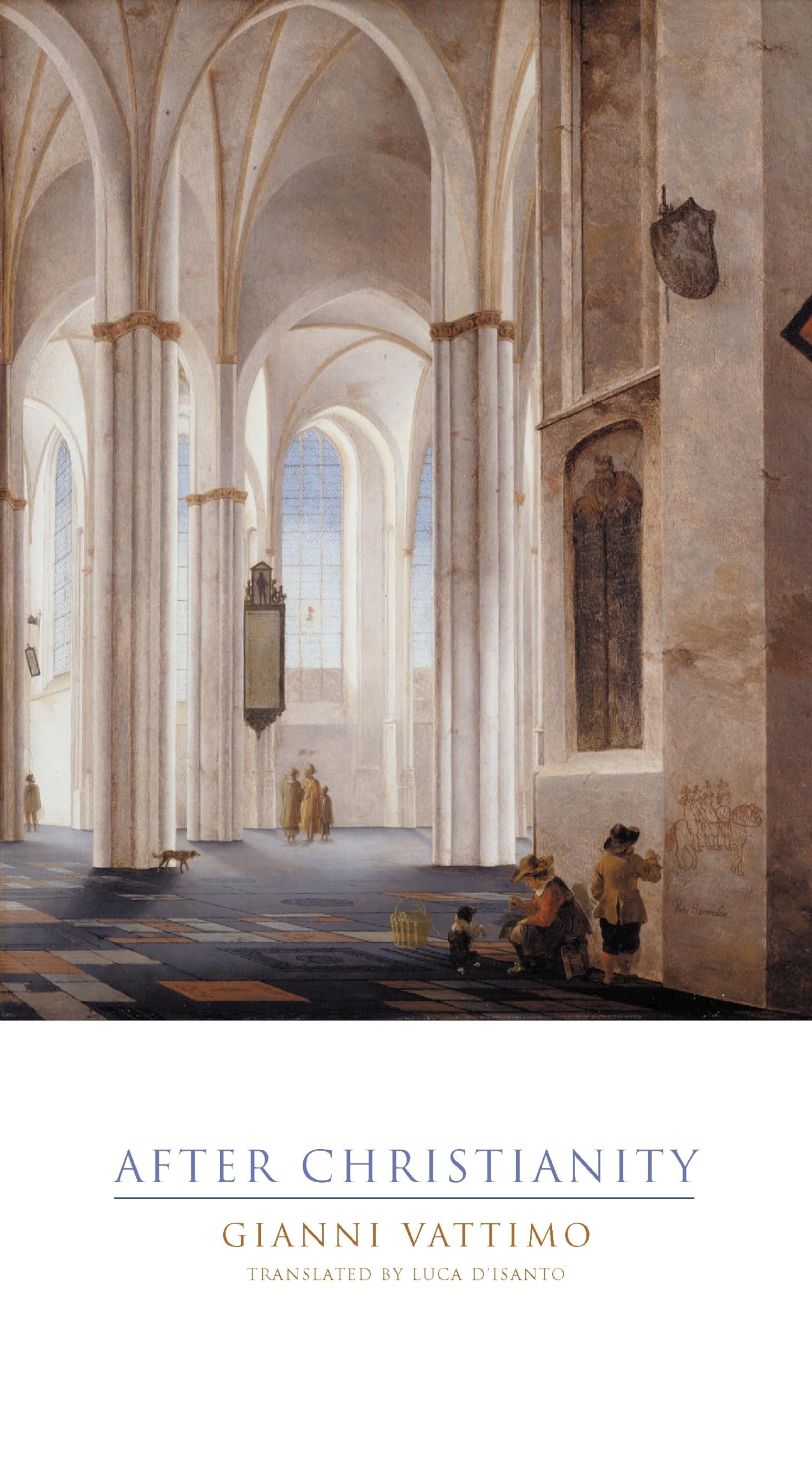
Title
After Christianity,Used
Sold by Ergodebooks, an authorized reseller.
Returns accepted within 30 days | support@ergodebooks.com
Shipping Information
- Free Standard Shipping — United States only
- Processing Time: 3–5 business days
- Estimated Delivery: 6–10 business days after dispatch
- Double-boxed, fully insured & discreetly packaged
- Tracking number sent via email once dispatched
Returns & Refund
Returns accepted within 30 days of delivery.
Damaged or Defective Item
Free return shipping + replacement or full refund
Wrong Item Received
Free return shipping + replacement or full refund
Change of Mind
Return shipping at customer's expense · 25% restocking fee applies
Payment Option

What has been the fate of Christianity since Nietzsche's famous announcement of the 'death of God'? What is the possibility of religion, specifically Christianity, thriving in our postmodern era? In this provocative new book, Gianni Vattimo, leading Italian philosopher, politician, and framer of the European constitution, addresses these critical questions.When Vattimo was asked by a former teacher if he still believed in God, his reply was, 'Well, I believe that I believe.' This paradoxical declaration of faith serves as the foundation for a brilliant exposition on Christianity in the new millenniuman age characterized by a deep uncertainty of opinionand a personal account of how Vattimo himself recovered his faith through Nietzsche and Heidegger. He first argues that secularization is in fact the fulfillment of the central Christian message, and prepares us for a new mode of Christianity. He then explains that Nietzsche's thesis concerns only the 'moral god' and leaves room for the emergence of 'new gods.' Third, Vattimo claims that the postmodern condition of fragmentation, antiEurocentrism, and postcolonialism can be usefully understood in light of Joachim of Fiore's thesis concerning the 'Spiritual Age' of history. Finally, Vattimo argues for the idea of 'weak thought.' Because philosophy in the postmetaphysical age can only acknowledge that 'all is interpretation,' that the 'real' is always relative and not the hard and fast 'truth' we once thought it to be, contemporary thought must recognize itself and its claims as 'weak' as opposed to 'strong' foundationalist claims of the metaphysical past. Vattimo concludes that these factors make it possible for religion and God to become a serious topic for philosophy again, and that philosophy should now formally engage religion.
⚠️ WARNING (California Proposition 65):
This product may contain chemicals known to the State of California to cause cancer, birth defects, or other reproductive harm.
For more information, please visit www.P65Warnings.ca.gov.
- Q: How many pages does 'After Christianity' have? A: This book has one hundred twenty-eight pages. It offers a concise exploration of Christianity in the postmodern era.
- Q: What is the binding type of 'After Christianity'? A: The book is available in hardcover. This ensures durability and a quality feel when reading.
- Q: What are the dimensions of 'After Christianity'? A: The dimensions are five point thirty-one inches in length, zero point seventy-two inches in width, and nine point twenty-six inches in height. This size makes it convenient to hold and read.
- Q: Who is the author of 'After Christianity'? A: The author is Gianni Vattimo, a prominent Italian philosopher and politician. His insights provide a unique perspective on contemporary Christianity.
- Q: What themes does 'After Christianity' explore? A: The book explores themes of secularization, the notion of 'weak thought', and the relevance of religion in modern philosophy. It questions the fate of Christianity in today's society.
- Q: Is 'After Christianity' suitable for all readers? A: Yes, the book is suitable for readers interested in philosophy and religious studies. It is particularly relevant for those exploring the intersection of faith and modern thought.
- Q: How should I read 'After Christianity'? A: You can read it like any standard book, ideally in a quiet space for reflection. The thoughtful prose encourages deep contemplation of its themes.
- Q: What reading level is 'After Christianity' appropriate for? A: This book is best suited for adults and advanced students. Its philosophical content may require prior knowledge of related concepts.
- Q: Can I find 'After Christianity' in libraries? A: Yes, many libraries carry this book. You can check your local library's catalog for availability.
- Q: How should I store 'After Christianity'? A: Store the book in a cool, dry place away from direct sunlight. This will help preserve its quality over time.
- Q: Does 'After Christianity' require special care? A: No, it does not require special care. Just handle it with care to maintain its condition.
- Q: What if my copy of 'After Christianity' arrives damaged? A: If it arrives damaged, contact the seller for a replacement or return. Most sellers have a return policy for damaged goods.
- Q: Is there a warranty for 'After Christianity'? A: No, there is typically no warranty for books. However, you may inquire about the seller's return policy.
- Q: How can I return 'After Christianity' if needed? A: To return the book, follow the return instructions provided by the seller. Ensure to keep the original packaging for easier returns.
- Q: Can 'After Christianity' be a good gift? A: Yes, it makes a thoughtful gift for those interested in philosophy or religion. Its engaging content encourages meaningful discussions.
- Q: What sets 'After Christianity' apart from other philosophical books? A: This book uniquely combines personal narrative with philosophical analysis, making complex ideas accessible and relatable.