
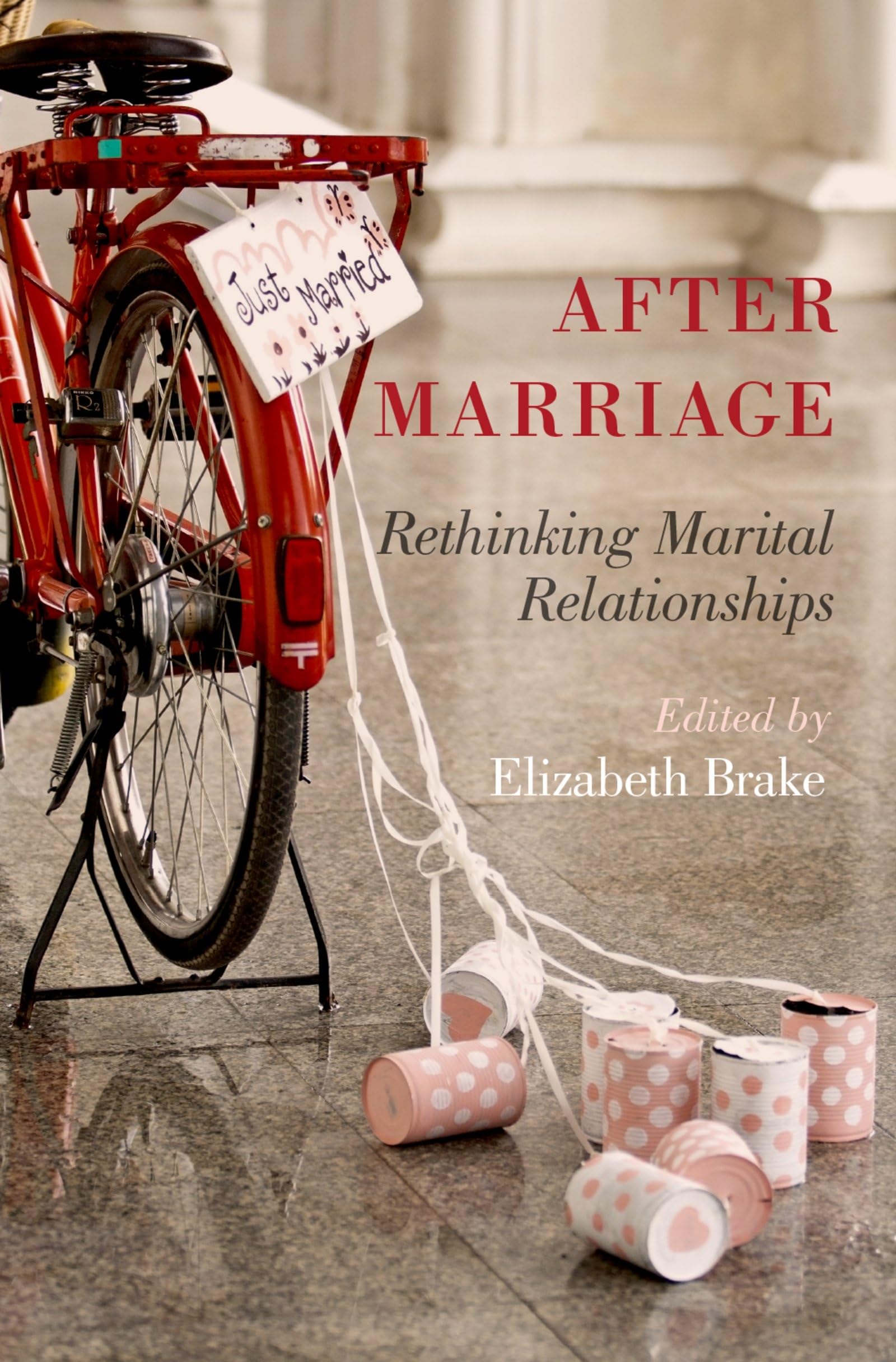
Title
After Marriage: Rethinking Marital Relationships,Used
Sold by Ergodebooks, an authorized reseller.
Returns accepted within 30 days | support@ergodebooks.com
Shipping Information
- Free Standard Shipping — United States only
- Processing Time: 3–5 business days
- Estimated Delivery: 6–10 business days after dispatch
- Double-boxed, fully insured & discreetly packaged
- Tracking number sent via email once dispatched
Returns & Refund
Returns accepted within 30 days of delivery.
Damaged or Defective Item
Free return shipping + replacement or full refund
Wrong Item Received
Free return shipping + replacement or full refund
Change of Mind
Return shipping at customer's expense · 25% restocking fee applies
Payment Option

This collection of essays by liberal and feminist philosophers addresses the question of whether marriage reform ought to stop with samesex marriage. Some philosophers have recently argued that marriage is illiberal and should be abolished or radically reformed to include groups and nonromantic friendships. In response, Simon May argues that marriage law can be justified without an illiberal appeal to an ideal relationship type, and Ralph Wedgwood argues that the liberal values which justify samesex marriage do not justify further extension. Other authors argue for new legal forms for intimate relationships. Marriage abolitionist Clare Chambers argues that piecemeal directives rather than relationship contracts should replace marriage, and Samantha Brennan and Bill Cameron argue for separating marriage and parenting, with parenting rather than marriage becoming, legally and socially, the foundation of the family. Elizabeth Brake argues for a nonhierarchical friendship model for marriage. Peter de Marneffe argues that polygamy should be decriminalized, but that the liberal state need not recognize it, while Laurie Shrage argues that polygamy could be legally structured to protect privacy and equality. Dan Nolan argues for temporary marriage as a legal option, while Anca Gheaus argues that marital commitments are problematic instruments for securing the good of romantic and sexual love. Taken together, these essays challenge contemporary understandings of marriage and the state's role in it.
⚠️ WARNING (California Proposition 65):
This product may contain chemicals known to the State of California to cause cancer, birth defects, or other reproductive harm.
For more information, please visit www.P65Warnings.ca.gov.
- Q: What is the main theme of 'After Marriage: Rethinking Marital Relationships'? A: The main theme of the book centers on re-evaluating the institution of marriage through essays by liberal and feminist philosophers, discussing whether marriage reform should extend beyond same-sex marriage.
- Q: Who are the authors contributing to this collection? A: The collection features essays from various authors, including Simon May, Ralph Wedgwood, Clare Chambers, Samantha Brennan, Bill Cameron, Elizabeth Brake, Peter de Marneffe, Laurie Shrage, Dan Nolan, and Anca Gheaus.
- Q: What is the publication date of this book? A: The book was published on January 4, 2016.
- Q: How many pages does 'After Marriage' have? A: The book contains 272 pages.
- Q: Is 'After Marriage' available in different formats? A: This book is available in paperback format.
- Q: What type of philosophical perspectives are presented in the essays? A: The essays present liberal and feminist philosophical perspectives on the nature of marriage, including arguments for reform, abolition, and alternative relationship models.
- Q: Does the book discuss the legal recognition of polygamy? A: Yes, Peter de Marneffe discusses the decriminalization of polygamy and its potential legal structures to ensure privacy and equality.
- Q: What unique relationship models are proposed in this book? A: The book discusses various relationship models, including non-hierarchical friendships, temporary marriages, and separating marriage from parenting.
- Q: What kind of condition is the book in? A: The book is in new condition.
- Q: Who is the primary author of the book? A: The primary author of the book is Elizabeth Brake.