
Title
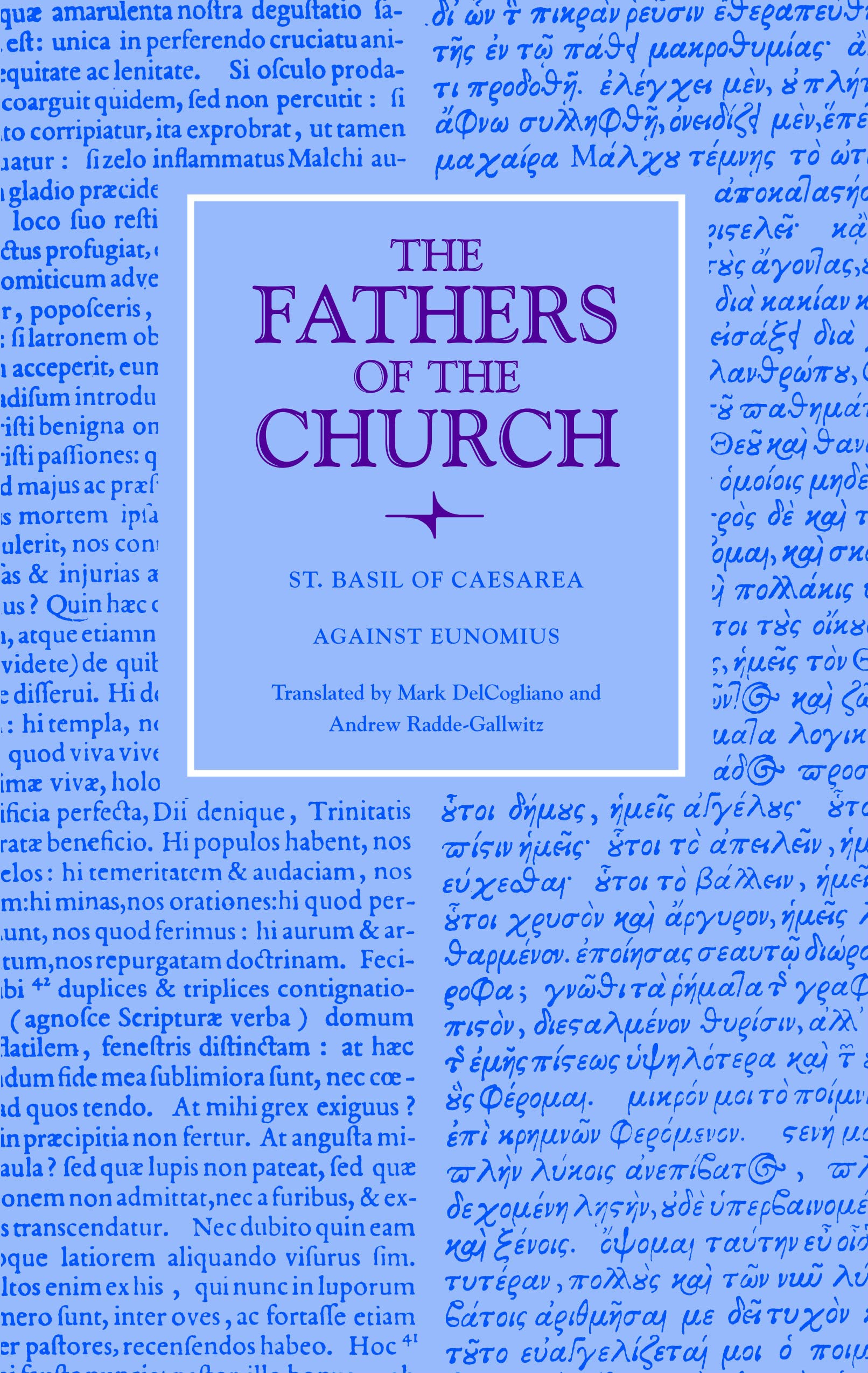
Against Eunomius (Fathers Of The Church Patristic Series),Used
Sold by Ergodebooks, an authorized reseller.
Returns accepted within 30 days | support@ergodebooks.com
Shipping Information
- Free Standard Shipping — United States only
- Processing Time: 3–5 business days
- Estimated Delivery: 6–10 business days after dispatch
- Double-boxed, fully insured & discreetly packaged
- Tracking number sent via email once dispatched
Returns & Refund
Returns accepted within 30 days of delivery.
Damaged or Defective Item
Free return shipping + replacement or full refund
Wrong Item Received
Free return shipping + replacement or full refund
Change of Mind
Return shipping at customer's expense · 25% restocking fee applies
Payment Option

Basil of Caesarea is considered one of the architects of the ProNicene Trinitarian doctrine adopted at the Council of Constantinople in 381, which eastern and western Christians to this day profess as ''orthodox.'' Nowhere is his Trinitarian theology more clearly expressed than in his first major doctrinal work, Against Eunomius, finished in 364 or 365 CE. Responding to Eunomius, whose Apology gave renewed impetus to a tradition of starkly subordinationist Trinitarian theology that would survive for decades, Basil's Against Eunomius reflects the intense controversy raging at that time among Christians across the Mediterranean world over who God is. In this treatise, Basil attempts to articulate a theology both of God's unitary essence and of the distinctive features that characterize the Father, Son, and Holy Spirita distinction that some hail as the cornerstone of ''Cappadocian'' theology. In Against Eunomius, we see the clash not simply of two dogmatic positions on the doctrine of the Trinity, but of two fundamentally opposed theological methods. Basil's treatise is as much about how theology ought to be done and what human beings can and cannot know about God as it is about the exposition of Trinitarian doctrine. Thus Against Eunomius marks a turning point in the Trinitarian debates of the fourth century, for the first time addressing the methodological and epistemological differences that gave rise to theological differences. Amidst the polemical vitriol of Against Eunomius is a call to epistemological humility on the part of the theologian, a call to recognize the limitations of even the best theology. While Basil refined his theology through the course of his career, Against Eunomius remains a testament to his early theological development and a privileged window into the Trinitarian controversies of the midfourth century.
⚠️ WARNING (California Proposition 65):
This product may contain chemicals known to the State of California to cause cancer, birth defects, or other reproductive harm.
For more information, please visit www.P65Warnings.ca.gov.