If you have any questions, you are always welcome to contact us. We'll get back to you as soon as possible, withing 24 hours on weekdays.
Customer service
All questions about your order, return and delivery must be sent to our customer service team by e-mail at yourstore@yourdomain.com
Sale & Press
If you are interested in selling our products, need more information about our brand or wish to make a collaboration, please contact us at press@yourdomain.com
Help
If you have any questions, you are always welcome to contact us. We'll get back to you as soon as possible, withing 24 hours on weekdays.
Customer service
All questions about your order, return and delivery must be sent to our customer service team by e-mail at yourstore@yourdomain.com
Sale & Press
If you are interested in selling our products, need more information about our brand or wish to make a collaboration, please contact us at press@yourdomain.com
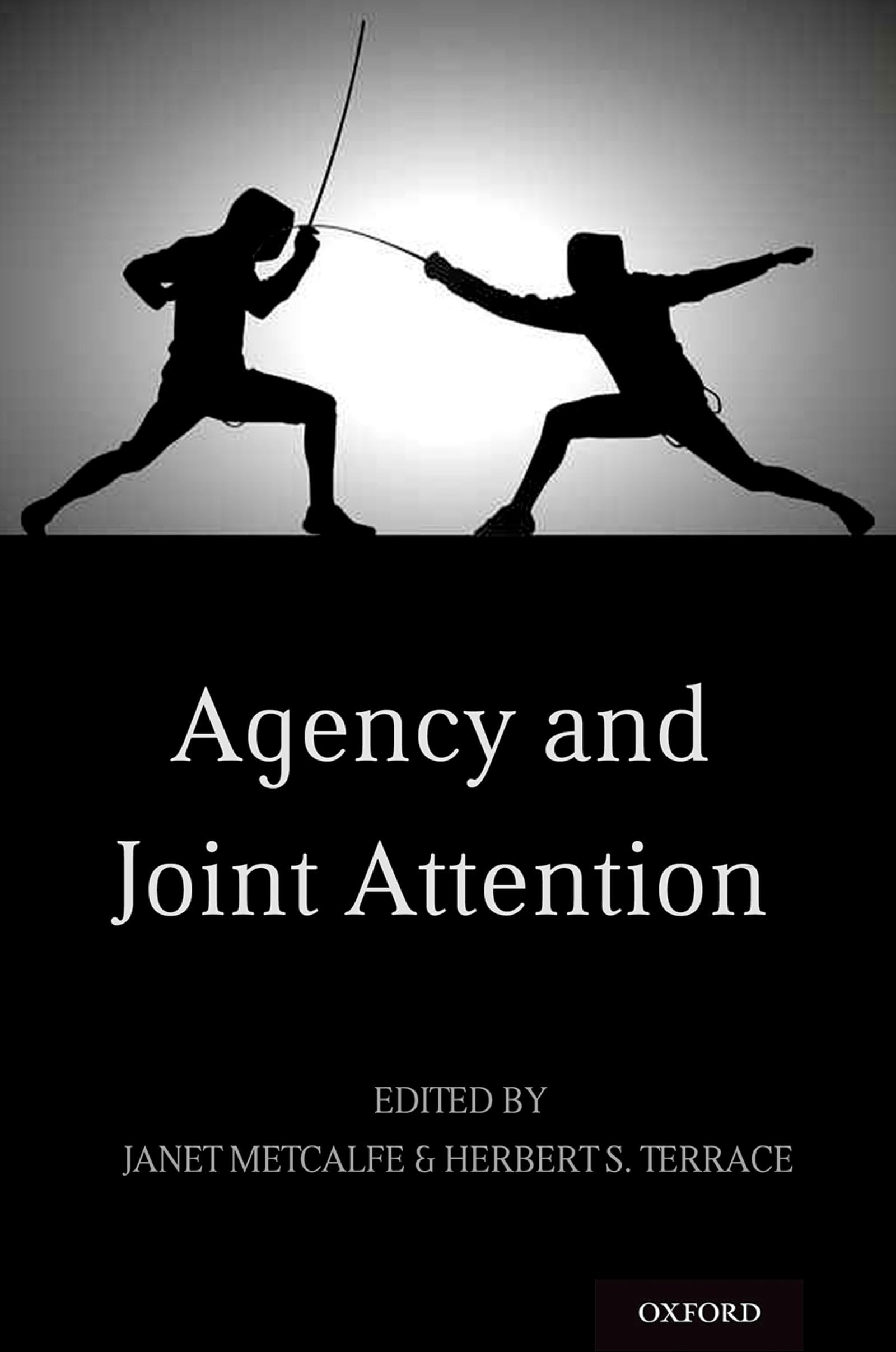
Human infants do not seem to be born with concepts of self or joint attention. One basic goal of Agency and Joint Attention is to unravel how these abilities originate. One approach that has received a lot of recent attention is social. Some argue that by virtue of an infant's intense eye gaze with her mother, she is able, by the age of four months, to establish a relationship with her mother that differentiates between "me" and "you." At about twelve months, the infant acquires the nonverbal ability to share attention with her mother or other caregivers. Although the concepts of self and joint attention are nonverbal and uniquely human, the question remains, how do we establish metacognitive control of these abilities? A tangential question is whether nonhuman animals develop abilities that are analogous to self and joint attention.Much of this volume is devoted to the development of metacognition of self and joint attention in experiments on the origin of consciousness, knowing oneself, social referencing, joint action, the neurological basis of joint attention, the role of joint action, mirror neurons, phenomenology, and cues for agency.
⚠️ WARNING (California Proposition 65):
This product may contain chemicals known to the State of California to cause cancer,
birth defects, or other reproductive harm.
For MAP (Minimum Advertised Price) violations and Intellectual Property (IP) or Trademark concerns, please contact:
support@ergodebooks.com
⚠️ California Proposition 65 Warning: Some products sold on this website may expose you to chemicals known to the State of California to cause cancer, birth defects, or other reproductive harm. For more information, visit www.P65Warnings.ca.gov.