
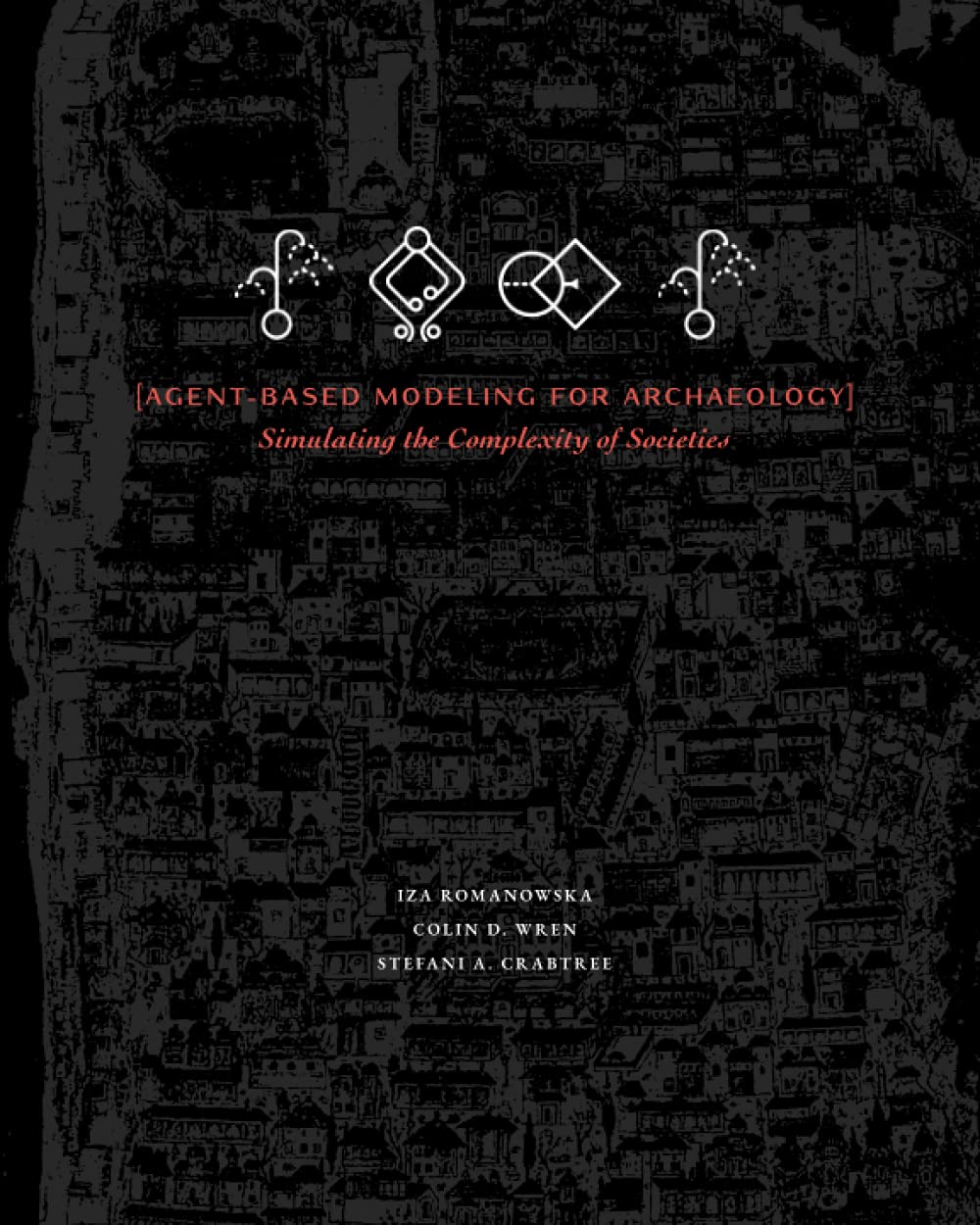
Title
AgentBased Modeling for Archaeology: Simulating the Complexity of Societies,Used
Sold by Ergodebooks, an authorized reseller.
Returns accepted within 30 days | support@ergodebooks.com
Shipping Information
- Free Standard Shipping — United States only
- Processing Time: 3–5 business days
- Estimated Delivery: 6–10 business days after dispatch
- Double-boxed, fully insured & discreetly packaged
- Tracking number sent via email once dispatched
Returns & Refund
Returns accepted within 30 days of delivery.
Damaged or Defective Item
Free return shipping + replacement or full refund
Wrong Item Received
Free return shipping + replacement or full refund
Change of Mind
Return shipping at customer's expense · 25% restocking fee applies
Payment Option

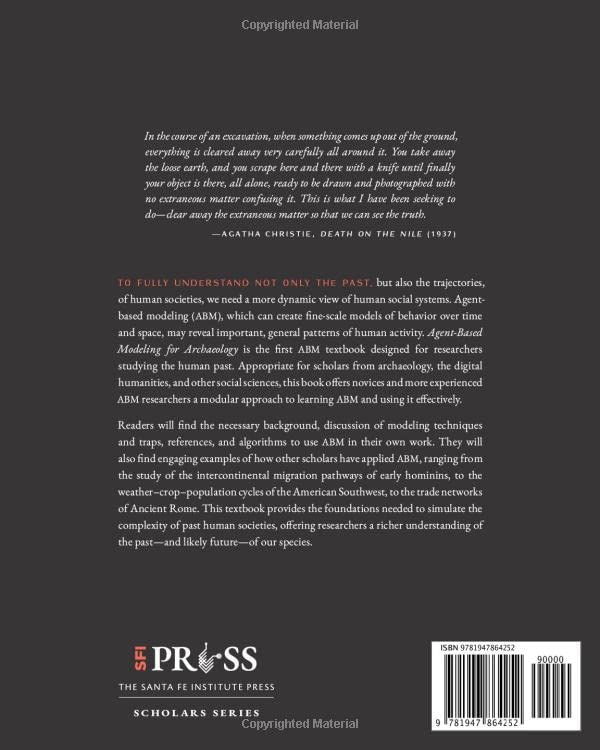
To fully understand not only the past, but also the trajectories, of human societies, we need a more dynamic view of human social systems. Agentbased modeling (ABM), which can create finescale models of behavior over time and space, may reveal important, general patterns of human activity. AgentBased Modeling for Archaeology is the first ABM textbook designed for researchers studying the human past. Appropriate for scholars from archaeology, the digital humanities, and other social sciences, this book offers novices and more experienced ABM researchers a modular approach to learning ABM and using it effectively.Readers will find the necessary background, discussion of modeling techniques and traps, references, and algorithms to use ABM in their own work. They will also find engaging examples of how other scholars have applied ABM, ranging from the study of the intercontinental migration pathways of early hominins, to the weathercroppopulation cycles of the American Southwest, to the trade networks of Ancient Rome. This textbook provides the foundations needed to simulate the complexity of past human societies, offering researchers a richer understanding of the pastand likely futureof our species.The electronic version of this textbook can be downloaded for free at: https://santafeinstitute.github.io/ABMA/
⚠️ WARNING (California Proposition 65):
This product may contain chemicals known to the State of California to cause cancer, birth defects, or other reproductive harm.
For more information, please visit www.P65Warnings.ca.gov.
- Q: How many pages does the book have? A: This book has four hundred forty-two pages. It provides a comprehensive exploration of agent-based modeling in archaeology.
- Q: What is the binding type of this book? A: The book is available in paperback binding. This makes it lightweight and easy to handle for reading.
- Q: What are the dimensions of the book? A: The book measures eight inches in length, one point eleven inches in width, and ten inches in height. These dimensions make it a standard-sized textbook.
- Q: Who is the author of this book? A: The author is Iza Romanowska. She offers insights into agent-based modeling for archaeological research.
- Q: What topics are covered in this book? A: The book covers various topics, including modeling techniques, algorithms, and practical applications in archaeology. It is designed for both novices and experienced researchers.
- Q: Is this book suitable for beginners in archaeology? A: Yes, the book is suitable for beginners. It offers a modular approach to learning agent-based modeling, making it accessible.
- Q: How can I apply the concepts from this book? A: You can apply the concepts by using the provided algorithms and examples in your own research. The book includes case studies that illustrate practical applications.
- Q: What research fields can benefit from this book? A: Fields like archaeology, digital humanities, and social sciences can benefit from this book. It provides insights into human social systems and their complexities.
- Q: Can I find examples of agent-based modeling in this book? A: Yes, the book includes engaging examples of agent-based modeling. These examples range from early human migration to trade networks in Ancient Rome.
- Q: How should I store this book to keep it in good condition? A: Store the book upright in a cool, dry place. Avoid exposing it to direct sunlight to prevent fading and damage.
- Q: Is there a digital version available? A: Yes, the electronic version of the textbook can be downloaded for free. It is available at the Santa Fe Institute's website.
- Q: What if the book arrives damaged? A: If your book arrives damaged, you should contact the seller for a replacement. Most sellers will have a return or exchange policy in place.
- Q: Does this book include references for further reading? A: Yes, the book includes references to assist readers in further research. This can enhance understanding and provide additional resources.
- Q: What is the main purpose of this book? A: The main purpose is to provide a foundational understanding of agent-based modeling in archaeology. It aims to enrich researchers' comprehension of human societies.
- Q: Is this book appropriate for advanced researchers? A: Yes, advanced researchers will find valuable insights and discussions in this book. It offers a comprehensive exploration of modeling techniques.