
Title
Agents of Discord: Deprogramming, PseudoScience, and the American Anticult Movement,Used
Sold by Ergodebooks, an authorized reseller.
Returns accepted within 30 days | support@ergodebooks.com
Shipping Information
- Free Standard Shipping — United States only
- Processing Time: 3–5 business days
- Estimated Delivery: 6–10 business days after dispatch
- Double-boxed, fully insured & discreetly packaged
- Tracking number sent via email once dispatched
Returns & Refund
Returns accepted within 30 days of delivery.
Damaged or Defective Item
Free return shipping + replacement or full refund
Wrong Item Received
Free return shipping + replacement or full refund
Change of Mind
Return shipping at customer's expense · 25% restocking fee applies
Payment Option

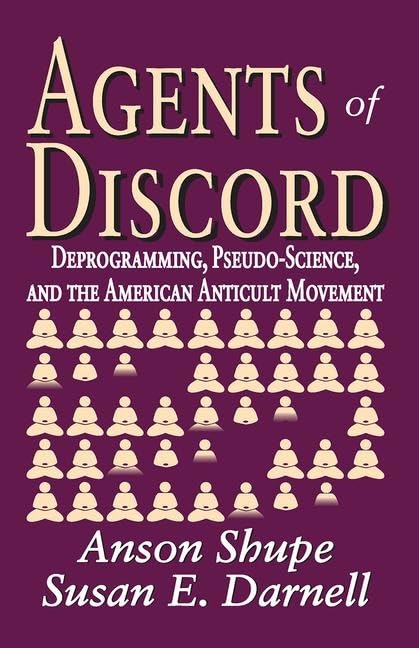
It is widely acknowledged that the United States has always provided fertile ground for the growth of new religious movements and cults, but modern organized efforts to oppose and restrict them have been less well understood. In Agents of Discord, Anson Shupe and Susan E. Darnell offer a groundbreaking analysis of the operations and motives of these oppositional groups, which they generally group under the umbrella term of the anticult movement.Historically there have always been parallel groups opposed to certain religious movements, whether these be antiQuaker, antiRoman Catholic, or antiMormon. The authors establish the cultural context of such movements in the nineteenth century. They point out the link between modern anticult movements and nativist movements in American history. Turning to the postwar era, the authors discuss the rise of anticult movements and focus specifically on one of the most prominent, the Cult Awareness Network (CAN). CAN was a twotiered organization. Partly composed of volunteers, donors, and families affected by cult movements, it also included what the authors call an "inner sanctum" of behavioral science professionals, attorneys, and deprogrammers. Using neverbeforereported data on CAN's activities, the authors cite an extensive history of financial impropriety that finally led to the organization's bankruptcy. They offer a pointed critique, informed by current scholarship, of the "brainwashing" model of mental enslavement presented by the anticult movement that has been a central assumption undergirding its activities. At the same time, they show how increasing professionalization has gradually begun a shift of such movements to a therapeutic model of exit counseling that rejects the crude methods of earlier intervention strategies.In their analysis of the anticult movement nationally and internationally, Shupe and Darnell merge sociological concepts and social history to make unique sense of a heretofore relatively unexplored phenomenon.
⚠️ WARNING (California Proposition 65):
This product may contain chemicals known to the State of California to cause cancer, birth defects, or other reproductive harm.
For more information, please visit www.P65Warnings.ca.gov.