
Title
Ages and Timelines: Subtraction on the Open Number Line (Context for Learning Math),New
Sold by Ergodebooks, an authorized reseller.
Returns accepted within 30 days | support@ergodebooks.com
Shipping Information
- Free Standard Shipping — United States only
- Processing Time: 3–5 business days
- Estimated Delivery: 6–10 business days after dispatch
- Double-boxed, fully insured & discreetly packaged
- Tracking number sent via email once dispatched
Returns & Refund
Returns accepted within 30 days of delivery.
Damaged or Defective Item
Free return shipping + replacement or full refund
Wrong Item Received
Free return shipping + replacement or full refund
Change of Mind
Return shipping at customer's expense · 25% restocking fee applies
Payment Option

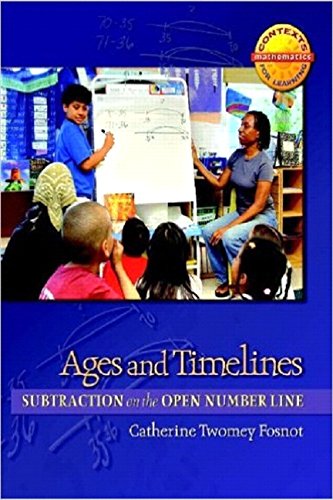
Ages and Timelines: Subtraction on the Open Number Line is one of eight units in the Contexts for Learning Mathematics Investigating Number Sense, Addition, and Subtraction (K3) This unit begins with the story of Carlos, an eightyearold boy who is fascinated by his greatgrandfathers thick, beautiful silver hair. His greatgrandfather lives in Puerto Rico and Carlos is preparing to meet him for the first time. Having only seen photos of him as a much younger man, Carlos wonders how old his greatgrandfather is and how many years it will take before he might have hair like that, too. As Carlos begins to investigate these questions, his whole family becomes involved in exploring age differences and figuring out how old they each were when Carlos was born. When Carlos shares his investigation with his teacher, the whole school gets involved in the project. This story context sets the stage for a series of investigations in this unit. Children interview their family members and compare age differences. Timelines are introduced as a context for using the open number linea helpful model used as a tool to explore and represent strategies for addition and subtraction. This unit will focus on the open number line as a model for subtraction. In contrast to a number line with counting numbers written below, an open number line is just an empty line used to record childrens addition and subtraction strategies. Only the numbers that children use are recorded and the addition and subtraction are recorded as leaps or jumps. For example, if a childs strategy for adding 8 + 79 is 79 + 1 + 7, using a landmark number of 80, it would be recorded on the open number line The recording would be similar if a child solves 87 8 by first removing 7 and then 1.Modeling childrens thinking on the open number line helps them move beyond counting one by one for addition and subtraction, to strategies such as taking leaps of ten, decomposing, and/or using landmark numbers. Use of the open number line also encourages discussion of the relationship between addition and subtraction and of the relationship between various problems in which the operation of subtraction can be employedsuch as removal, comparative difference, and finding a missing addend. As the unit progresses, timelines are used to record years of birth, rather than ages. This change in context challenges learners to grapple with larger numbers and with the changing places of the partwhole relations of numbers on the number line. For example, first the number 79 may be marked on the number line as 8 less than 87; then it may be the difference between 2005 and 1926. Several minilessons for subtraction are also included in the unit. These are structured using strings of related problems as a way to guide learners more explicitly toward computational fluency with subtraction. Note: It is expected that children will have had substantial experience with number lines prior to this unit. If this is not the case, you might want to take a look at the unit Measuring for the Art Show, to see how the number line model can be developed. To learn more visit http://www.contextsforlearning.com
⚠️ WARNING (California Proposition 65):
This product may contain chemicals known to the State of California to cause cancer, birth defects, or other reproductive harm.
For more information, please visit www.P65Warnings.ca.gov.