
Title
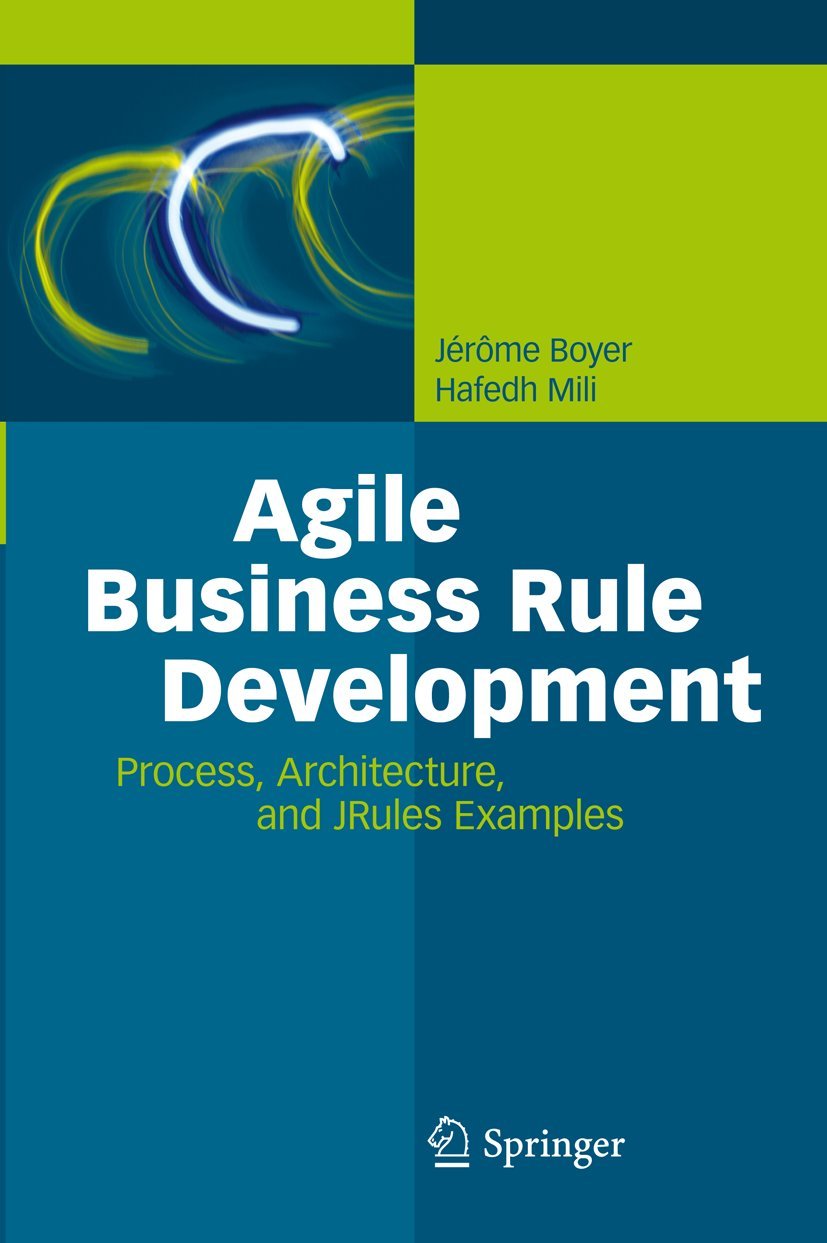
Agile Business Rule Development: Process, Architecture, and JRules Examples,New
Sold by Ergodebooks, an authorized reseller.
Returns accepted within 30 days | support@ergodebooks.com
Shipping Information
- Free Standard Shipping — United States only
- Processing Time: 3–5 business days
- Estimated Delivery: 6–10 business days after dispatch
- Double-boxed, fully insured & discreetly packaged
- Tracking number sent via email once dispatched
Returns & Refund
Returns accepted within 30 days of delivery.
Damaged or Defective Item
Free return shipping + replacement or full refund
Wrong Item Received
Free return shipping + replacement or full refund
Change of Mind
Return shipping at customer's expense · 25% restocking fee applies
Payment Option

Business rules are everywhere. Every enterprise process, task, activity, or function is governed by rules. However, some of these rules are implicit and thus poorly enforced, others are written but not enforced, and still others are perhaps poorly written and obscurely enforced. The business rule approach looks for ways to elicit, communicate, and manage business rules in a way that all stakeholders can understand, and to enforce them within the IT infrastructure in a way that supports their traceability and facilitates their maintenance.Boyer and Mili will help you to adopt the business rules approach effectively. While most business rule development methodologies put a heavy emphasis on upfront business modeling and analysis, agile business rule development (ABRD) as introduced in this book is incremental, iterative, and testdriven. Rather than spending weeks discovering and analyzing rules for a complete business function, ABRD puts the emphasis on producing executable, tested rule sets early in the project without jeopardizing the quality, longevity, and maintainability of the end result. The authors presentation covers all four aspects required for a successful application of the business rules approach: (1) foundations, to understand what business rules are (and are not) and what they can do for you; (2) methodology, to understand how to apply the business rules approach; (3) architecture, to understand how rule automation impacts your application; (4) implementation, to actually deliver the technical solution within the context of a particular business rule management system (BRMS). Throughout the book, the authors use an insurance case study that deals with claim processing.Boyer and Mili cater to different audiences: Project managers will find a pragmatic, proven methodology for delivering and maintaining business rule applications. Business analysts and rule authors will benefit from guidelines and best practices for rule discovery and analysis. Application architects and software developers will appreciate an exploration of the design space for business rule applications, proven architectural and design patterns, and coding guidelines for using JRules.
⚠️ WARNING (California Proposition 65):
This product may contain chemicals known to the State of California to cause cancer, birth defects, or other reproductive harm.
For more information, please visit www.P65Warnings.ca.gov.