
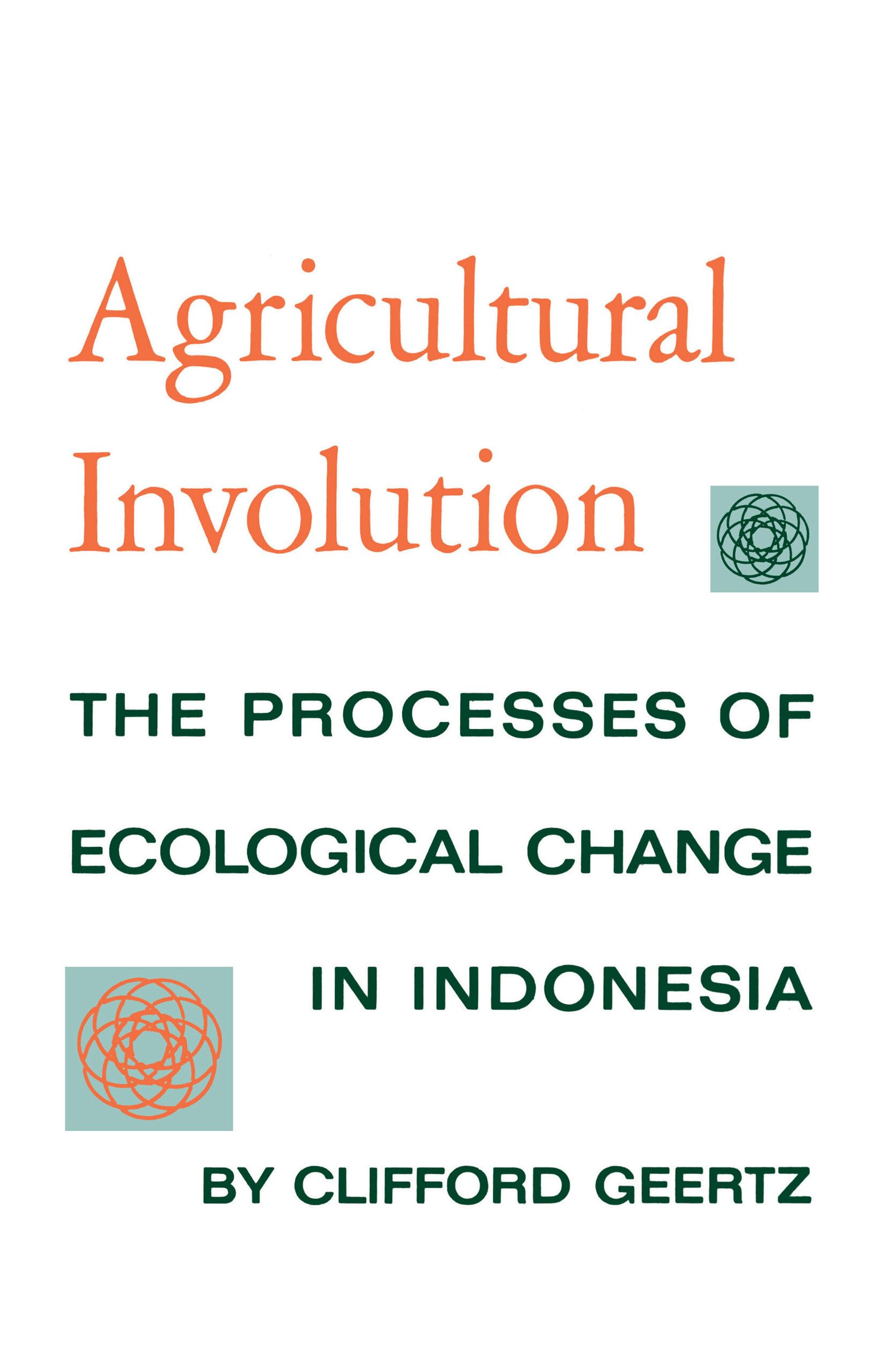
Title
Agricultural Involution: The Processes of Ecological Change in Indonesia,New
Sold by Ergodebooks, an authorized reseller.
Returns accepted within 30 days | support@ergodebooks.com
Shipping Information
- Free Standard Shipping — United States only
- Processing Time: 3–5 business days
- Estimated Delivery: 6–10 business days after dispatch
- Double-boxed, fully insured & discreetly packaged
- Tracking number sent via email once dispatched
Returns & Refund
Returns accepted within 30 days of delivery.
Damaged or Defective Item
Free return shipping + replacement or full refund
Wrong Item Received
Free return shipping + replacement or full refund
Change of Mind
Return shipping at customer's expense · 25% restocking fee applies
Payment Option

Agricultural Involution: The Processes of Ecological Change in Indonesia is one of the most famous of the early works of Clifford Geertz. It principal thesis is that many centuries of intensifying wetrice cultivation in Indonesia had produced greater social complexity without significant technological or political change, a process Geertz terms 'involution'.Written for a USfunded project on the local developments and following the modernization theory of Walt Whitman Rostow, Geertz examines in this book the agricultural system in Indonesia and its two dominant forms of agriculture, swidden and sawah. In addition to researching its agricultural systems, the book turns to an examination of their historical development. Of particular note is Geertz's discussion of what he famously describes as the process of 'agricultural involution' in Java, where both the external economic demands of the Dutch rulers and the internal pressures due to population growth led to intensification rather than change.
⚠️ WARNING (California Proposition 65):
This product may contain chemicals known to the State of California to cause cancer, birth defects, or other reproductive harm.
For more information, please visit www.P65Warnings.ca.gov.
- Q: What is the page count of this book? A: This book has one hundred ninety-five pages. It's a comprehensive exploration of agricultural practices in Indonesia.
- Q: What are the dimensions of 'Agricultural Involution'? A: The dimensions are five point five one inches in length, zero point four nine inches in width, and eight point two seven inches in height. This makes it a compact paperback.
- Q: Who is the author of this book? A: The author is Clifford Geertz. He is well-known for his influential works in anthropology and social sciences.
- Q: What type of binding does this book have? A: This book is bound in paperback. It's designed for durability and ease of use.
- Q: What category does this book fall under? A: This book falls under the category of Economic Conditions. It focuses on agricultural practices and their socio-economic implications.
- Q: Is this book suitable for students studying anthropology? A: Yes, this book is suitable for students studying anthropology. It offers insights into agricultural systems and social complexity.
- Q: How do I read and understand the concepts in this book? A: To understand the concepts, it's recommended to read it slowly and take notes. Geertz's arguments are complex but rewarding.
- Q: Is this book appropriate for casual readers? A: Yes, casual readers can enjoy this book. It presents intriguing ideas about culture and agriculture in an accessible manner.
- Q: Does this book require prior knowledge of agriculture? A: No, prior knowledge of agriculture is not necessary. The author explains concepts clearly for general readers.
- Q: How should I store this book for longevity? A: Store this book in a cool, dry place, away from direct sunlight. This helps maintain its condition over time.
- Q: Can I use this book as a reference for research? A: Yes, this book is an excellent reference for research. It provides a detailed analysis of ecological and agricultural change.
- Q: What if the book arrives damaged? A: If the book arrives damaged, you should contact the seller for a return or exchange. Keep all packaging for the return process.
- Q: What is the main thesis of 'Agricultural Involution'? A: The main thesis is that wet-rice cultivation in Indonesia led to social complexity without major changes in technology or politics.
- Q: How does this book compare to other works by Geertz? A: This book is foundational compared to other works by Geertz. It focuses specifically on agricultural practices, unlike his later cultural analyses.
- Q: Are there any illustrations or charts in this book? A: No, this book primarily consists of text without illustrations or charts. It focuses on analytical writing.
- Q: What makes this book significant in agricultural studies? A: This book is significant because it introduces the concept of 'involution,' highlighting the complexities of agricultural systems over time.