
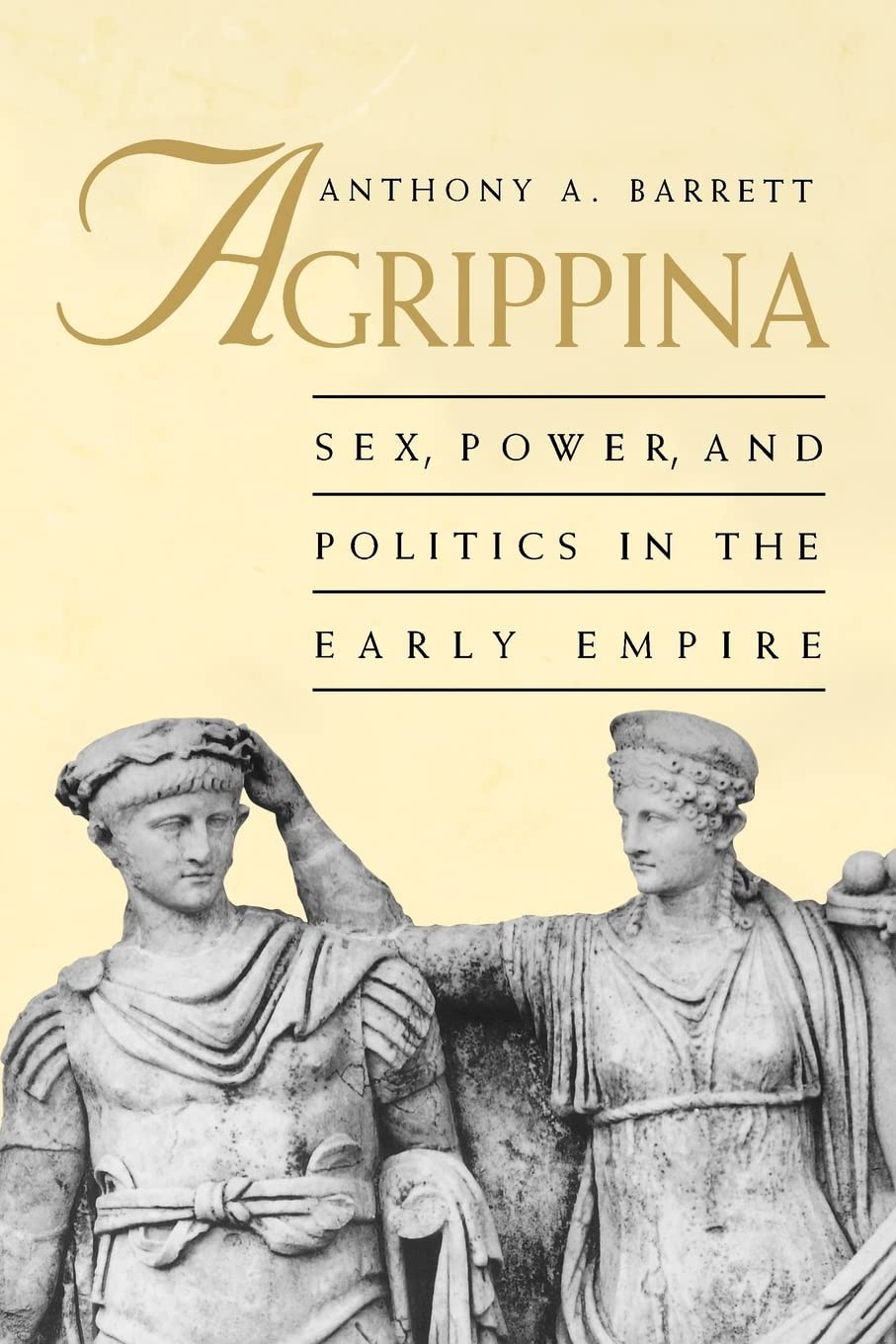
Title
Agrippina: Sex, Power, and Politics in the Early Empire,Used
Sold by Ergodebooks, an authorized reseller.
Returns accepted within 30 days | support@ergodebooks.com
Shipping Information
- Free Standard Shipping — United States only
- Processing Time: 3–5 business days
- Estimated Delivery: 6–10 business days after dispatch
- Double-boxed, fully insured & discreetly packaged
- Tracking number sent via email once dispatched
Returns & Refund
Returns accepted within 30 days of delivery.
Damaged or Defective Item
Free return shipping + replacement or full refund
Wrong Item Received
Free return shipping + replacement or full refund
Change of Mind
Return shipping at customer's expense · 25% restocking fee applies
Payment Option

Agrippina the Younger attained a level of power in firstcentury Rome unprecedented for a woman. According to ancient sources, she achieved her success by plotting against her brother, the emperor Caligula, murdering her husband, the emperor Claudius, and controlling her son, the emperor Nero, by sleeping with him. Modern scholars tend to accept this verdict. But in his dynamic biographythe first on Agrippina in EnglishAnthony Barrett paints a startling new picture of this influential woman.Drawing on the latest archaeological, numismatic, and historical evidence, Barrett argues that Agrippina has been misjudged. Although she was ambitious, says Barrett, she made her way through ability and determination rather than by sexual allure, and her political contributions to her time seem to have been positive. After Agrippina's marriage to Claudius there was a marked decline in the number of judicial executions and there was close cooperation between the Senate and the emperor; the settlement of Cologne, founded under her aegis, was a model of social harmony; and the first five years of Nero's reign, while she was still alive, were the most enlightened of his rule. According to Barrett, Agrippina's one real failing was her relationship with her son, the monster of her own making who had her murdered in horrific and violent circumstances. Agrippina's impact was so lasting, however, that for some 150 years after her death no woman in the imperial family dared assume an assertive political role.
⚠️ WARNING (California Proposition 65):
This product may contain chemicals known to the State of California to cause cancer, birth defects, or other reproductive harm.
For more information, please visit www.P65Warnings.ca.gov.
- Q: What is the main focus of the book 'Agrippina: Sex, Power, and Politics in the Early Empire'? A: The book explores the life of Agrippina the Younger, examining her unprecedented power as a woman in first-century Rome, her political maneuvers, and her influence on key figures like her son, Nero.
- Q: Who is the author of this biography? A: The biography is authored by Anthony Barrett, who presents a new perspective on Agrippina based on recent archaeological and historical evidence.
- Q: What type of evidence does Anthony Barrett use to support his claims about Agrippina? A: Barrett draws on the latest archaeological, numismatic, and historical evidence to reassess Agrippina's life and political contributions.
- Q: How many pages does the book have? A: The book contains 352 pages.
- Q: In what format is 'Agrippina: Sex, Power, and Politics in the Early Empire' available? A: The book is available in paperback format.
- Q: What is the condition of the book being offered? A: The book is listed as 'New', indicating it has not been previously owned or read.
- Q: When was 'Agrippina: Sex, Power, and Politics in the Early Empire' published? A: The book was published on July 11, 1999.
- Q: What is the significance of Agrippina's marriage to Claudius according to Barrett? A: Barrett argues that after Agrippina married Claudius, there was a notable decline in judicial executions and an increase in cooperation between the Senate and the emperor.
- Q: Does the book provide a mostly positive or negative portrayal of Agrippina? A: The book presents a more nuanced and largely positive portrayal of Agrippina, arguing that her political contributions were beneficial rather than merely driven by ambition.
- Q: What is one of Agrippina's major failings as discussed in the book? A: According to Barrett, Agrippina's major failing was her complicated relationship with her son Nero, who ultimately had her murdered.