
Title
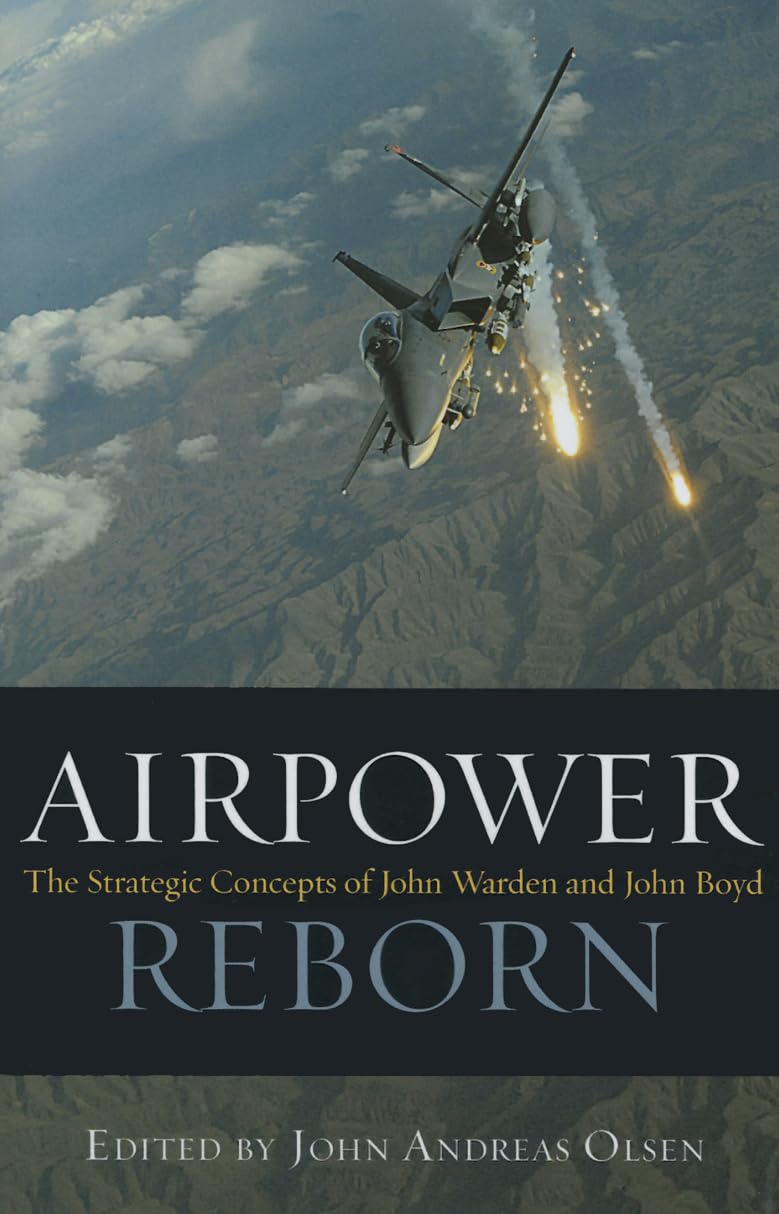
Airpower Reborn: The Strategic Concepts of John Warden and John Boyd (History of Military Aviation),Used
Sold by Ergodebooks, an authorized reseller.
Returns accepted within 30 days | support@ergodebooks.com
Shipping Information
- Free Standard Shipping — United States only
- Processing Time: 3–5 business days
- Estimated Delivery: 6–10 business days after dispatch
- Double-boxed, fully insured & discreetly packaged
- Tracking number sent via email once dispatched
Returns & Refund
Returns accepted within 30 days of delivery.
Damaged or Defective Item
Free return shipping + replacement or full refund
Wrong Item Received
Free return shipping + replacement or full refund
Change of Mind
Return shipping at customer's expense · 25% restocking fee applies
Payment Option

Airpower Reborn offers a conceptual approach to warfare that emphasizes airpower's unique capability to achieve strategic effects. Six worldleading theorists argue that a viable strategy must transcend the purely military sphere, view the adversary as a multidimensional system, and pursue systemic paralysis and strategic effects rather than military destruction or attrition.The book is divided into three parts. The first section presents a historical perspective on airpower theory and airpower strategy, tracing their evolution from the 1920s to the 1980s. The second section contains indepth examinations of the strategic concepts that John R. Boyd and John A. Warden developed in the 1980s and 1990s, with an emphasis on their contemporary relevance. The final section provides further context on modern airpower theory and strategy. Theory, in this setting, serves as the basic paradigm, strategy represents its generic, mechanismscentered application, and plans of campaign constitute the specific steps for any given situation.In short, the authors look beyond the landcentric, battlefieldoriented paradigm that has continued to dominate military theories and strategies long after airpower offered new options. The book acknowledges the essential role of advanced technology in improving airpower capabilities, but emphasizes that air services must cultivate and harness the intellectual acumen of airmen and encourage officers and men to think conceptually and strategically about the application of aerospace power. Modern airpower can offer political decisionmakers more and better optionsprovided the underlying strategy coherently links the application of airpower directly to the endstate objectives rather than limiting it to "the battle."The book recommends that all countries should consider establishing a dynamic and vibrant environment for mastering aerospace history, theory, strategy, and doctrine; a milieu for cultivating broader knowledge of and insight into airpower; and a setting in which airpower experts have the opportunity to communicate their narrative to politicians, the media, and fellow officers, and to interact to mutual benefit with experts from all sectors of governance. This effort should emphasize the potentially unique contribution of airpower to political objectives and joint operations, and in turn connect to operational headquarters that do operational planning. Mastering such strategic thought lies at the heart of the military profession, but it requires indepth knowledge and understanding of theory, strategy, and airpower, and transcends traditional metrics.
⚠️ WARNING (California Proposition 65):
This product may contain chemicals known to the State of California to cause cancer, birth defects, or other reproductive harm.
For more information, please visit www.P65Warnings.ca.gov.
- Q: How many pages does the book have? A: The book has two hundred fifty-six pages. This provides a comprehensive exploration of airpower's strategic concepts.
- Q: What are the dimensions of this book? A: The book measures six point seventy-five inches in length, zero point seventy-five inches in width, and ten inches in height. This size makes it suitable for reading on various surfaces.
- Q: What type of binding does the book use? A: The book features a hardcover binding. This ensures durability and longevity in handling and storage.
- Q: Who is the author of this book? A: The author of the book is John Andreas Olsen. He is known for his expertise in military aviation and airpower theory.
- Q: What genre does this book fall under? A: The book falls under the genre of military history and aviation. It provides significant insights into airpower strategy.
- Q: Is this book suitable for beginners in military theory? A: Yes, the book is suitable for beginners. It offers a conceptual approach that is accessible even to those new to military theory.
- Q: What key concepts are discussed in this book? A: The book discusses strategic concepts of airpower, including systemic paralysis and the relevance of advanced technology. These concepts are crucial for understanding modern warfare.
- Q: How does the book address modern airpower strategy? A: The book emphasizes the necessity of linking airpower application directly to political objectives. This perspective enhances understanding of contemporary military operations.
- Q: Is there a historical perspective in this book? A: Yes, the book includes a historical perspective on airpower theory. It traces the evolution of airpower from the 1920s to the 1980s.
- Q: What is the target audience for this book? A: The target audience includes military professionals, historians, and anyone interested in aviation strategy. Its insights are relevant for both academic and practical applications.
- Q: How should I care for this hardcover book? A: To care for the hardcover book, keep it in a dry, cool place and avoid direct sunlight. This will help preserve its condition over time.
- Q: Can this book be used as a reference for military strategies? A: Yes, this book can be used as a reference for military strategies. It provides valuable insights into airpower theory and application.
- Q: What if I receive a damaged copy of the book? A: If you receive a damaged copy, contact the seller for a return or replacement. Most sellers offer a satisfaction guarantee for such issues.
- Q: Is this book appropriate for academic study? A: Yes, the book is appropriate for academic study. It offers well-researched theories and strategic concepts suitable for scholarly analysis.
- Q: Does the book discuss the impact of technology on airpower? A: Yes, the book discusses the impact of advanced technology on airpower capabilities. It highlights the importance of technology in modern warfare.