

Title
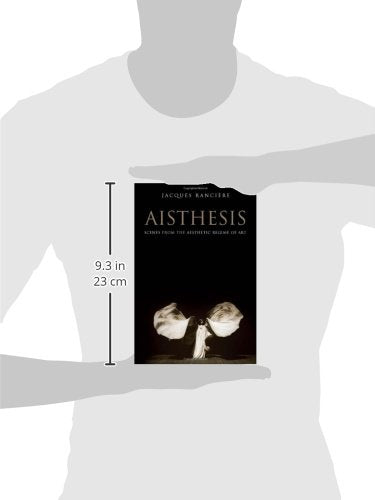
Aisthesis: Scenes from the Aesthetic Regime of Art,Used
Sold by Ergodebooks, an authorized reseller.
Returns accepted within 30 days | support@ergodebooks.com
Shipping Information
- Free Standard Shipping — United States only
- Processing Time: 3–5 business days
- Estimated Delivery: 6–10 business days after dispatch
- Double-boxed, fully insured & discreetly packaged
- Tracking number sent via email once dispatched
Returns & Refund
Returns accepted within 30 days of delivery.
Damaged or Defective Item
Free return shipping + replacement or full refund
Wrong Item Received
Free return shipping + replacement or full refund
Change of Mind
Return shipping at customer's expense · 25% restocking fee applies
Payment Option

Composed in a series of scenes, AisthesisRancires definitive statement on the aesthetictakes its reader from Dresden in 1764 to New York in 1941. Along the way, we view the Belvedere Torso with Winckelmann, accompany Hegel to the museum and Mallarm to the FoliesBergre, attend a lecture by Emerson, visit exhibitions in Paris and New York, factories in Berlin, and film sets in Moscow and Hollywood. Rancire uses these sites and eventssome famous, others forgottento ask what becomes art and what comes of it. He shows how a regime of artistic perception and interpretation was constituted and transformed by erasing the specificities of the different arts, as well as the borders that separated them from ordinary experience. This incisive study provides a history of artistic modernity far removed from the conventional postures of modernism.
⚠️ WARNING (California Proposition 65):
This product may contain chemicals known to the State of California to cause cancer, birth defects, or other reproductive harm.
For more information, please visit www.P65Warnings.ca.gov.
- Q: What is the main theme of 'Aisthesis: Scenes from the Aesthetic Regime of Art'? A: The main theme of 'Aisthesis' revolves around the evolution of the aesthetic regime of art, exploring how artistic perception and interpretation have transformed over time through various historical contexts.
- Q: Who is the author of this book? A: The author of 'Aisthesis' is Jacques Rancière, a noted philosopher known for his work in aesthetics and political theory.
- Q: What type of binding does this book have? A: This book is available in a hardcover binding, which provides durability and a premium feel.
- Q: When was 'Aisthesis: Scenes from the Aesthetic Regime of Art' published? A: The book was published on June 4, 2013.
- Q: How many pages does 'Aisthesis' have? A: The book contains a total of 304 pages.
- Q: Is 'Aisthesis' suitable for academic study? A: Yes, 'Aisthesis' is suitable for academic study, particularly for those interested in art criticism, aesthetics, and the history of art.
- Q: What is the condition of the book being sold? A: The book is in new condition, ensuring that it has not been previously used or damaged.
- Q: Does the book include any illustrations or images? A: The primary focus of 'Aisthesis' is the text and its philosophical arguments; it does not primarily include illustrations or images.
- Q: What is the significance of the title 'Aisthesis'? A: The title 'Aisthesis' refers to the sensory perception and experience in art, highlighting the relationship between art and its audience.
- Q: Can this book be used as a reference for understanding modern art? A: Yes, 'Aisthesis' provides insights into the development of modern art and its critical reception, making it a valuable reference for understanding contemporary artistic practices.