If you have any questions, you are always welcome to contact us. We'll get back to you as soon as possible, withing 24 hours on weekdays.
Customer service
All questions about your order, return and delivery must be sent to our customer service team by e-mail at yourstore@yourdomain.com
Sale & Press
If you are interested in selling our products, need more information about our brand or wish to make a collaboration, please contact us at press@yourdomain.com
Help
If you have any questions, you are always welcome to contact us. We'll get back to you as soon as possible, withing 24 hours on weekdays.
Customer service
All questions about your order, return and delivery must be sent to our customer service team by e-mail at yourstore@yourdomain.com
Sale & Press
If you are interested in selling our products, need more information about our brand or wish to make a collaboration, please contact us at press@yourdomain.com
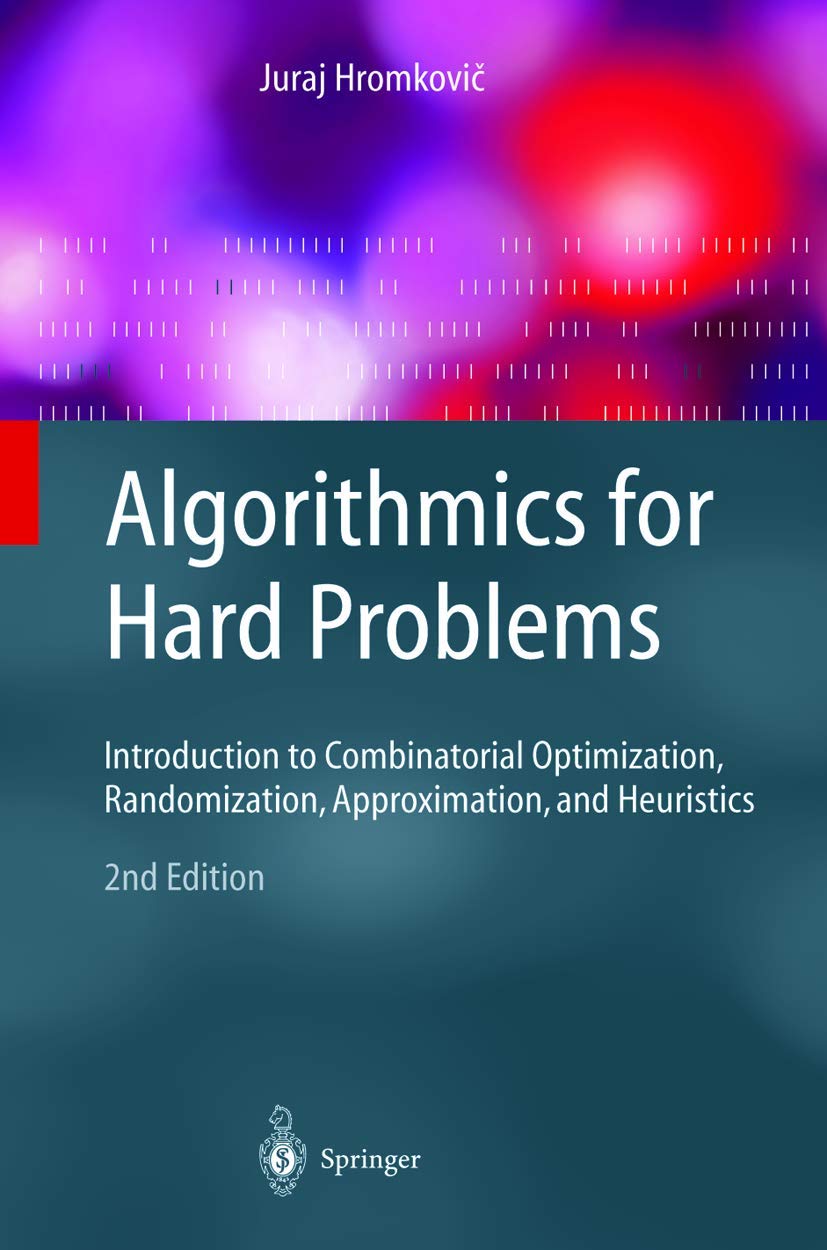
Algorithmic design, especially for hard problems, is more essential for success in solving them than any standard improvement of current computer tech nologies. Because of this, the design of algorithms for solving hard problems is the core of current algorithmic research from the theoretical point of view as well as from the practical point of view. There are many general text books on algorithmics, and several specialized books devoted to particular approaches such as local search, randomization, approximation algorithms, or heuristics. But there is no textbook that focuses on the design of algorithms for hard computing tasks, and that systematically explains, combines, and compares the main possibilities for attacking hard algorithmic problems. As this topic is fundamental for computer science, this book tries to close this gap. Another motivation, and probably the main reason for writing this book, is connected to education. The considered area has developed very dynami cally in recent years and the research on this topic discovered several profound results, new concepts, and new methods. Some of the achieved contributions are so fundamental that one can speak about paradigms which should be in cluded in the education of every computer science student. Unfortunately, this is very far from reality. This is because these paradigms are not sufficiently known in the computer science community, and so they are insufficiently com municated to students and practitioners.
⚠️ WARNING (California Proposition 65):
This product may contain chemicals known to the State of California to cause cancer,
birth defects, or other reproductive harm.
For MAP (Minimum Advertised Price) violations and Intellectual Property (IP) or Trademark concerns, please contact:
support@ergodebooks.com
⚠️ California Proposition 65 Warning: Some products sold on this website may expose you to chemicals known to the State of California to cause cancer, birth defects, or other reproductive harm. For more information, visit www.P65Warnings.ca.gov.