
Title
Algorithms For Random Generation And Counting: A Markov Chain Approach (Progress In Theoretical Computer Science),Used
Sold by Ergodebooks, an authorized reseller.
Returns accepted within 30 days | support@ergodebooks.com
Shipping Information
- Free Standard Shipping — United States only
- Processing Time: 3–5 business days
- Estimated Delivery: 6–10 business days after dispatch
- Double-boxed, fully insured & discreetly packaged
- Tracking number sent via email once dispatched
Returns & Refund
Returns accepted within 30 days of delivery.
Damaged or Defective Item
Free return shipping + replacement or full refund
Wrong Item Received
Free return shipping + replacement or full refund
Change of Mind
Return shipping at customer's expense · 25% restocking fee applies
Payment Option

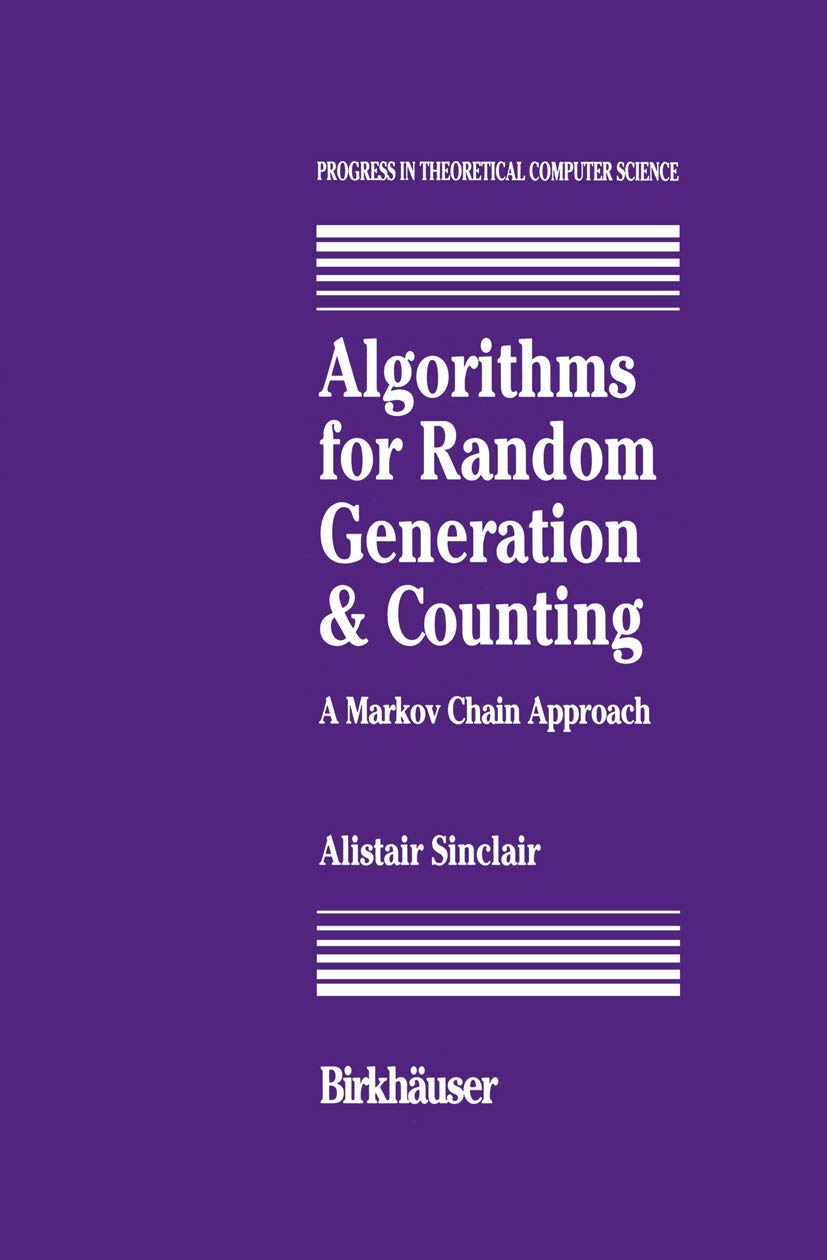
This monograph is a slightly revised version of my PhD thesis [86], com pleted in the Department of Computer Science at the University of Edin burgh in June 1988, with an additional chapter summarising more recent developments. Some of the material has appeared in the form of papers [50,88]. The underlying theme of the monograph is the study of two classical problems: counting the elements of a finite set of combinatorial structures, and generating them uniformly at random. In their exact form, these prob lems appear to be intractable for many important structures, so interest has focused on finding efficient randomised algorithms that solve them ap proxim~ly, with a small probability of error. For most natural structures the two problems are intimately connected at this level of approximation, so it is natural to study them together. At the heart of the monograph is a single algorithmic paradigm: sim ulate a Markov chain whose states are combinatorial structures and which converges to a known probability distribution over them. This technique has applications not only in combinatorial counting and generation, but also in several other areas such as statistical physics and combinatorial optimi sation. The efficiency of the technique in any application depends crucially on the rate of convergence of the Markov chain.
⚠️ WARNING (California Proposition 65):
This product may contain chemicals known to the State of California to cause cancer, birth defects, or other reproductive harm.
For more information, please visit www.P65Warnings.ca.gov.
- Q: What is the page count of the book? A: The book contains one hundred fifty-five pages. This includes various chapters discussing algorithms in detail.
- Q: What is the book's binding type? A: The book is available in hardcover. This makes it durable and suitable for long-term use.
- Q: What are the dimensions of the book? A: The book measures six point fourteen inches in length, zero point forty-four inches in width, and nine point twenty-one inches in height.
- Q: How do I read this book effectively? A: To read this book effectively, start with the introduction and then proceed through each chapter sequentially. This will help you understand the algorithms discussed.
- Q: Is this book suitable for beginners? A: Yes, this book is suitable for those with a basic understanding of computer science. However, some prior knowledge of algorithms is beneficial.
- Q: What topics are covered in the book? A: The book covers topics related to random generation and counting, particularly focusing on Markov chains and combinatorial structures.
- Q: How should I store the book to keep it in good condition? A: Store the book upright on a shelf in a cool, dry place. Avoid exposure to direct sunlight to prevent fading.
- Q: Can I clean the book if it gets dirty? A: Yes, you can clean the book gently with a dry cloth. Avoid using water or cleaning solutions as they may damage the pages.
- Q: Is this book safe for all ages? A: Yes, the book is safe for all ages. It is an academic text focused on theoretical computer science.
- Q: What if I receive a damaged book? A: If you receive a damaged book, contact customer support for assistance with returns or exchanges. Keep the original packaging for reference.
- Q: Does the book come with a warranty? A: No, this book does not come with a warranty. However, most retailers have return policies for damaged items.
- Q: How can I compare this book with other computer science texts? A: To compare this book, look at its focus on Markov chains and combinatorial algorithms against other books that cover broader topics in computer science.
- Q: Is this book recommended for advanced studies? A: While it provides valuable insights, it is primarily suitable for those with a foundational understanding. Advanced readers may find it a good reference.
- Q: What is the author's background? A: The author, A. Sinclair, completed the work as a PhD thesis and has expertise in computer science, particularly in algorithms and combinatorial theory.
- Q: Are there any additional resources related to the book? A: Yes, the book references several papers and publications that provide additional context and recent developments in the field.
- Q: What is the main theme of the book? A: The main theme revolves around counting and generating combinatorial structures using efficient randomized algorithms.