If you have any questions, you are always welcome to contact us. We'll get back to you as soon as possible, withing 24 hours on weekdays.
Customer service
All questions about your order, return and delivery must be sent to our customer service team by e-mail at yourstore@yourdomain.com
Sale & Press
If you are interested in selling our products, need more information about our brand or wish to make a collaboration, please contact us at press@yourdomain.com
Help
If you have any questions, you are always welcome to contact us. We'll get back to you as soon as possible, withing 24 hours on weekdays.
Customer service
All questions about your order, return and delivery must be sent to our customer service team by e-mail at yourstore@yourdomain.com
Sale & Press
If you are interested in selling our products, need more information about our brand or wish to make a collaboration, please contact us at press@yourdomain.com
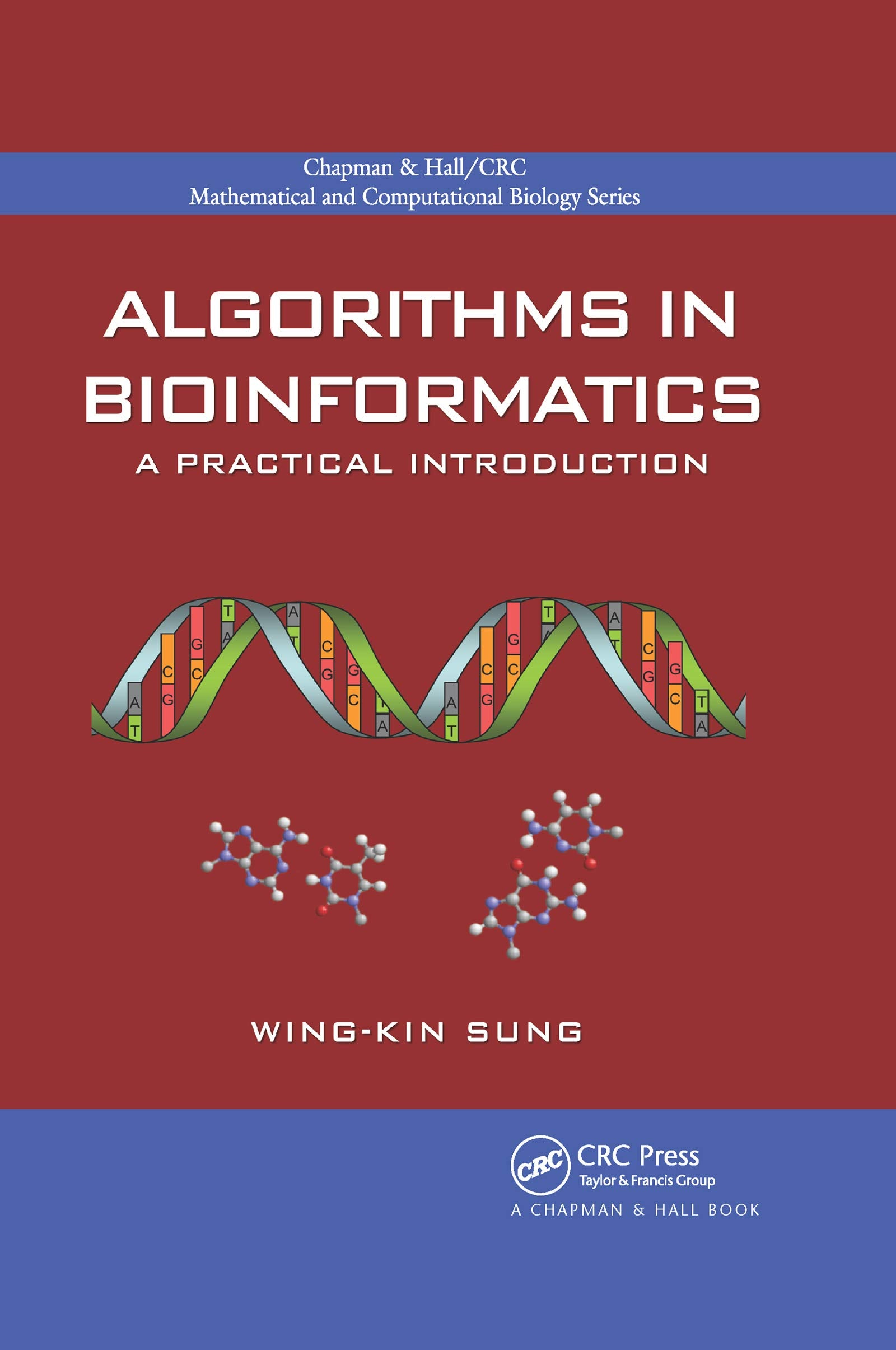
Thoroughly Describes Biological Applications, Computational Problems, and Various Algorithmic SolutionsDeveloped from the authors own teaching material, Algorithms in Bioinformatics: A Practical Introduction provides an indepth introduction to the algorithmic techniques applied in bioinformatics. For each topic, the author clearly details the biological motivation and precisely defines the corresponding computational problems. He also includes detailed examples to illustrate each algorithm and endofchapter exercises for students to familiarize themselves with the topics. Supplementary material is available at http://www.comp.nus.edu.sg/~ksung/algo_in_bioinfo/This classroomtested textbook begins with basic molecular biology concepts. It then describes ways to measure sequence similarity, presents simple applications of the suffix tree, and discusses the problem of searching sequence databases. After introducing methods for aligning multiple biological sequences and genomes, the text explores applications of the phylogenetic tree, methods for comparing phylogenetic trees, the problem of genome rearrangement, and the problem of motif finding. It also covers methods for predicting the secondary structure of RNA and for reconstructing the peptide sequence using mass spectrometry. The final chapter examines the computational problem related to population genetics.
⚠️ WARNING (California Proposition 65):
This product may contain chemicals known to the State of California to cause cancer,
birth defects, or other reproductive harm.
For MAP (Minimum Advertised Price) violations and Intellectual Property (IP) or Trademark concerns, please contact:
support@ergodebooks.com
⚠️ California Proposition 65 Warning: Some products sold on this website may expose you to chemicals known to the State of California to cause cancer, birth defects, or other reproductive harm. For more information, visit www.P65Warnings.ca.gov.