
Title

Amaury,Used
Sold by Ergodebooks, an authorized reseller.
Returns accepted within 30 days | support@ergodebooks.com
Shipping Information
- Free Standard Shipping — United States only
- Processing Time: 3–5 business days
- Estimated Delivery: 6–10 business days after dispatch
- Double-boxed, fully insured & discreetly packaged
- Tracking number sent via email once dispatched
Returns & Refund
Returns accepted within 30 days of delivery.
Damaged or Defective Item
Free return shipping + replacement or full refund
Wrong Item Received
Free return shipping + replacement or full refund
Change of Mind
Return shipping at customer's expense · 25% restocking fee applies
Payment Option

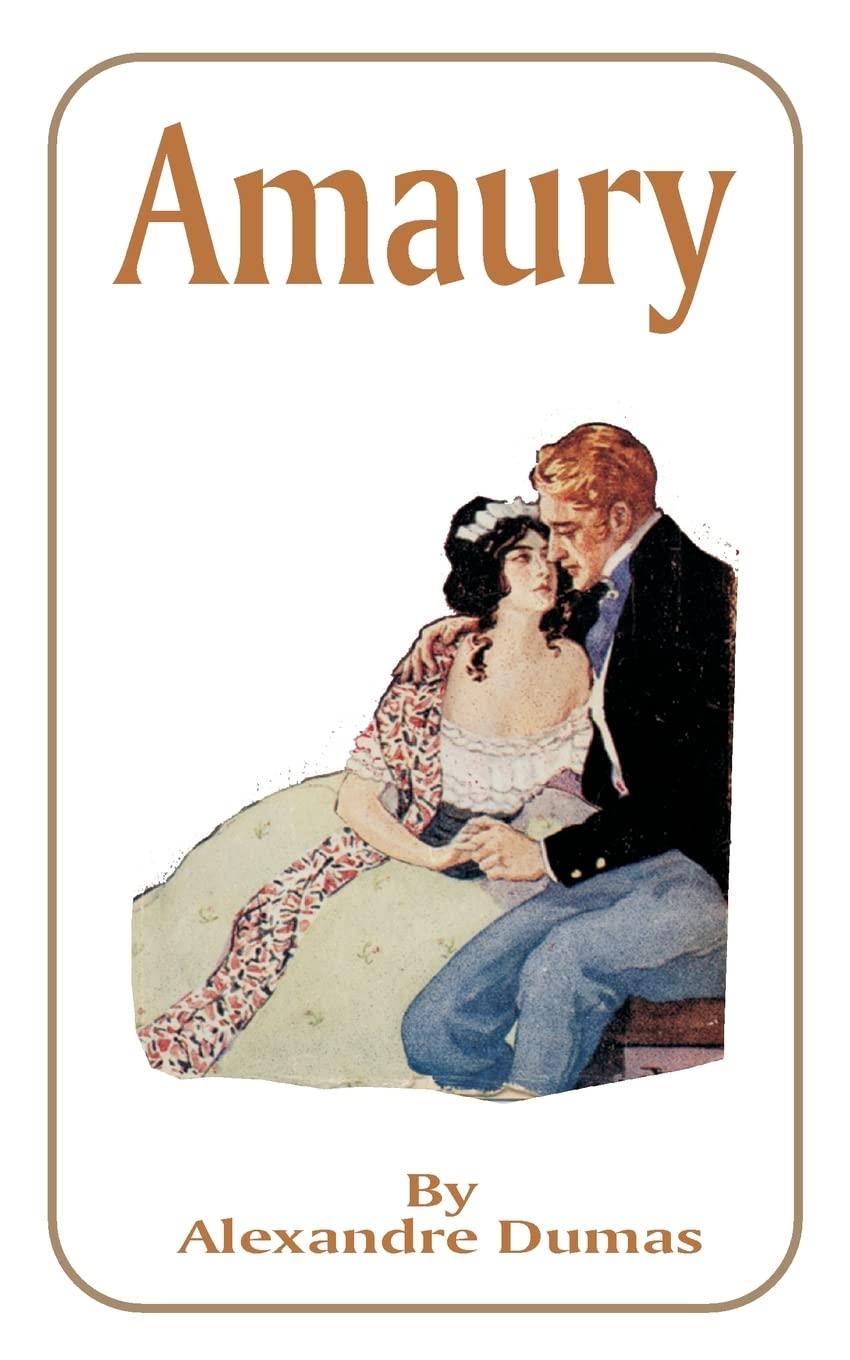
A romantic novel (with moments of both tragedy and comedy) on the general theme of jealousy, set in the countryside outside Paris in 183839. In Amaury, Dumas attempts an artistic dissection of jealousy, but all his characters keep turning into Alexandre Dumas, (who finds jealousy an unworthy emotion) and rise above it. Amaury is also of interest as Dumas' sole attempt at an epistolary novel, a form that (as this book shows) Dumas found uncongenial, since he kept abandoning the epistolary format for straight narration, and all of the letters read as if written by the same person, which, of course, they were.As the novel opens, a group of French aristocrats are conversing, and one of them asks the question, "Meurton d'amour?" Does one die of love? In response, one them pulls forth a manuscript that purports to be the diary and letters of the family of the deceased M. d'Avrigny, widower and court physician to the King. The novel is nominally composed of the diary and letters being read aloud.Amaury de Leoville, young, and wealthy, and orphaned, is beginning his career in the French diplomatic service. Amaury was raised by M. d'Avrigny, a friend of his late father, along side d'Avrigny's frail blonde daughter, Madeleine, and yet another orphan, the vigorous darkhaired Antoinette.Amaury has fallen in love with Madeleine, while both Madeleine and Antoinette have fallen in love with Amaury. Amaury asks M. d'Avrigny for Madeleine's hand, is summarily refused and thrown out of his childhood home, because, as M. d'Avrigny confides to his diary, he is jealous of Madeleine's love for Amaury. After a perfunctory chapter of anguish, M. d'Avrigny decides he is being unreasonable and permits the wedding. Unfortunately, Madeleine is dying of consumption (tuberculosis), so the wedding never occurs. Madeleine infers that Antoinette also loves Amaury, and, jealous of her rude good health, subjects Antoinette to assorted undeserved slights. After a perfunctory chapter of anguish, Madeleine decides she is being unfair, and begs Antoinette's forgiveness, which Antoinette of course grants.Dumas vividly describes Madeleine's decline and death, and the extravagant grief which inflicts her father, lover, and cousin. Amaury plans suicide, but is dissuaded. M. d'Avrigny deteriorates in grief and solitude. Amaury travels on his diplomatic mission, and corresponds with Antoinette, who swears she will never marry. However, M. d'Avrigny decides that it forms part of his parental duty to find a good match for Antoinette, and asks Amaury, on his return, to act as Antoinette's guardian in the event of his (expected) death. Two presentable suitors are rustled up, a young Marquis and Amaury's friend Philip.From tragedy, Dumas manages a swift transition to comedy. Amaury has, without being aware of it, fallen in love with Antoinette (who has always loved Amaury), and the finds the two suitors highly objectionable. When Philip appears to be finding favor with Antoinette, Amaury challenges Philip to a duel. Philip accepts the challenge, despite never having touched either sword or pistol. The duel ends in farce when Philip inadvertently shoots off the hat of Amaury's second. The second, enraged, shoots off Philip's hat, and everyone decides that they have behaved unreasonably.M. d'Avrigny gives his blessing and then dies, Amaury and Antoinette marry and live happily ever after. Dumas concludes (I think) that it is better to live for love than to die for it.
⚠️ WARNING (California Proposition 65):
This product may contain chemicals known to the State of California to cause cancer, birth defects, or other reproductive harm.
For more information, please visit www.P65Warnings.ca.gov.