If you have any questions, you are always welcome to contact us. We'll get back to you as soon as possible, withing 24 hours on weekdays.
Customer service
All questions about your order, return and delivery must be sent to our customer service team by e-mail at yourstore@yourdomain.com
Sale & Press
If you are interested in selling our products, need more information about our brand or wish to make a collaboration, please contact us at press@yourdomain.com
Help
If you have any questions, you are always welcome to contact us. We'll get back to you as soon as possible, withing 24 hours on weekdays.
Customer service
All questions about your order, return and delivery must be sent to our customer service team by e-mail at yourstore@yourdomain.com
Sale & Press
If you are interested in selling our products, need more information about our brand or wish to make a collaboration, please contact us at press@yourdomain.com
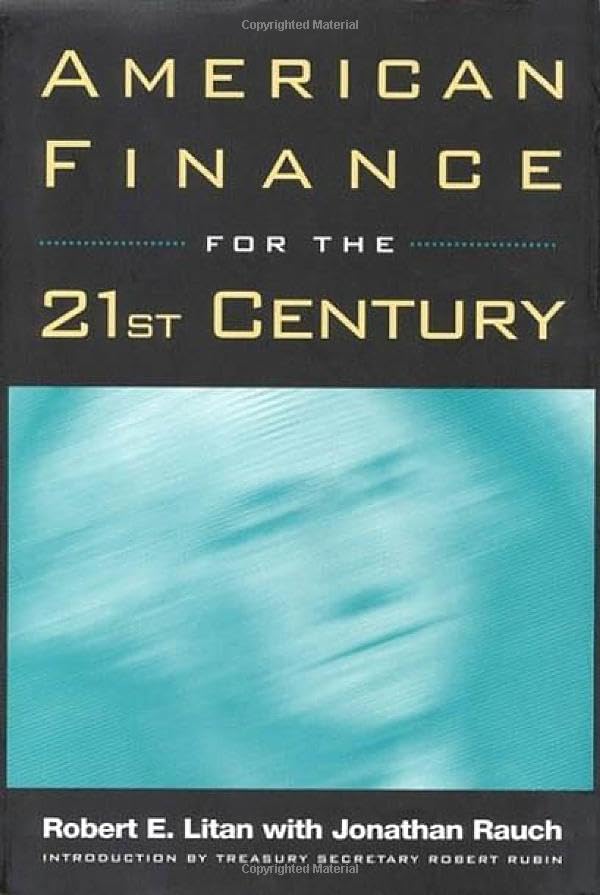
As recently as thirty years ago, Americans lived in a financial world that today seems distant. Investment and borrowing choices were meager: virtually all transactions were conducted in cash or by check. The financial services industry was heavily regulated, as an outgrowth of the Depression, while an elaborate safety net was constructed to prevent a repeat of that dismal episode in American history. Today, consumers and businesses have a dizzying array of choices about where to invest and borrow. Plastic credit cards and electronic transfers increasingly are replacing cash and checks. Much regulation has been dismantled, although the industry remains fragmented by rules that continue to separate banks from other enterprises. Meanwhile, finance has gone global and increasingly hightech. This book, originally prepared as a report to Congress by the Treasury Department, outlines a framework for setting policy toward the financial services industry in the coming decades. The authors, who worked closely with senior Treasury officials in developing their recommendations, identify three core principles that lie at the heart of that framework: an enhanced role for competition; a shift in emphasis from preventing failures of financial institutions at all cost toward containing the damage of any failures that inevitably occur in a competitive market; and a greater reliance on more targeted interventions to achieve policy goals rather than broad measures, such as flat prohibitions on certain activities. '
⚠️ WARNING (California Proposition 65):
This product may contain chemicals known to the State of California to cause cancer,
birth defects, or other reproductive harm.
For MAP (Minimum Advertised Price) violations and Intellectual Property (IP) or Trademark concerns, please contact:
support@ergodebooks.com
⚠️ California Proposition 65 Warning: Some products sold on this website may expose you to chemicals known to the State of California to cause cancer, birth defects, or other reproductive harm. For more information, visit www.P65Warnings.ca.gov.