
Title
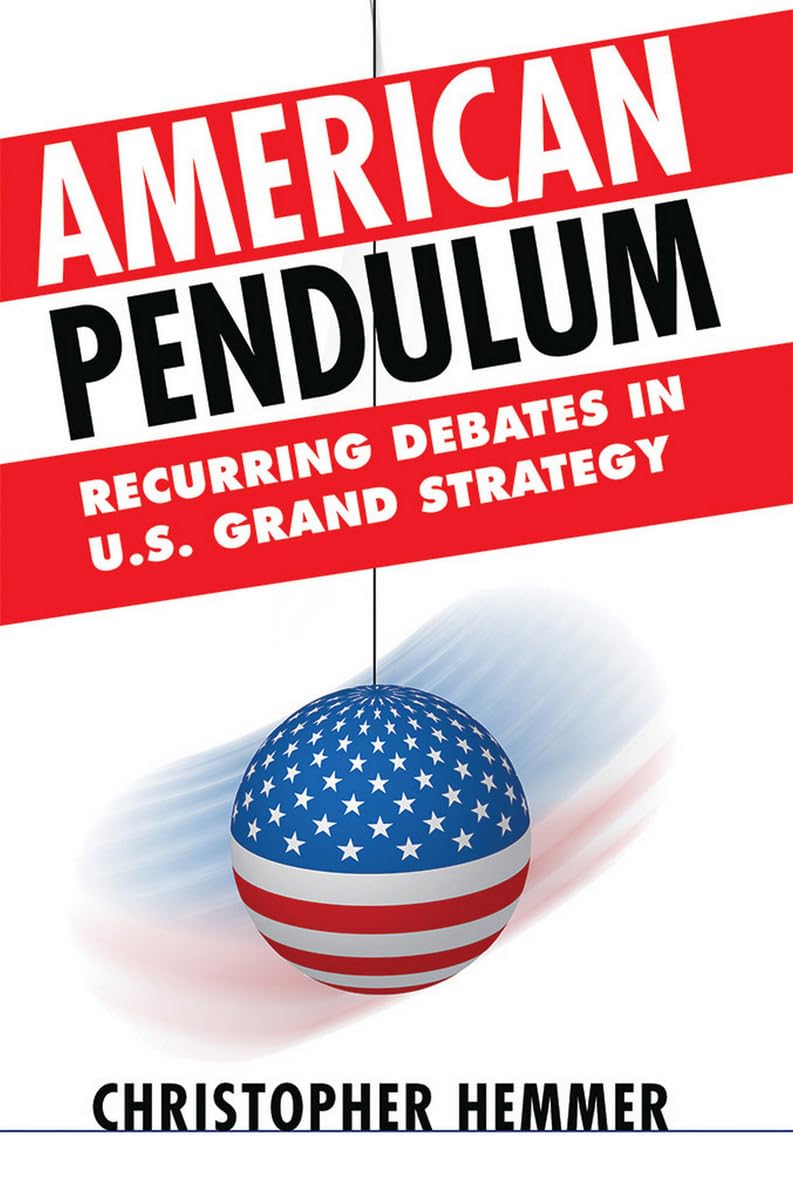
American Pendulum: Recurring Debates in U.S. Grand Strategy (Cornell Studies in Security Affairs),Used
Sold by Ergodebooks, an authorized reseller.
Returns accepted within 30 days | support@ergodebooks.com
Shipping Information
- Free Standard Shipping — United States only
- Processing Time: 3–5 business days
- Estimated Delivery: 6–10 business days after dispatch
- Double-boxed, fully insured & discreetly packaged
- Tracking number sent via email once dispatched
Returns & Refund
Returns accepted within 30 days of delivery.
Damaged or Defective Item
Free return shipping + replacement or full refund
Wrong Item Received
Free return shipping + replacement or full refund
Change of Mind
Return shipping at customer's expense · 25% restocking fee applies
Payment Option

As new presidential administrations come into power, they each bring their own approach to foreign policy. No grand strategy, however, is going to be completely novel. New administrations never start with a blank slate, so it is always possible to see similarities between an administration and its predecessors. Conversely, since each administration faces novel problems and operates in a unique context, no foreign policy strategy is going to be an exact replica of its predecessors. In American Pendulum, Christopher Hemmer examines Americas grand strategic choices between 1914 and 2014 using four recurring debates in American foreign policy as lenses. First, how should the United States balance the tradeoffs between working alone versus working with other states and international organizations? Second, what is the proper place of American values in foreign policy? Third, where does the strategic perimeter of the United States lie? And fourth, is time on the side of the United States or of its enemies?Offering new readings of debates within the Wilson, Truman, Nixon, Bush, and Obama administrations, Hemmer asserts that heated debates, disagreements, and even confusions over U.S. grand strategy are not only normal but also beneficial. He challenges the claim that uncertainties or inconsistences about the nations role in the world or approach to security issues betray strategic confusion or the absence of a grand strategy. American foreign policy, he states, is most in danger not when debates are at their most pointed but when the weight of opinion crushes dissent. As the United States looks ahead to an increasingly multipolar world with increasing complicated security issues, Hemmer concludes, developing an effective grand strategy requires ongoing contestation and compromises between competing visions and policies.
⚠️ WARNING (California Proposition 65):
This product may contain chemicals known to the State of California to cause cancer, birth defects, or other reproductive harm.
For more information, please visit www.P65Warnings.ca.gov.