If you have any questions, you are always welcome to contact us. We'll get back to you as soon as possible, withing 24 hours on weekdays.
Customer service
All questions about your order, return and delivery must be sent to our customer service team by e-mail at yourstore@yourdomain.com
Sale & Press
If you are interested in selling our products, need more information about our brand or wish to make a collaboration, please contact us at press@yourdomain.com
Help
If you have any questions, you are always welcome to contact us. We'll get back to you as soon as possible, withing 24 hours on weekdays.
Customer service
All questions about your order, return and delivery must be sent to our customer service team by e-mail at yourstore@yourdomain.com
Sale & Press
If you are interested in selling our products, need more information about our brand or wish to make a collaboration, please contact us at press@yourdomain.com
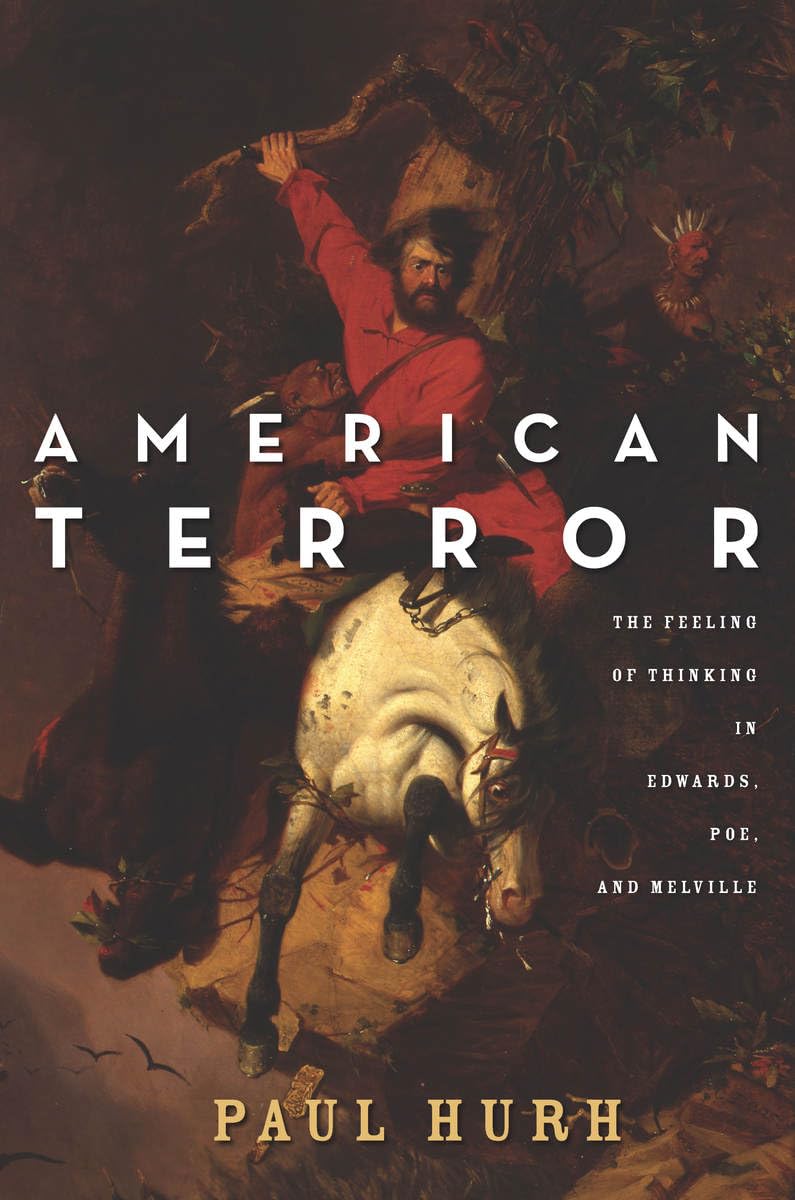
If America is a nation founded upon Enlightenment ideals, then why are so many of its most celebrated pieces of literature so dark? American Terror returns to the question of American literature's distinctive tone of terror through a close study of three authorsJonathan Edwards, Edgar Allan Poe, and Herman Melvillewho not only wrote works of terror, but who defended, theorized, and championed it. Combining updated historical perspectives with close reading, Paul Hurh shows how these authors developed terror as a special literary affect informed by the way the concept of thinking becomes, in the wake of Enlightenment empiricism, increasingly defined by a set of austere mechanic processes, such as the scientific method and the algebraic functions of analytical logic. Rather than trying to find a feeling that would transcend thinking by subtending reason to emotion, these writers found in terror the feeling of thinking, the peculiar feeling of reason's authority over emotional schemes. In so doing, they grappled with a shared set of enduring questions: What is the difference between thinking and feeling? Why does it seem impossible to reason oneself out of an irrational fear? And what becomes of the freedom of the will when we discover that affects can push it around?
⚠️ WARNING (California Proposition 65):
This product may contain chemicals known to the State of California to cause cancer,
birth defects, or other reproductive harm.
For MAP (Minimum Advertised Price) violations and Intellectual Property (IP) or Trademark concerns, please contact:
support@ergodebooks.com
⚠️ California Proposition 65 Warning: Some products sold on this website may expose you to chemicals known to the State of California to cause cancer, birth defects, or other reproductive harm. For more information, visit www.P65Warnings.ca.gov.