If you have any questions, you are always welcome to contact us. We'll get back to you as soon as possible, withing 24 hours on weekdays.
Customer service
All questions about your order, return and delivery must be sent to our customer service team by e-mail at yourstore@yourdomain.com
Sale & Press
If you are interested in selling our products, need more information about our brand or wish to make a collaboration, please contact us at press@yourdomain.com
Help
If you have any questions, you are always welcome to contact us. We'll get back to you as soon as possible, withing 24 hours on weekdays.
Customer service
All questions about your order, return and delivery must be sent to our customer service team by e-mail at yourstore@yourdomain.com
Sale & Press
If you are interested in selling our products, need more information about our brand or wish to make a collaboration, please contact us at press@yourdomain.com
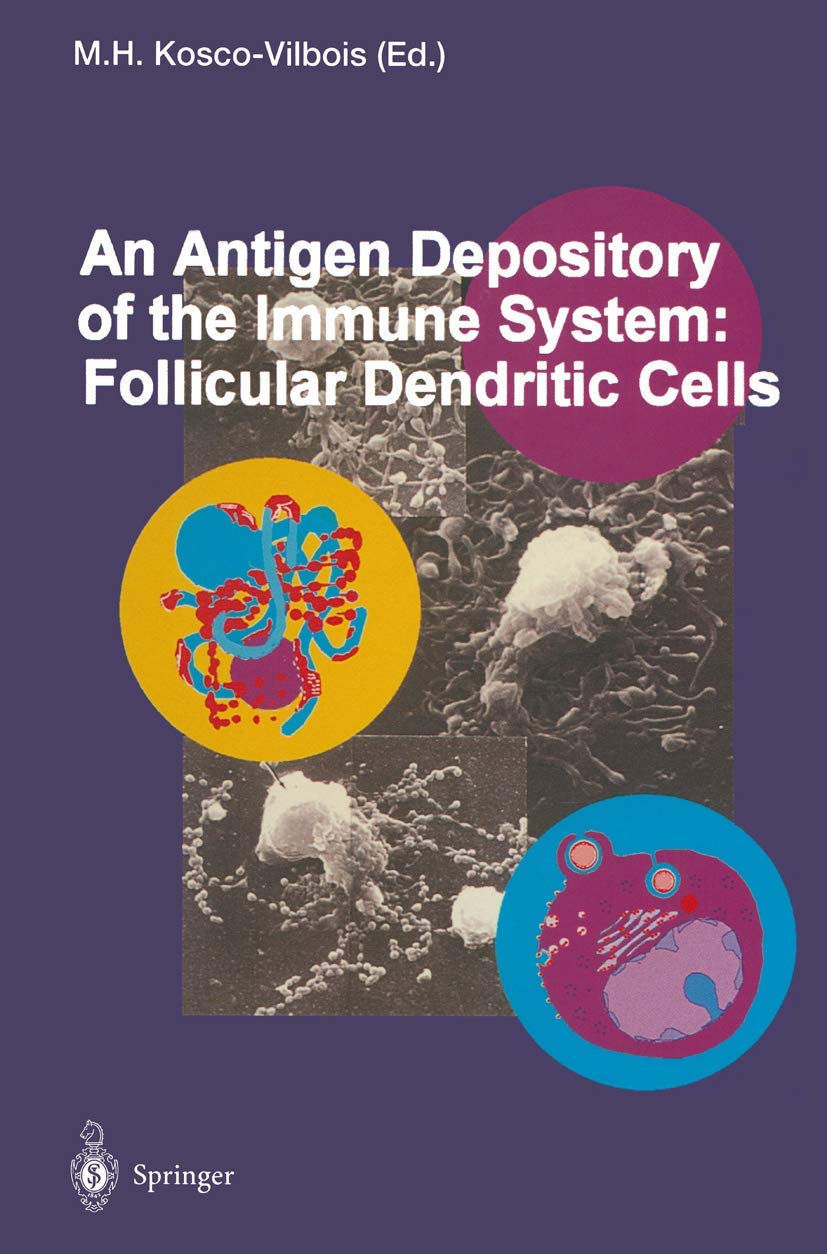
Follicular dendritic cells (FOe) are unique among cells of the immune system. While their morphological characteristics re sulted in their inclusion as a 'dendritic cell type', tt1ey differ quite significantly from the other members of the dendritic cell family. In contrast to Tcellassociated dendritic cells or the Langerhans cells found in the skin, FOe reside in highly organized B cell follicles within secondary lymphoid tissues. This site of resi dence provided a nomenclature committee in 1982 with the second descriptive factor for the derivation of their name. The cardinal feature of FOe is to trap and retain antigen on the surface of their dendritic processes for extended amounts of time and it is this feature that provides the conceptual compo nent for the title of this book. In response to an antigenic challenge, primary B cell follicles undergo dynamic events, giving rise to germinal centers which are associated with activation, expansion, and differentiation processes of B cells. The interactions of B cells with Foe and T cells in the germinal centers are essential for generating the complete repertoire of antibody isotypes obtained during an antibody response. In addition, stimuli either initiated or main tained during the germinal center reponse leads to production of high affinity antibodies through the processes of somatic muta tion and clonal selection. In this context, FOe act as a pivotal source of antigen. They accumulate foreign proteins (e. g.
⚠️ WARNING (California Proposition 65):
This product may contain chemicals known to the State of California to cause cancer,
birth defects, or other reproductive harm.
For MAP (Minimum Advertised Price) violations and Intellectual Property (IP) or Trademark concerns, please contact:
support@ergodebooks.com
⚠️ California Proposition 65 Warning: Some products sold on this website may expose you to chemicals known to the State of California to cause cancer, birth defects, or other reproductive harm. For more information, visit www.P65Warnings.ca.gov.