
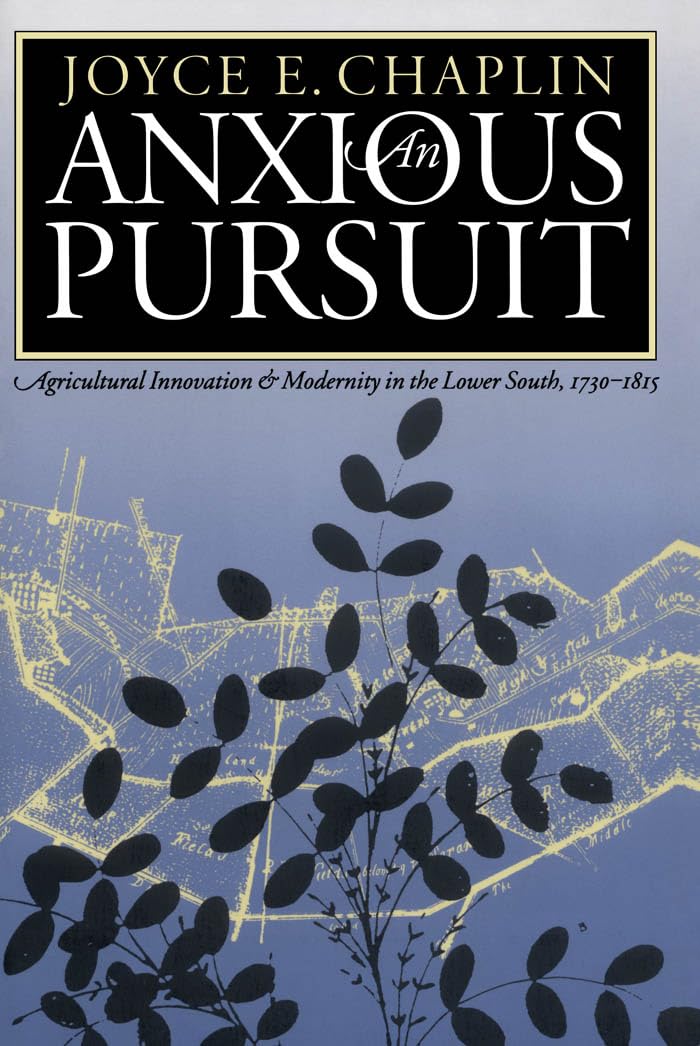
Title
An Anxious Pursuit: Agricultural Innovation And Modernity In The Lower South, 17301815 (Published By The Omohundro Institute Of,Used
Sold by Ergodebooks, an authorized reseller.
Returns accepted within 30 days | support@ergodebooks.com
Shipping Information
- Free Standard Shipping — United States only
- Processing Time: 3–5 business days
- Estimated Delivery: 6–10 business days after dispatch
- Double-boxed, fully insured & discreetly packaged
- Tracking number sent via email once dispatched
Returns & Refund
Returns accepted within 30 days of delivery.
Damaged or Defective Item
Free return shipping + replacement or full refund
Wrong Item Received
Free return shipping + replacement or full refund
Change of Mind
Return shipping at customer's expense · 25% restocking fee applies
Payment Option

In An Anxious Pursuit, Joyce Chaplin examines the impact of the Enlightenment ideas of progress on the lives and minds of American planters in the colonial Lower South. She focuses particularly on the influence of Scottish notions of progress, tracing the extent to which planters in South Carolina, Georgia, and British East Florida perceived themselves as a modern, improving people. She reads developments in agricultural practice as indices of planters' desire for progress, and she demonstrates the central role played by slavery in their pursuit of modern life. By linking behavior and ideas, Chaplin has produced a work of cultural history that unites intellectual, social, and economic history.Using public records as well as planters' and farmers' private papers, Chaplin examines innovations in rice, indigo, and cotton cultivation as a window through which to see planters' pursuit of a modern future. She demonstrates that planters actively sought to improve their society and economy even as they suffered a pervasive anxiety about the corrupting impact of progress and commerce. The basis for their accomplishments and the root of their anxieties, according the Chaplin, were the same: racebased chattel slavery. Slaves provied the labor necessary to attain planters' vision of the modern, but the institution ultimately limited the Lower South's ability to compete in the contemporary world.Indeed, whites continued to wonder whether their innovations, some of them defied by slaves, truly improved the region. Chaplin argues that these apprehensions prefigured the antimodern stance of the antebellum period, but she contends that they were as much a reflection of the doubt inherent in theories of progress as an outright rejection of those ideas.
⚠️ WARNING (California Proposition 65):
This product may contain chemicals known to the State of California to cause cancer, birth defects, or other reproductive harm.
For more information, please visit www.P65Warnings.ca.gov.