
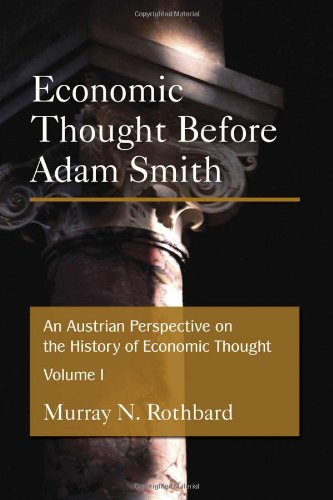
Title
An Austrian Perspective On The History Of Economic Thought (2 Vol. Set),Used
Sold by Ergodebooks, an authorized reseller.
Returns accepted within 30 days | support@ergodebooks.com
Shipping Information
- Free Standard Shipping — United States only
- Processing Time: 3–5 business days
- Estimated Delivery: 6–10 business days after dispatch
- Double-boxed, fully insured & discreetly packaged
- Tracking number sent via email once dispatched
Returns & Refund
Returns accepted within 30 days of delivery.
Damaged or Defective Item
Free return shipping + replacement or full refund
Wrong Item Received
Free return shipping + replacement or full refund
Change of Mind
Return shipping at customer's expense · 25% restocking fee applies
Payment Option

The Appearance Of The Famous (And Massive) Volumes Of Rothbard'S History Of Economic Thought In A New Edition Is Cause For Great Celebration. They Have Been Out Of Print For Many Years, And Were Previously Only Available At A Price Exceeding $200 For The Set. They Are At Last Accessible Again, In Beautiful Hardcover, And At An Affordable Price.In Economic Thought Before Adam Smith, Murray Rothbard Traces Economic Ideas From Ancient Sources To Show That Laissezfaire Liberalism And Economic Thought Itself Began With The Scholastics And Early Roman, Greek, And Canon Law. He Celebrates Aristotle And Democritus, For Example, But Loathes Plato And Diogenes. He Is Kind Toward Taoism And Stoicism. He Is No Fan Of Tertullian But Very Much Likes St. Jerome, Who Defended The Merchant Class. Now, That Takes Us Only To Page 33, Just The Beginning Of A Wild Ride Through The Middle Ages And Renaissance And Modern Times Through 1870.Rothbard Read Deeply In Thinkers Dating Back Hundreds And Thousands Of Years, And Spotted Every Promising Line Of Thought And Every Unfortunate One. He Knew When An Idea Would Lead To Prosperity, And When It Would Lead To Calamity. He Could Spot A Protokeynesian Or Protomarxist Idea In The Middle Ages, Just As He Could Find Freemarket Lines Of Thought In Ancient Manuscripts.Many Scholars Believe This Was His Most Important Work. The Irony Is That It Is Not The Work It Was Supposed To Be, And Thank Goodness. He Was Asked To Do A Short Overview Of The Modern Era. He Ended Up Writing More Than 1,000 Pages Of Original Ideas That Remade The Whole Of Intellectual History Up Through The Late 19Th Century.Once Rothbard Got Into The Project, He Found That Most All Historians Have Made The Same Error: They Have Believed That The History Of Thought Was A Long History Of Progress. He Found That Sound Ideas Ebb And Flow In History. So He Set Out To Rescue The Great Ideas From The Past And Compare Them With The Bad Ideas Of The 'New Economics.'His Demolition Of Karl Marx Is More Complete And In Depth Than Any Other Ever Published. His Reconstruction Of 19Thcentury Banking Debates Has Provided Enough New Ideas For A Dozen Dissertations, And Contemporary Realmoney Reform. His Surprising Evisceration Of John Stuart Mill Is Cause To Rethink The Whole History Of Classical Liberalism.Most Famously, Rothbard Demonstrated That Adam Smith'S Economic Theories Were, In Many Ways, A Comedown From His Predecessors In France And Spain. For Example, Smith Puzzled Over The Source Of Value And Finally Tagged Labor As The Source (A Mistake Marx Built On). But For Centuries Prior, The Earliest Economists Knew That Value Came From Within The Human Mind. It Was A Human Estimation, Not An Objective Construct.Rothbard Was A Pioneer In Incorporating The Sociology Of Religion Into The History Of Economic Ideas. He Saw That The Advent Of Christianity Had A Huge Impact On The Theory Of The State. He Observed The Rise Of Absolutism And Theory Of Nationalism That Came With The Reformation. He Traced The Changes In The Western View Toward Lending And Interest Payments Over The Course Of A Thousand Years.This Set Is A Monument To Rothbard'S Genius, A Resource That Will Be Valuable To Intellectuals For Generations, And A Great Read Too!
⚠️ WARNING (California Proposition 65):
This product may contain chemicals known to the State of California to cause cancer, birth defects, or other reproductive harm.
For more information, please visit www.P65Warnings.ca.gov.
- Q: How many pages are in the book? A: There are one thousand eighty-four pages in the book. This extensive content covers a wide array of economic thought throughout history.
- Q: What type of binding does this book have? A: The book is bound in hardcover. This durable binding ensures longevity and protection for the pages.
- Q: Who is the author of this book? A: The author is Murray Rothbard. He is a renowned economist known for his significant contributions to economic theory.
- Q: Is this book suitable for beginners in economics? A: Yes, the book is suitable for beginners. It provides a comprehensive overview of economic thought and historical context.
- Q: What is the main focus of the book? A: The main focus is on the history of economic thought. Rothbard explores various economic theories and their development over centuries.
- Q: Can I read this book if I have no prior knowledge of economics? A: Yes, you can read it with no prior knowledge. Rothbard presents complex ideas in an accessible manner for all readers.
- Q: How should I store this book to keep it in good condition? A: Store the book upright on a shelf in a cool, dry place. Avoid direct sunlight to prevent fading of the cover and pages.
- Q: Is there a specific way to clean the book? A: Yes, you should use a dry cloth to gently wipe the cover. Avoid using liquids to prevent damage to the pages.
- Q: What should I do if the book arrives damaged? A: If the book arrives damaged, you should contact the seller for a return or exchange. Most sellers will have a policy in place for damaged goods.
- Q: Are there any significant themes covered in this book? A: Yes, significant themes include the evolution of economic ideas and critiques of various economic theories. Rothbard focuses on both historical context and philosophical implications.
- Q: How does this book compare to other economics texts? A: This book offers a unique perspective by tracing the history of economic thought rather than focusing solely on contemporary theories. It's highly regarded for its depth and analysis.
- Q: Is this book appropriate for academic study? A: Yes, the book is appropriate for academic study. It is often used as a resource in economics courses and discussions.
- Q: What is the ISBN number for this book? A: The ISBN number is zero nine four five four six six four eight X. This identifier can help you find the exact edition.
- Q: Does this book include any illustrations or charts? A: No, the book does not include illustrations or charts. It focuses primarily on text and scholarly discussions.
- Q: What are the dimensions of the book? A: The specific dimensions are not provided. However, it is generally a standard-sized hardcover book suitable for reading and display.