
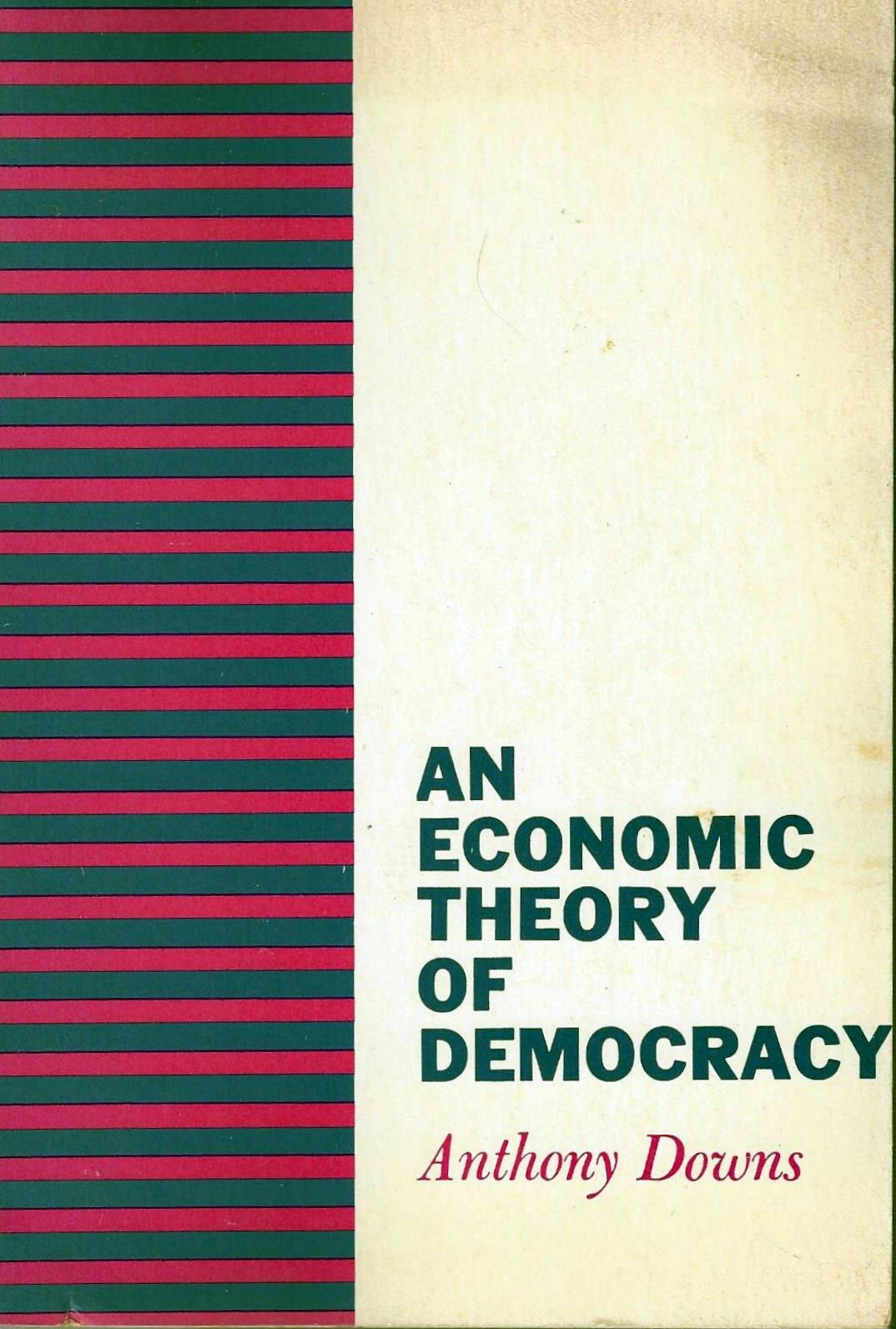
Title
An Economic Theory of Democracy,Used
Sold by Ergodebooks, an authorized reseller.
Returns accepted within 30 days | support@ergodebooks.com
Shipping Information
- Free Standard Shipping — United States only
- Processing Time: 3–5 business days
- Estimated Delivery: 6–10 business days after dispatch
- Double-boxed, fully insured & discreetly packaged
- Tracking number sent via email once dispatched
Returns & Refund
Returns accepted within 30 days of delivery.
Damaged or Defective Item
Free return shipping + replacement or full refund
Wrong Item Received
Free return shipping + replacement or full refund
Change of Mind
Return shipping at customer's expense · 25% restocking fee applies
Payment Option

This book seeks to elucidate its subject the governing of democratic state by making intelligible the party politics of democracies. Downs treats this differently than do other students of politics. His explanations are systematically related to, and deductible from, precisely stated assumptions about the motivations that attend the decisions of voters and parties and the environment in which they act. He is consciously concerned with the economy in explanation, that is, with attempting to account for phenomena in terms of a very limited number of facts and postulates. He is concerned also with the central features of party politics in any democratic state, not with that in the United State or any other single country. I. BASIC STRUCTURE OF THE MODEL. 1. Introduction. 2. Party Motivation and the Function of Government in Society. 3. The Basic Logic of Voting. 4. The Basic Logic of Government DecisionMaking. II. THE GENERAL EFFECTS OF UNCERTAINTY. 5. The Meaning of Uncertainty. 6. How Uncertainty Affects Government DecisionMaking. 7. The Development of Political Ideologies as Means of Getting Votes. 8. The Statics and Dynamics of Party Ideologies 9. Problems of Rationality Under Coalition Governments. 10. Government VoteMaximizing and Individual marginal Equilibrium. III. SPECIFIC EFFECTS OF INFORMATION COSTS. 11. The Process of Becoming Informed. 12. How Rational Citizens Reduce Information Costs. 13. The Returns From Information and Their Diminution. 14. The Causes and Effects of Rational Abstention. IV. DERIVATIVE IMPLICATIONS AND HYPOTHESIS. 15. A Comment on Economic Theories of Government Behavior. 16. Testable Prepositions Derived from the Theory.
⚠️ WARNING (California Proposition 65):
This product may contain chemicals known to the State of California to cause cancer, birth defects, or other reproductive harm.
For more information, please visit www.P65Warnings.ca.gov.
- Q: What is the total number of pages in 'An Economic Theory of Democracy'? A: This book contains three hundred ten pages. It provides a comprehensive exploration of democracy and party politics.
- Q: What are the dimensions of 'An Economic Theory of Democracy'? A: The book measures five point twenty-five inches in length, zero point seventy-five inches in width, and eight inches in height.
- Q: What is the binding type of 'An Economic Theory of Democracy'? A: This book is published in paperback binding. It offers a flexible and lightweight reading experience.
- Q: How should I approach reading 'An Economic Theory of Democracy'? A: You can read this book at your own pace, focusing on understanding democratic concepts and party politics. It is suitable for anyone interested in political science.
- Q: Is 'An Economic Theory of Democracy' suitable for beginners in political science? A: Yes, this book is suitable for beginners. It presents fundamental concepts in an accessible manner.
- Q: What themes are covered in 'An Economic Theory of Democracy'? A: The book covers themes such as party motivation, voting logic, and government decision-making. It delves into the economics of democratic governance.
- Q: How should I store 'An Economic Theory of Democracy' to keep it in good condition? A: Store the book in a cool, dry place away from direct sunlight. This will help preserve the integrity of the paperback binding.
- Q: Can I clean 'An Economic Theory of Democracy' if it gets dirty? A: Yes, you can gently wipe the cover with a dry cloth. Avoid using water or cleaning solutions to prevent damage.
- Q: What if 'An Economic Theory of Democracy' arrives damaged? A: If the book arrives damaged, contact the seller for a return or exchange. Most sellers have a return policy for such situations.
- Q: Is there a warranty for 'An Economic Theory of Democracy'? A: Typically, books do not come with a warranty. However, check with the seller regarding their return policy.
- Q: How does 'An Economic Theory of Democracy' compare to other political science books? A: This book offers a unique economic perspective on democracy, differentiating it from others that may focus more on historical or theoretical aspects.
- Q: Is 'An Economic Theory of Democracy' relevant for contemporary political analysis? A: Yes, its insights into party politics and voter behavior remain highly relevant for analyzing modern democratic systems.
- Q: What are the key takeaways from 'An Economic Theory of Democracy'? A: Key takeaways include an understanding of voter motivations, the impact of uncertainty on decision-making, and the dynamics of party ideologies.
- Q: Who is the author of 'An Economic Theory of Democracy'? A: The book is authored by Anthony Downs, a prominent political economist known for his work on democratic theory.
- Q: What category does 'An Economic Theory of Democracy' fall into? A: This book falls into the category of Democracy. It specifically examines the economic aspects of democratic governance.