
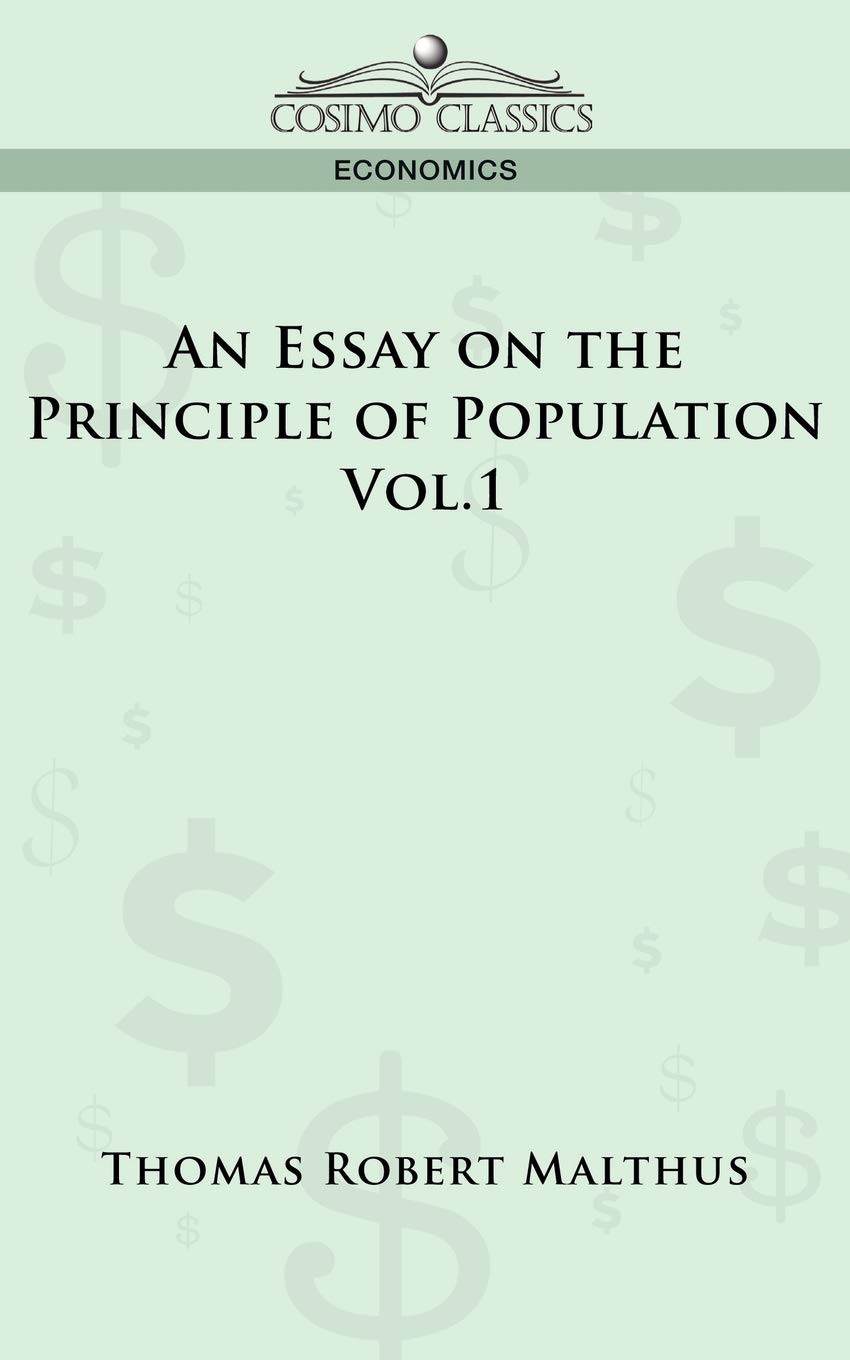
Title
An Essay On The Principle Of Population Vol. 1
Sold by Ergodebooks, an authorized reseller.
Returns accepted within 30 days | support@ergodebooks.com
Shipping Information
- Free Standard Shipping — United States only
- Processing Time: 3–5 business days
- Estimated Delivery: 6–10 business days after dispatch
- Double-boxed, fully insured & discreetly packaged
- Tracking number sent via email once dispatched
Returns & Refund
Returns accepted within 30 days of delivery.
Damaged or Defective Item
Free return shipping + replacement or full refund
Wrong Item Received
Free return shipping + replacement or full refund
Change of Mind
Return shipping at customer's expense · 25% restocking fee applies
Payment Option

Product Description Around 1796, Mr. Malthus, An English Gentleman, Had Finished Reading A Book That Confidently Predicted Human Life Would Continue To Grow Richer, More Comfortable And More Secure, And That Nothing Could Stop The March Of Progress. He Discussed This Theme With His Son, Thomas, And Thomas Ardently Disagreed With Both His Father And The Book He Had Been Reading, Along With The Entire Idea Of Unending Human Progress. Mr. Malthus Suggested That He Write Down His Objections So That They Could Discuss Them Pointbypoint. Not Long After, Thomas Returned With A Rather Long Essay. His Father Read It And Was So Impressed That He Urged His Son To Have It Published. And So, In 1798, Thomas Malthus' An Essay On Population Appeared. Though It Was Attacked At The Time And Ridiculed For Many Years Afterward, It Has Remained One Of The Most Influential Works In The English Language On The General Checks And Balances Of The World'S Population And Its Necessary Control. Volume 1 Includes: Book I: Of The Checks To The Population In The Less Civilised Parts Of The World And In Past Times And Book Ii: Of The Checks To The Population In The Different States Of Modern Europe. Also Available From Cosimo Classics: Malthus' An Essay On Populationvol. 2 Thomas Robert Malthus, Born In 1766 And Educated At Jesus College, Cambridge. In 1798, He Was Curate At Albury In Surrey, And Become Professor History And Political Economy At Haileybury College, 1805. He Died In 1834. About The Author Thomas Robert Malthus, Born In 1766 And Educated At Jesus College, Cambridge. In 1798, He Was Curate At Albury In Surrey, And Become Professor History And Political Economy At Haileybury College, 1805. He Died In 1834.
⚠️ WARNING (California Proposition 65):
This product may contain chemicals known to the State of California to cause cancer, birth defects, or other reproductive harm.
For more information, please visit www.P65Warnings.ca.gov.
- Q: How many pages does this book have? A: This book has three hundred twenty-four pages. It provides a detailed exploration of population dynamics and its impacts.
- Q: What is the binding type of this book? A: This book is published in paperback binding. This makes it lightweight and easy to handle for reading.
- Q: What are the dimensions of this book? A: The book measures five inches in length, zero point seventy-five inches in width, and eight inches in height. These dimensions make it portable and convenient.
- Q: What is the main theme of this book? A: The main theme revolves around population control and its implications. It discusses checks to population growth historically and in modern Europe.
- Q: Who is the author of this book? A: The author of this book is Thomas Robert Malthus. He is known for his influential works on population theory.
- Q: What historical context does this book address? A: This book addresses the historical checks to population growth. It reflects on both less civilized parts of the world and modern Europe.
- Q: Is this book suitable for young readers? A: This book is generally aimed at an adult audience. Its themes and discussions may be complex for younger readers.
- Q: How should I approach reading this book? A: It's best to read this book with a focus on its historical context and theories. Taking notes on key arguments can enhance understanding.
- Q: Can this book be used for academic purposes? A: Yes, this book is suitable for academic purposes. It is widely referenced in studies about population dynamics and economics.
- Q: How do I store this book to keep it in good condition? A: Store this book upright in a cool, dry place. Avoid exposure to direct sunlight to prevent fading of the cover.
- Q: Are there any specific care instructions for this book? A: To care for this book, keep it away from moisture and avoid bending the spine excessively. This will help maintain its condition.
- Q: What if the book arrives damaged? A: If the book arrives damaged, you should contact customer service for a replacement or return. They will provide guidance on the return process.
- Q: Can I return this book if I change my mind? A: Yes, you can return this book if you change your mind. Check the return policy for specific terms and conditions.
- Q: Is this book part of a series? A: Yes, this book is part of a two-volume series. Volume two is also available from the same publisher.
- Q: How does this book compare to other works on population theory? A: This book is considered foundational in population theory. It differs from others by its historical perspective and economic analysis.
- Q: What should I do if I have questions about the book's content? A: If you have questions about the book's content, consider joining a discussion group or looking for academic articles that analyze its themes.