
Title
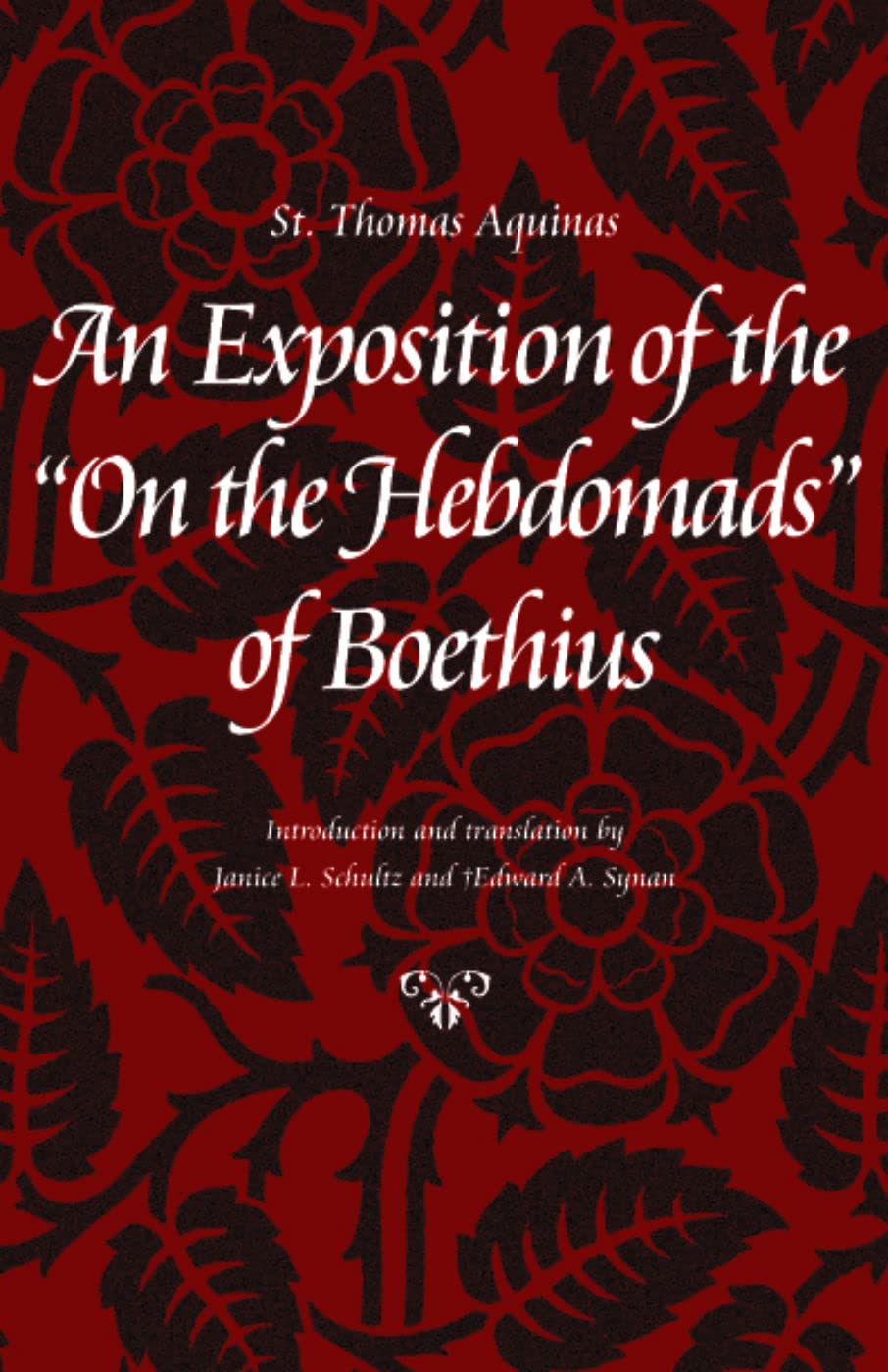
An Exposition Of The On The Hebdomads Of Boethius (Thomas Aquinas In Translation),Used
Sold by Ergodebooks, an authorized reseller.
Returns accepted within 30 days | support@ergodebooks.com
Shipping Information
- Free Standard Shipping — United States only
- Processing Time: 3–5 business days
- Estimated Delivery: 6–10 business days after dispatch
- Double-boxed, fully insured & discreetly packaged
- Tracking number sent via email once dispatched
Returns & Refund
Returns accepted within 30 days of delivery.
Damaged or Defective Item
Free return shipping + replacement or full refund
Wrong Item Received
Free return shipping + replacement or full refund
Change of Mind
Return shipping at customer's expense · 25% restocking fee applies
Payment Option

In his sixthcentury work commonly known as the De hebdomadibus, Boethius (ca. 480524) poses the question of how created things or substances can be good just as they arethat is, good just by existingwithout being the same as the source of all goodness, God, who is understood to be Goodness Itself. In his commentary written in the thirteenth century, St. Thomas Aquinas sets out to explain the problem Boethius is treating as well as to explicate Boethius's solution. In doing so, however, the Angelic Doctor suggests a more developed analysis of goodness, based on his own metaphysical perspective. Still, his view can be seen to continue the emphasis Boethius himself placed on the notion of creationbringing into beingas crucial to understanding the issues at hand.The introduction to this translation provides critical historical background, including an account of the influence of Cicero and Augustine, for understanding Boethius's view of being, or esse. Based on historical and textual analysis, the authors reaffirm the 'traditional' interpretation, which holds that for Boethius esse indicates form rather than a distinct act of being. In articulating the difference between Boethius's and Aquinas's positions on esse and on goodness, and hence the relation of esse and goodness, Schultz and Synan show not only that Aquinas was respectful of Boethius's stance, but that his own position could be seen as a development in harmony with his predecessor's thought.The English translation itself, in facingpage format with the 1992 Leonine critical edition of Aquinas's Latin text, remains faithful to the text and at the same time clear and readable. The work will be valuable to those interested in the fundamental philosophical and theological questions facing mediaeval thinkers and also to those interested in Aquinas's metaphysical thought.
⚠️ WARNING (California Proposition 65):
This product may contain chemicals known to the State of California to cause cancer, birth defects, or other reproductive harm.
For more information, please visit www.P65Warnings.ca.gov.