
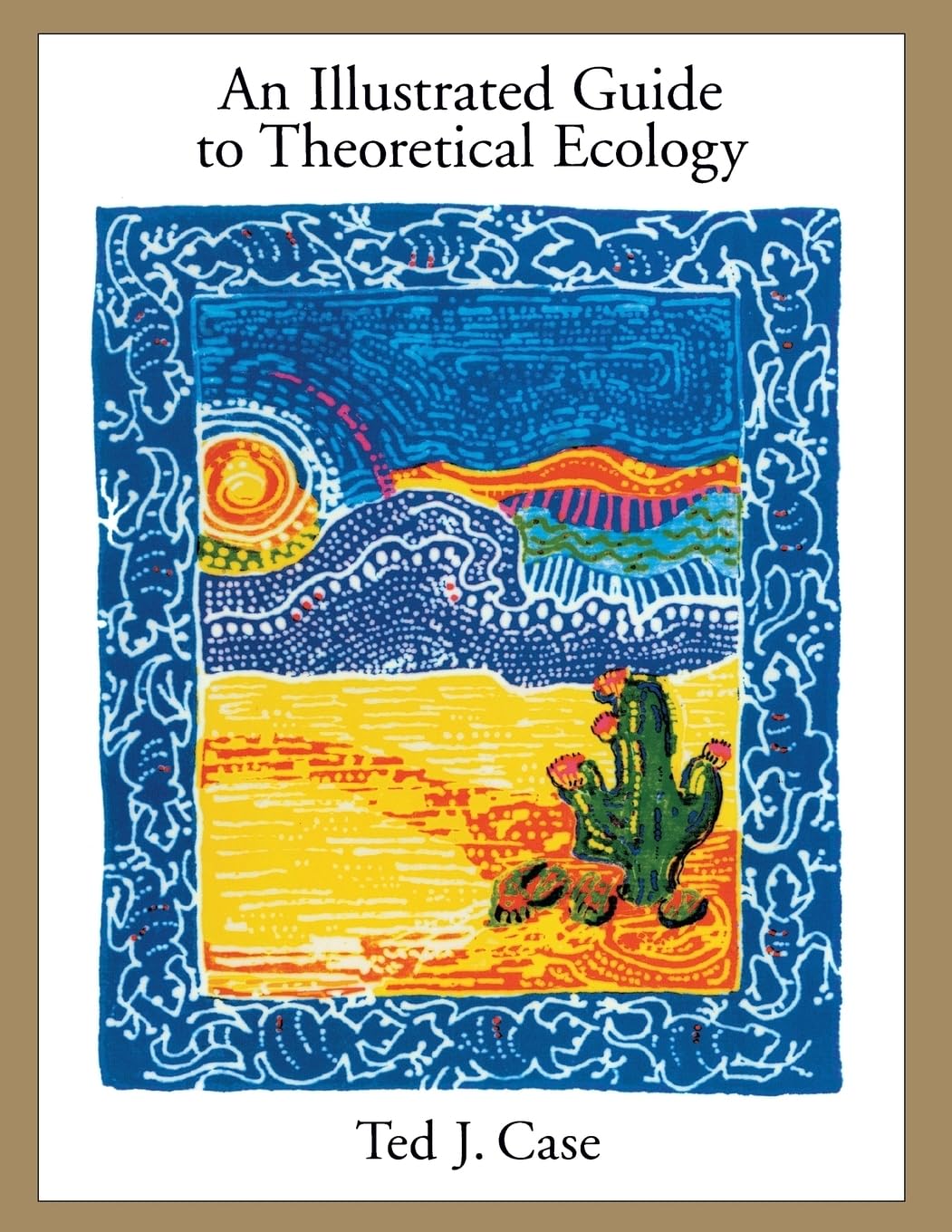
Title
An Illustrated Guide to Theoretical Ecology,New
Sold by Ergodebooks, an authorized reseller.
Returns accepted within 30 days | support@ergodebooks.com
Shipping Information
- Free Standard Shipping — United States only
- Processing Time: 3–5 business days
- Estimated Delivery: 6–10 business days after dispatch
- Double-boxed, fully insured & discreetly packaged
- Tracking number sent via email once dispatched
Returns & Refund
Returns accepted within 30 days of delivery.
Damaged or Defective Item
Free return shipping + replacement or full refund
Wrong Item Received
Free return shipping + replacement or full refund
Change of Mind
Return shipping at customer's expense · 25% restocking fee applies
Payment Option

An Illustrated Guide to Theoretical Ecology uses a combination of visual presentations and the symbolic logic of algebra and calculus to provide the most accessible introduction to ecological theory available. It gives students the basic tools they need to understand the complexities of ecological systems and to analyze simple quantitative ecological problems. The author walks students through the most common models in ecology, beginning with first principles and then gently making each formulation accessible through a stepbystep development of equations paired with lavish illustrations. He also applies theoretical developments to practical issues in conservation and resource management, offering a more visceral understanding of the purpose and utility of the theory and demonstrating how it may need modification in its application to realworld problems and future directions. The text also includes some basic ecological genetics and an exploration of metapopulation dynamics.An Illustrated Guide to Theoretical Ecology is enhanced by over 500 twocolor diagrams, many endofchapter problems, and a website that includes simulation models that parallel each chapters development (http://www.nceas.ucsb.edu/BookCase). Ideal as a main text for advanced undergraduate courses in theoretical and mathematical ecology or conservation biology, this unique book can also serve as a supplement or a selfguided tutorial in general ecology, population ecology, and community ecology courses.
⚠️ WARNING (California Proposition 65):
This product may contain chemicals known to the State of California to cause cancer, birth defects, or other reproductive harm.
For more information, please visit www.P65Warnings.ca.gov.
- Q: How many pages does this book have? A: This book has four hundred sixty-four pages. It provides a comprehensive exploration of theoretical ecology in an accessible format.
- Q: What are the dimensions of this book? A: The book measures eight point thirty-nine inches in length, zero point ninety-one inches in width, and ten point eighty-eight inches in height. These dimensions make it a suitable size for easy handling.
- Q: What binding type does the book have? A: The book is available in paperback binding. This makes it lightweight and flexible for readers.
- Q: Is this book suitable for beginners in ecology? A: Yes, this book is suitable for beginners. It uses visual presentations and symbolic logic to introduce ecological concepts in an accessible manner.
- Q: What type of audience is this book intended for? A: This book is ideal for advanced undergraduate courses in theoretical and mathematical ecology or conservation biology. It also serves as a self-guided tutorial for general ecology.
- Q: Are there exercises included in the book? A: Yes, the book includes many end-of-chapter problems. These exercises help reinforce the concepts covered in each chapter.
- Q: How should I store this book to keep it in good condition? A: Store the book in a cool, dry place away from direct sunlight. This will help preserve its binding and pages.
- Q: Can I clean the book if it gets dirty? A: Yes, you can gently wipe the cover with a soft, dry cloth. Avoid using water or cleaning solutions that could damage the paper.
- Q: Does this book discuss real-world applications of ecological theory? A: Yes, the book applies theoretical developments to practical issues in conservation and resource management. This helps readers understand the utility of ecological theory.
- Q: What topics are covered in the book? A: The book covers ecological models, ecological genetics, and metapopulation dynamics. It provides a thorough introduction to various aspects of theoretical ecology.
- Q: How can I access the additional resources mentioned? A: You can access simulation models and additional resources through the website provided in the book. Visit http://www.nceas.ucsb.edu/BookCase for more information.
- Q: Is there any prior knowledge required to understand this book? A: No specific prior knowledge is required, but familiarity with basic algebra and calculus is beneficial. The book introduces concepts gradually for ease of understanding.
- Q: Who is the author of this book? A: The author is Ted J. Case. He is known for his work in ecology and has crafted this book to bridge theory and practical applications.
- Q: What publishing company released this book? A: The book is published by Oxford University Press, USA. They are known for high-quality academic publications.
- Q: Are illustrations included in the book? A: Yes, the book features over five hundred two-color diagrams. These illustrations enhance understanding of complex ecological concepts.