If you have any questions, you are always welcome to contact us. We'll get back to you as soon as possible, withing 24 hours on weekdays.
Customer service
All questions about your order, return and delivery must be sent to our customer service team by e-mail at yourstore@yourdomain.com
Sale & Press
If you are interested in selling our products, need more information about our brand or wish to make a collaboration, please contact us at press@yourdomain.com
Help
If you have any questions, you are always welcome to contact us. We'll get back to you as soon as possible, withing 24 hours on weekdays.
Customer service
All questions about your order, return and delivery must be sent to our customer service team by e-mail at yourstore@yourdomain.com
Sale & Press
If you are interested in selling our products, need more information about our brand or wish to make a collaboration, please contact us at press@yourdomain.com
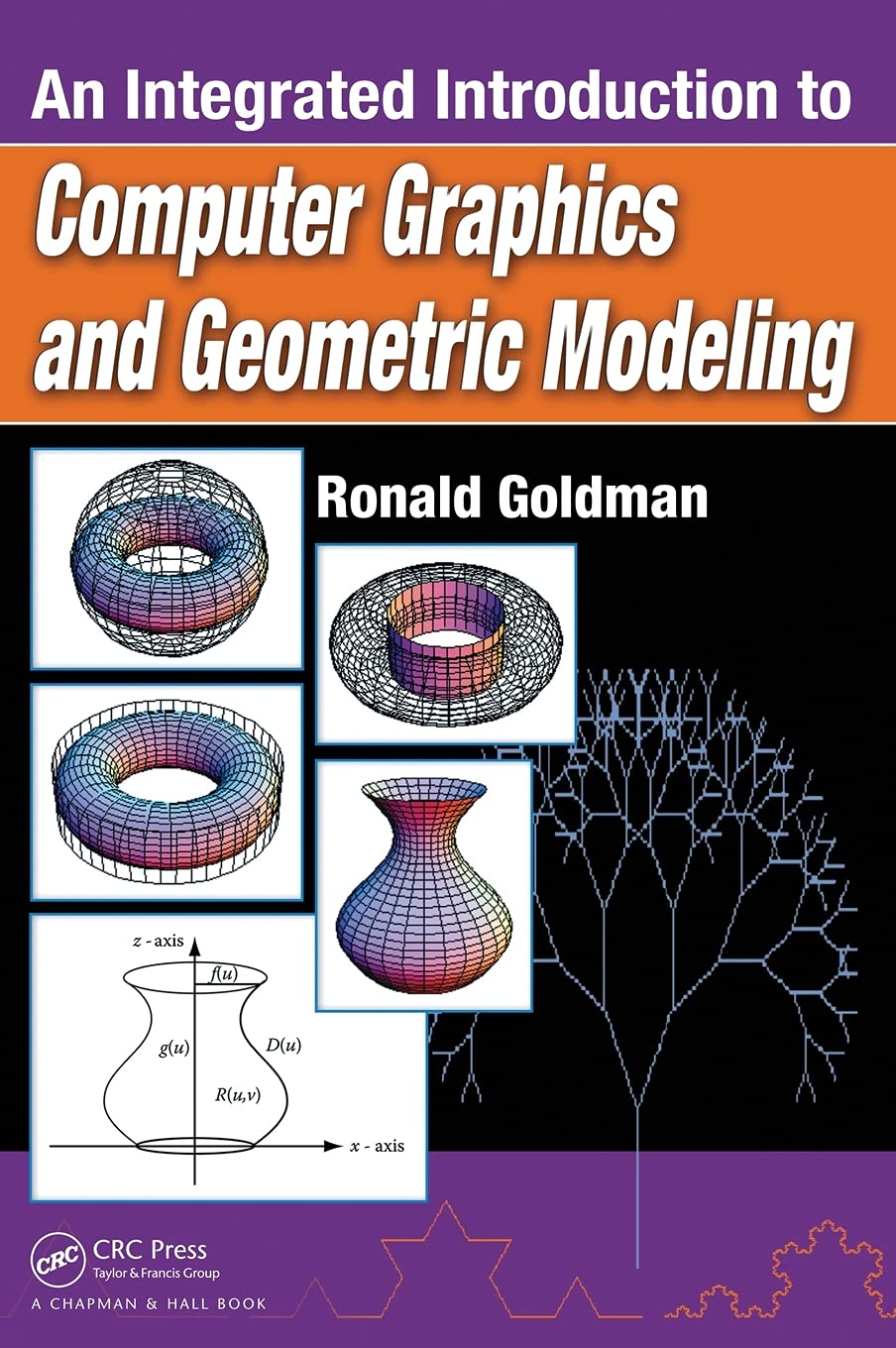
Taking a novel, more appealing approach than current texts, An Integrated Introduction to Computer Graphics and Geometric Modeling focuses on graphics, modeling, and mathematical methods, including ray tracing, polygon shading, radiosity, fractals, freeform curves and surfaces, vector methods, and transformation techniques. The author begins with fractals, rather than the typical linedrawing algorithms found in many standard texts. He also brings the turtle back from obscurity to introduce several major concepts in computer graphics.Supplying the mathematical foundations, the book covers linear algebra topics, such as vector geometry and algebra, affine and projective spaces, affine maps, projective transformations, matrices, and quaternions. The main graphics areas explored include reflection and refraction, recursive ray tracing, radiosity, illumination models, polygon shading, and hidden surface procedures. The book also discusses geometric modeling, including planes, polygons, spheres, quadrics, algebraic and parametric curves and surfaces, constructive solid geometry, boundary files, octrees, interpolation, approximation, Bezier and Bspline methods, fractal algorithms, and subdivision techniques.Making the material accessible and relevant for years to come, the text avoids descriptions of current graphics hardware and special programming languages. Instead, it presents graphics algorithms based on wellestablished physical models of light and cogent mathematical methods.
⚠️ WARNING (California Proposition 65):
This product may contain chemicals known to the State of California to cause cancer,
birth defects, or other reproductive harm.
For MAP (Minimum Advertised Price) violations and Intellectual Property (IP) or Trademark concerns, please contact:
support@ergodebooks.com
⚠️ California Proposition 65 Warning: Some products sold on this website may expose you to chemicals known to the State of California to cause cancer, birth defects, or other reproductive harm. For more information, visit www.P65Warnings.ca.gov.