
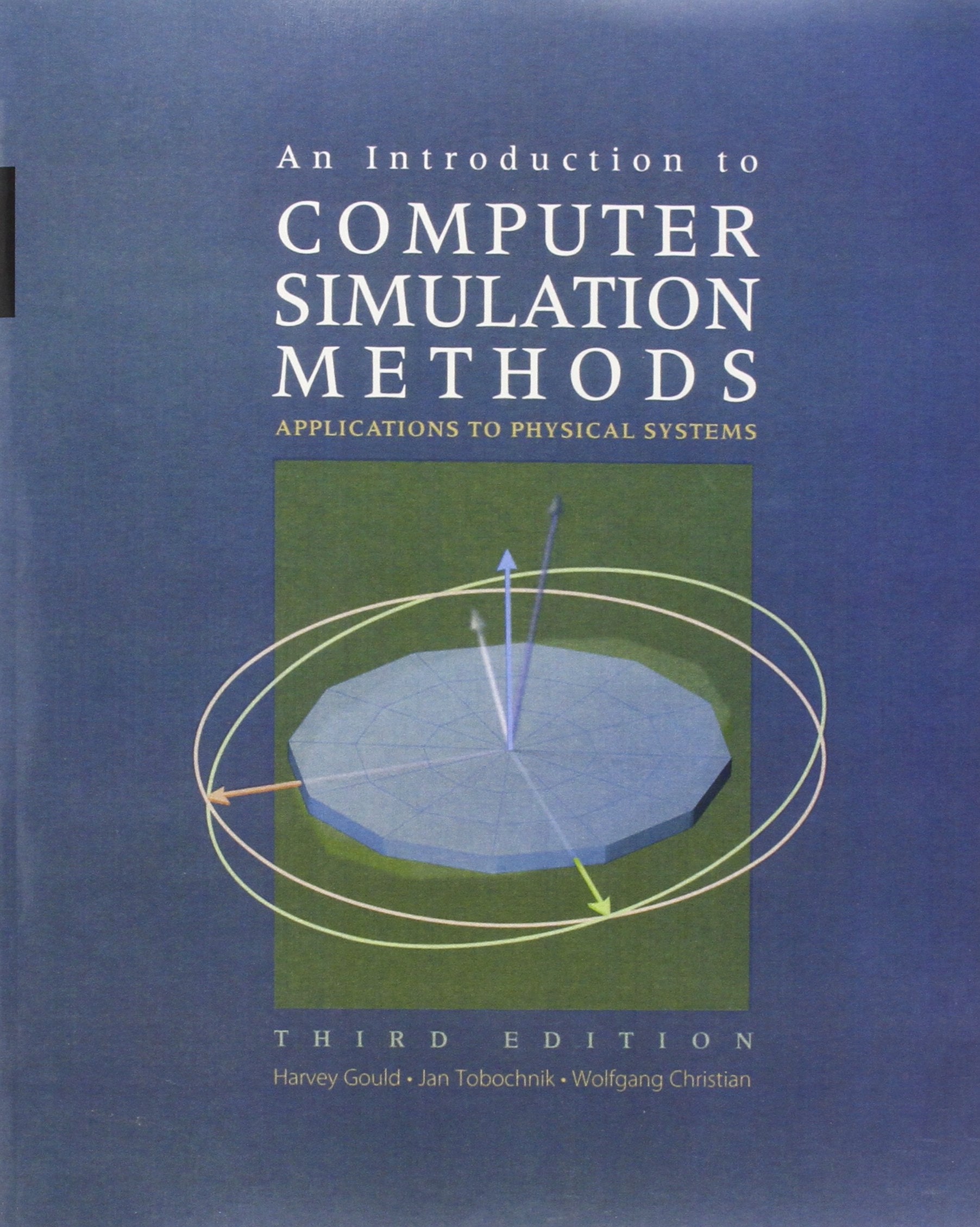
Title
An Introduction To Computer Simulation Methods: Applications To Physical Systems (3Rd Edition),New
Sold by Ergodebooks, an authorized reseller.
Returns accepted within 30 days | support@ergodebooks.com
Shipping Information
- Free Standard Shipping — United States only
- Processing Time: 3–5 business days
- Estimated Delivery: 6–10 business days after dispatch
- Double-boxed, fully insured & discreetly packaged
- Tracking number sent via email once dispatched
Returns & Refund
Returns accepted within 30 days of delivery.
Damaged or Defective Item
Free return shipping + replacement or full refund
Wrong Item Received
Free return shipping + replacement or full refund
Change of Mind
Return shipping at customer's expense · 25% restocking fee applies
Payment Option

Key Benefit: Now In Its Third Edition, This Book Teaches Physical Concepts Using Computer Simulations. The Text Incorporates Objectoriented Programming Techniques And Encourages Readers To Develop Good Programming Habits In The Context Of Doing Physics. Designed For Readers At All Levels, An Introduction To Computer Simulation Methods Uses Java, Currently The Most Popular Programming Language. Introduction, Tools For Doing Simulations, Simulating Particle Motion, Oscillatory Systems, Fewbody Problems: The Motion Of The Planets, The Chaotic Motion Of Dynamical Systems, Random Processes, The Dynamics Of Many Particle Systems, Normal Modes And Waves, Electrodynamics, Numerical And Monte Carlo Methods, Percolation, Fractals And Kinetic Growth Models, Complex Systems, Monte Carlo Simulations Of Thermal Systems, Quantum Systems, Visualization And Rigid Body Dynamics, Seeing In Special And General Relativity, Epilogue: The Unity Of Physics For All Readers Interested In Developing Programming Habits In The Context Of Doing Physics.
⚠️ WARNING (California Proposition 65):
This product may contain chemicals known to the State of California to cause cancer, birth defects, or other reproductive harm.
For more information, please visit www.P65Warnings.ca.gov.
- Q: What is the page count of this book? A: This book contains seven hundred twenty pages. It offers a comprehensive exploration of computer simulation methods in physics.
- Q: What are the dimensions of this book? A: The dimensions are seven point four inches in length, one point eight one inches in width, and nine point one inches in height. These sizes make it portable and easy to handle.
- Q: What is the binding type of this book? A: This book is available in paperback binding. This makes it lightweight and ideal for casual reading.
- Q: What programming language does this book use? A: This book uses Java as the primary programming language. Java is widely recognized and popular among programmers.
- Q: Is this book suitable for beginners in programming? A: Yes, this book is suitable for beginners. It teaches physical concepts using computer simulations in an accessible manner.
- Q: Can I use this book if I have no background in physics? A: Yes, you can use this book without a background in physics. It is designed for readers at all levels, making complex topics understandable.
- Q: How should I care for this book? A: To care for this book, keep it in a cool, dry place away from direct sunlight. This will help preserve the quality of the pages and binding.
- Q: Is this book safe for young readers? A: Yes, this book is safe for young readers. However, it is recommended for those who are interested in programming and physics.
- Q: How do I store this book properly? A: Store this book upright on a shelf, or lay it flat in a drawer. This will prevent bending or damage to the spine.
- Q: What is the warranty policy for this book? A: This book typically does not come with a warranty. However, check with the retailer for any return policies.
- Q: What if my book arrives damaged? A: If your book arrives damaged, contact the retailer's customer service for assistance with returns or exchanges.
- Q: Is this book appropriate for advanced readers? A: Yes, advanced readers will also find value in this book. It covers complex topics suitable for more experienced learners.
- Q: What topics are covered in this book? A: The book covers topics like particle motion, chaotic motion, and Monte Carlo simulations. It provides a broad understanding of computer simulation methods.
- Q: Does this book include practical examples? A: Yes, this book includes practical examples and programming tasks. These help readers apply theoretical knowledge to real-world scenarios.
- Q: Can I use this book for self-study? A: Yes, this book is excellent for self-study. It is structured to help individuals learn independently at their own pace.
- Q: Who is the author of this book? A: The author of this book is Harvey Gould. He is known for his expertise in physics and computer simulations.