
Title


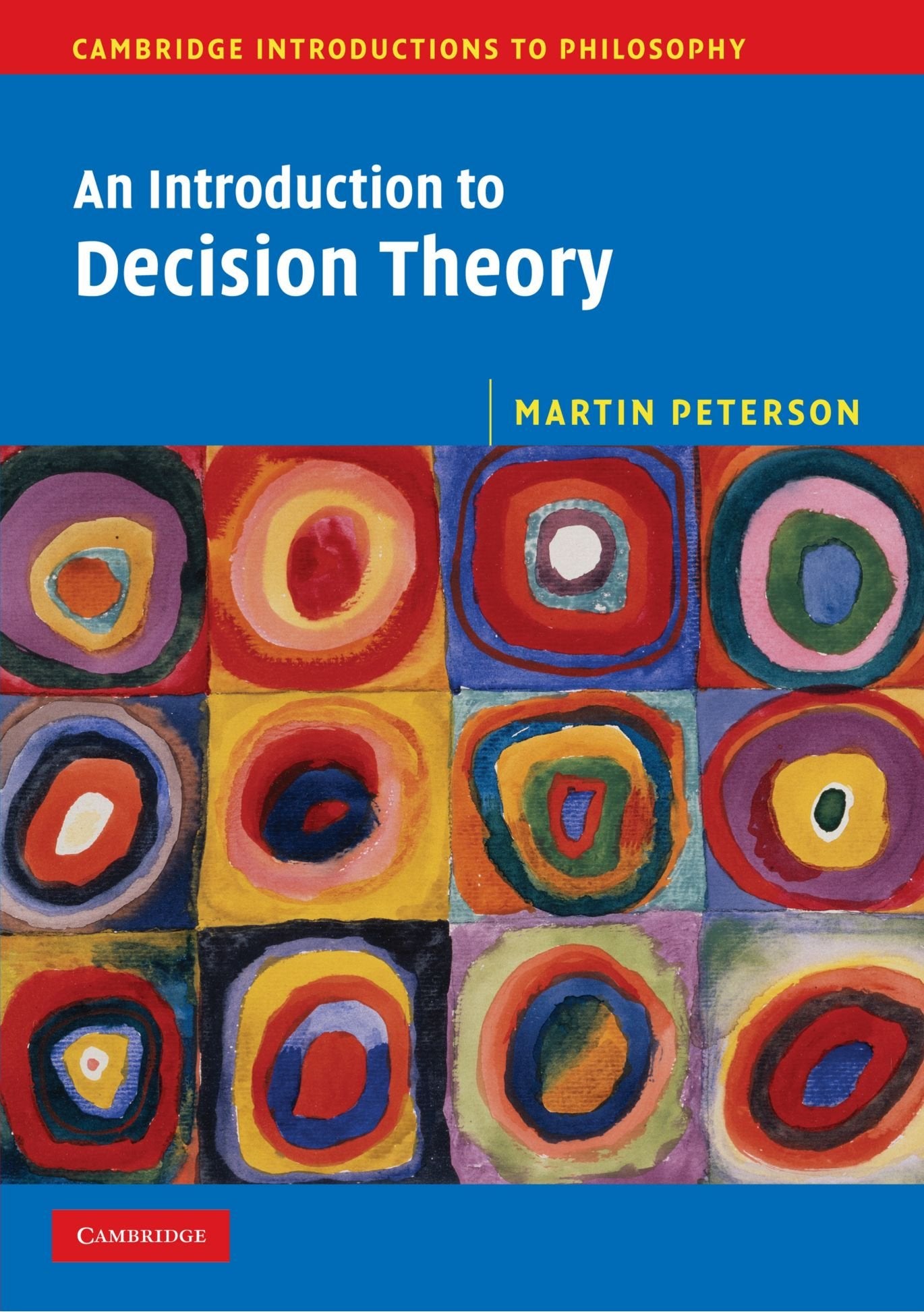
An Introduction To Decision Theory (Cambridge Introductions To Philosophy)
Sold by Ergodebooks, an authorized reseller.
Returns accepted within 30 days | support@ergodebooks.com
Shipping Information
- Free Standard Shipping — United States only
- Processing Time: 3–5 business days
- Estimated Delivery: 6–10 business days after dispatch
- Double-boxed, fully insured & discreetly packaged
- Tracking number sent via email once dispatched
Returns & Refund
Returns accepted within 30 days of delivery.
Damaged or Defective Item
Free return shipping + replacement or full refund
Wrong Item Received
Free return shipping + replacement or full refund
Change of Mind
Return shipping at customer's expense · 25% restocking fee applies
Payment Option

This Introduction To Decision Theory Offers Comprehensive And Accessible Discussions Of Decisionmaking Under Ignorance And Risk, The Foundations Of Utility Theory, The Debate Over Subjective And Objective Probability, Bayesianism, Causal Decision Theory, Game Theory, And Social Choice Theory. No Mathematical Skills Are Assumed, And All Concepts And Results Are Explained In Nontechnical And Intuitive As Well As More Formal Ways. There Are Over 100 Exercises With Solutions, And A Glossary Of Key Terms And Concepts. An Emphasis On Foundational Aspects Of Normative Decision Theory (Rather Than Descriptive Decision Theory) Makes The Book Particularly Useful For Philosophy Students, But It Will Appeal To Readers In A Range Of Disciplines Including Economics, Psychology, Political Science And Computer Science.
⚠️ WARNING (California Proposition 65):
This product may contain chemicals known to the State of California to cause cancer, birth defects, or other reproductive harm.
For more information, please visit www.P65Warnings.ca.gov.
- Q: What is the size of 'An Introduction to Decision Theory'? A: The book measures seven point twenty-five inches in length, zero point fifty-one inches in width, and ten inches in height. This compact size makes it easy to handle and read.
- Q: How many pages does the book have? A: The book contains three hundred twenty-five pages. This length provides a comprehensive exploration of decision theory topics.
- Q: What type of binding does this book have? A: This book is available in a paperback binding. This makes it lightweight and flexible for easy reading.
- Q: What age group is this book suitable for? A: This book is suitable for high school students and above. It is designed for readers with no prior mathematical skills.
- Q: Can beginners understand this book? A: Yes, beginners can understand this book. It explains complex concepts in non-technical and intuitive ways.
- Q: Is this book appropriate for philosophy students? A: Yes, this book is particularly useful for philosophy students. It emphasizes foundational aspects of normative decision theory.
- Q: How should I store this book? A: Store the book in a cool, dry place away from direct sunlight. This will help preserve its condition over time.
- Q: Can this book be used as a reference? A: Yes, this book can be used as a reference. It includes a glossary of key terms and concepts for easy lookup.
- Q: What if my book arrives damaged? A: If your book arrives damaged, contact the seller for a return or exchange. Most sellers offer customer support for such issues.
- Q: Does this book contain exercises? A: Yes, the book contains over one hundred exercises with solutions. This feature enhances understanding of decision theory concepts.
- Q: Is there a glossary included in the book? A: Yes, there is a glossary of key terms and concepts. This helps readers familiarize themselves with essential terminology.
- Q: How does this book compare to other decision theory books? A: This book is more accessible than many others in decision theory. It avoids heavy mathematical jargon, making it suitable for a wider audience.
- Q: Are there any prerequisites for reading this book? A: No, there are no prerequisites for reading this book. It is designed for those without prior knowledge in decision theory.
- Q: What are the main topics covered in this book? A: The book covers topics such as decision-making under ignorance and risk, utility theory, Bayesianism, and game theory. These are essential areas in decision theory.
- Q: Is this book suited for non-philosophy majors? A: Yes, this book appeals to readers in various disciplines, including economics, psychology, and computer science. It offers valuable insights applicable to many fields.