If you have any questions, you are always welcome to contact us. We'll get back to you as soon as possible, withing 24 hours on weekdays.
Customer service
All questions about your order, return and delivery must be sent to our customer service team by e-mail at yourstore@yourdomain.com
Sale & Press
If you are interested in selling our products, need more information about our brand or wish to make a collaboration, please contact us at press@yourdomain.com
Help
If you have any questions, you are always welcome to contact us. We'll get back to you as soon as possible, withing 24 hours on weekdays.
Customer service
All questions about your order, return and delivery must be sent to our customer service team by e-mail at yourstore@yourdomain.com
Sale & Press
If you are interested in selling our products, need more information about our brand or wish to make a collaboration, please contact us at press@yourdomain.com
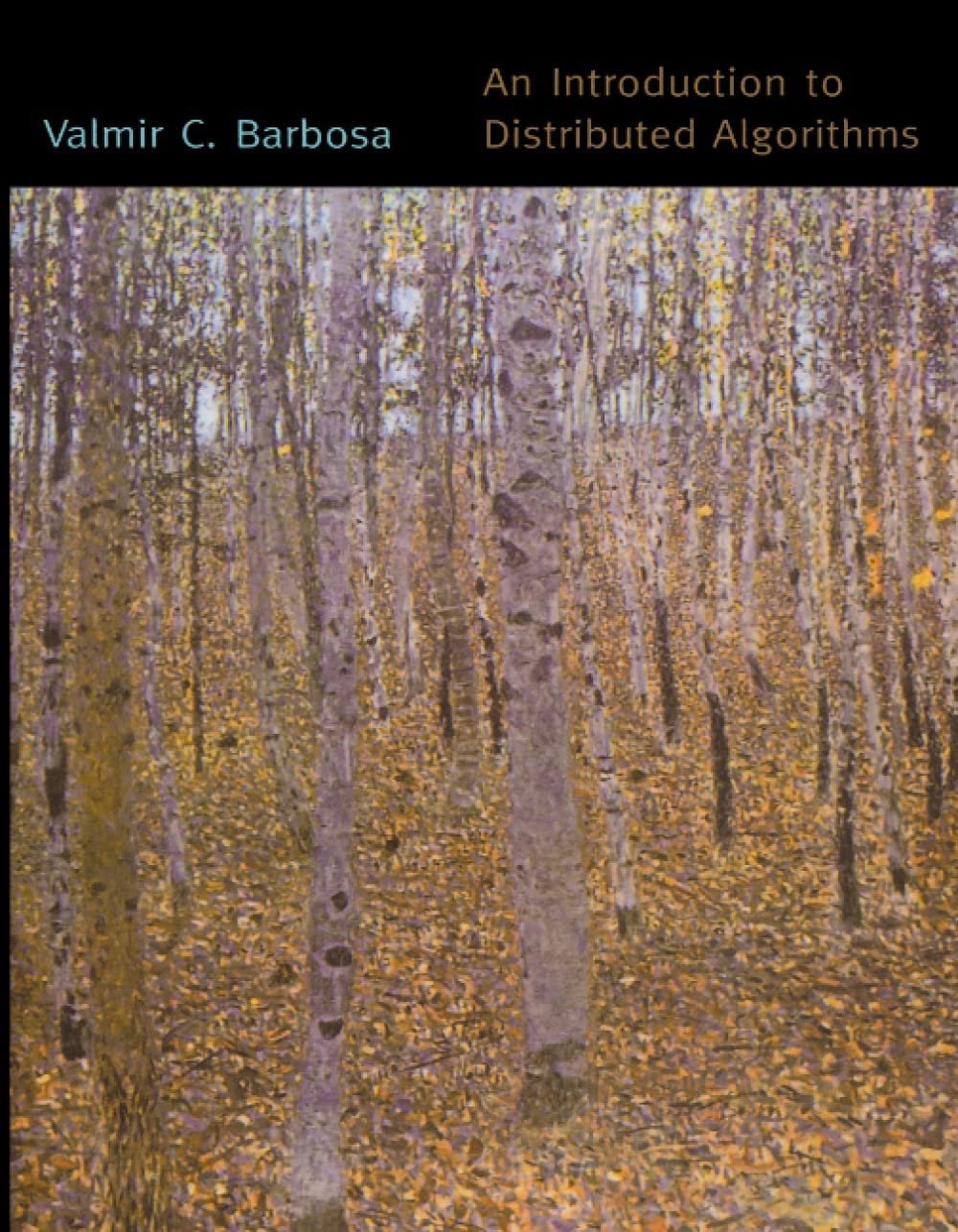
An Introduction to Distributed Algorithms takes up some of the main concepts and algorithms, ranging from basic to advanced techniques and applications, that underlie the programming of distributedmemory systems such as computer networks, networks of workstations, and multiprocessors. Written from the broad perspective of distributedmemory systems in general it includes topics such as algorithms for maximum flow, program debugging, and simulation that do not appear in more orthodox texts on distributed algorithms. Moving from fundamentals to advances and applications, ten chapters with exercises and bibliographic notes cover a variety of topics. These include models of distributed computation, information propagation, leader election, distributed snapshots, network synchronization, self stability, termination detection, deadlock detection, graph algorithms, mutual exclusion, program debugging, and simulation. All of the algorithms are presented in a clear, template based format for the description of messagepassing computations among the nodes of a connected graph. Such a generic setting allows the treatment of problems originating from many different application areas. The main ideas and algorithms are described in a way that balances intuition and formal rigor most are preceded by a general intuitive discussion and followed by formal statements as to correctness complexity or other properties.
⚠️ WARNING (California Proposition 65):
This product may contain chemicals known to the State of California to cause cancer,
birth defects, or other reproductive harm.
For MAP (Minimum Advertised Price) violations and Intellectual Property (IP) or Trademark concerns, please contact:
support@ergodebooks.com
⚠️ California Proposition 65 Warning: Some products sold on this website may expose you to chemicals known to the State of California to cause cancer, birth defects, or other reproductive harm. For more information, visit www.P65Warnings.ca.gov.