If you have any questions, you are always welcome to contact us. We'll get back to you as soon as possible, withing 24 hours on weekdays.
Customer service
All questions about your order, return and delivery must be sent to our customer service team by e-mail at yourstore@yourdomain.com
Sale & Press
If you are interested in selling our products, need more information about our brand or wish to make a collaboration, please contact us at press@yourdomain.com
Help
If you have any questions, you are always welcome to contact us. We'll get back to you as soon as possible, withing 24 hours on weekdays.
Customer service
All questions about your order, return and delivery must be sent to our customer service team by e-mail at yourstore@yourdomain.com
Sale & Press
If you are interested in selling our products, need more information about our brand or wish to make a collaboration, please contact us at press@yourdomain.com
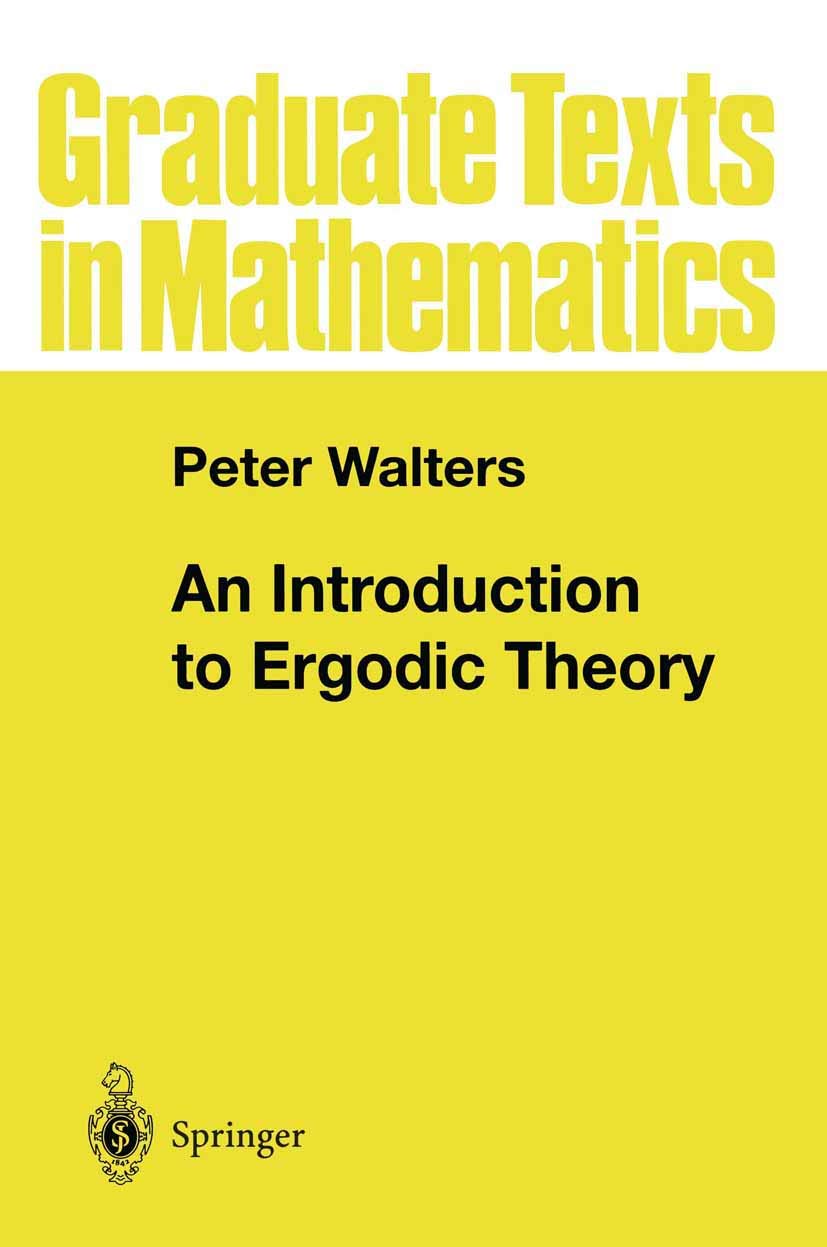
This text provides an introduction to ergodic theory suitable for readers knowing basic measure theory. The mathematical prerequisites are summarized in Chapter 0. It is hoped the reader will be ready to tackle research papers after reading the book. The first part of the text is concerned with measurepreserving transformations of probability spaces; recurrence properties, mixing properties, the Birkhoff ergodic theorem, isomorphism and spectral isomorphism, and entropy theory are discussed. Some examples are described and are studied in detail when new properties are presented. The second part of the text focuses on the ergodic theory of continuous transformations of compact metrizable spaces. The family of invariant probability measures for such a transformation is studied and related to properties of the transformation such as topological traitivity, minimality, the size of the nonwandering set, and existence of periodic points. Topological entropy is introduced and related to measuretheoretic entropy. Topological pressure and equilibrium states are discussed, and a proof is given of the variational principle that relates pressure to measuretheoretic entropies. Several examples are studied in detail. The final chapter outlines significant results and some applications of ergodic theory to other branches of mathematics.
⚠️ WARNING (California Proposition 65):
This product may contain chemicals known to the State of California to cause cancer,
birth defects, or other reproductive harm.
For MAP (Minimum Advertised Price) violations and Intellectual Property (IP) or Trademark concerns, please contact:
support@ergodebooks.com
⚠️ California Proposition 65 Warning: Some products sold on this website may expose you to chemicals known to the State of California to cause cancer, birth defects, or other reproductive harm. For more information, visit www.P65Warnings.ca.gov.