
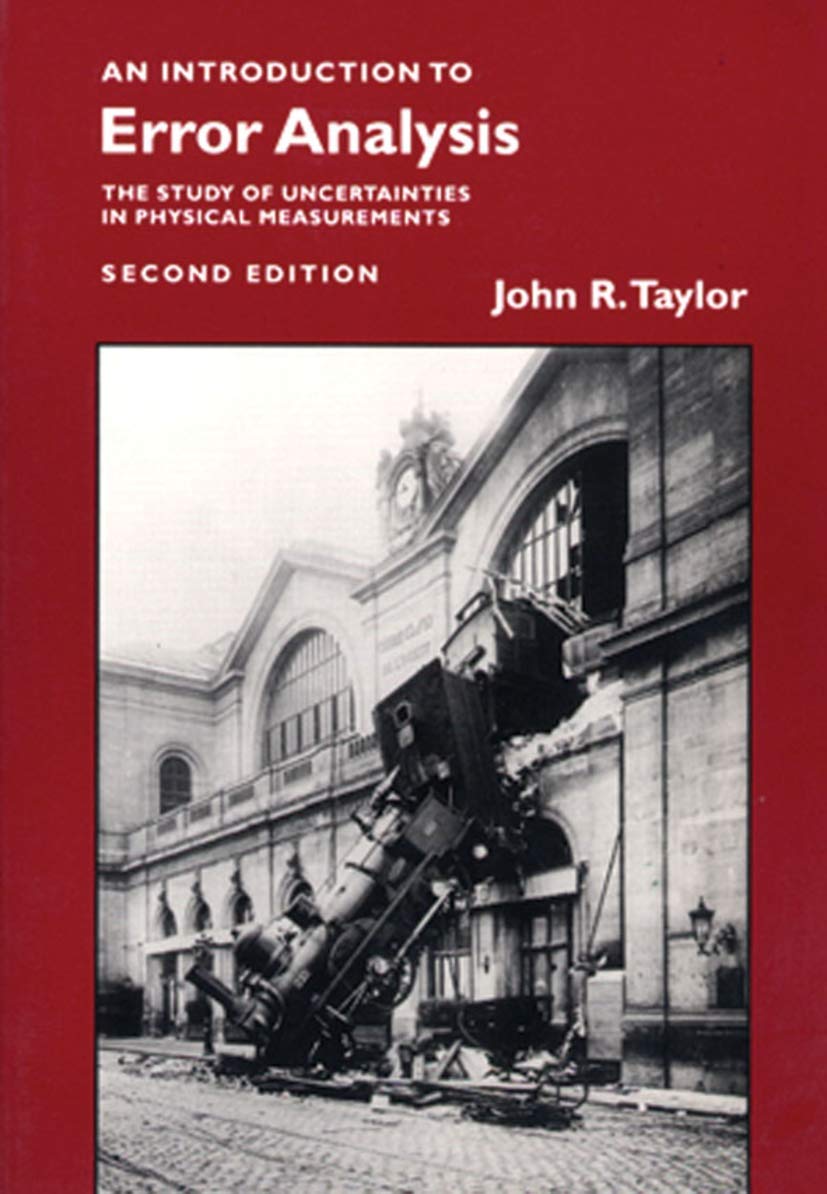
Title


An Introduction To Error Analysis: The Study Of Uncertainties In Physical Measurements
Sold by Ergodebooks, an authorized reseller.
Returns accepted within 30 days | support@ergodebooks.com
Shipping Information
- Free Standard Shipping — United States only
- Processing Time: 3–5 business days
- Estimated Delivery: 6–10 business days after dispatch
- Double-boxed, fully insured & discreetly packaged
- Tracking number sent via email once dispatched
Returns & Refund
Returns accepted within 30 days of delivery.
Damaged or Defective Item
Free return shipping + replacement or full refund
Wrong Item Received
Free return shipping + replacement or full refund
Change of Mind
Return shipping at customer's expense · 25% restocking fee applies
Payment Option

This Bestselling Text By John Taylor, Now Released In Its Second Edition, Introduces The Study Of Uncertainties To Lower Division Science Students. Assuming No Prior Knowledge, The Author Introduces Error Analysis Through The Use Of Familiar Examples Ranging From Carpentry To Wellknown Historic Experiments. Pertinent Worked Examples, Simple Exercises Throughout The Text, And Numerous Chapterending Problems Combine To Make The Book Ideal For Use In Physics, Chemistry, And Engineering Lab Courses. The First Edition Of This Book Has Been Translated Into Six Languages.
⚠️ WARNING (California Proposition 65):
This product may contain chemicals known to the State of California to cause cancer, birth defects, or other reproductive harm.
For more information, please visit www.P65Warnings.ca.gov.
- Q: How many pages does this book have? A: This book has three hundred twenty-seven pages. It offers extensive content on error analysis for lower division science students.
- Q: What is the binding type of this book? A: The binding type is paperback. This makes it lightweight and easy to carry for students.
- Q: What are the dimensions of this book? A: The book measures seven point twenty-five inches in length, zero point seventy-five inches in width, and ten point twenty-five inches in height. These dimensions make it a convenient size for reading.
- Q: Is this book suitable for beginners? A: Yes, this book is suitable for beginners. It assumes no prior knowledge and introduces concepts using familiar examples.
- Q: What subjects does this book cover? A: This book covers error analysis in physics, chemistry, and engineering. It is aimed at lower division science students.
- Q: Can this book be used in lab courses? A: Yes, it is ideal for physics, chemistry, and engineering lab courses. The book includes numerous exercises and problems to enhance learning.
- Q: How should I care for this book? A: To care for this book, keep it in a dry place and avoid exposure to direct sunlight. This will help preserve the condition of the paperback.
- Q: Is this book safe for children? A: Yes, this book is safe for children. It is educational and suitable for young learners interested in science.
- Q: What languages is this book available in? A: This book has been translated into nine languages. These include Spanish, French, Italian, Japanese, Polish, Chinese, Portuguese, Thai, and Korean.
- Q: What topics are covered in the exercises? A: The exercises cover fundamental concepts of error analysis. They range from simple calculations to complex problems based on real-world applications.
- Q: Does this book include examples from history? A: Yes, it includes well-known historic experiments as examples. This helps contextualize error analysis in practical scenarios.
- Q: Is there a glossary in this book? A: Yes, the book contains a glossary of terms related to error analysis. This is helpful for students unfamiliar with specific terminology.
- Q: What age group is this book appropriate for? A: This book is appropriate for high school and college-level students. It is designed for those studying physical sciences.
- Q: Does this book have a companion website? A: No, this book does not have a companion website. However, it may be supported by additional resources from the publisher.
- Q: What makes this book a bestseller? A: Its clear explanations and practical examples make it a bestseller. It effectively introduces error analysis to new students.