If you have any questions, you are always welcome to contact us. We'll get back to you as soon as possible, withing 24 hours on weekdays.
Customer service
All questions about your order, return and delivery must be sent to our customer service team by e-mail at yourstore@yourdomain.com
Sale & Press
If you are interested in selling our products, need more information about our brand or wish to make a collaboration, please contact us at press@yourdomain.com
Help
If you have any questions, you are always welcome to contact us. We'll get back to you as soon as possible, withing 24 hours on weekdays.
Customer service
All questions about your order, return and delivery must be sent to our customer service team by e-mail at yourstore@yourdomain.com
Sale & Press
If you are interested in selling our products, need more information about our brand or wish to make a collaboration, please contact us at press@yourdomain.com
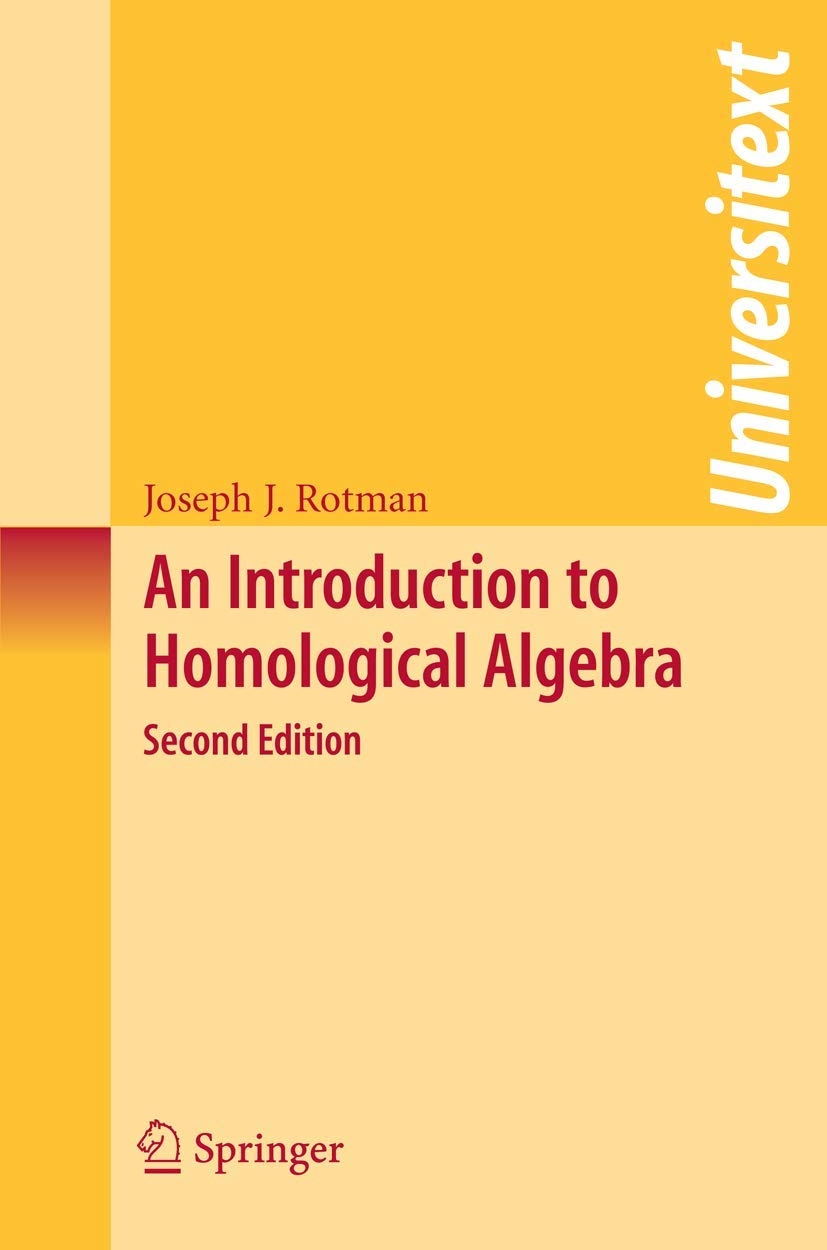
Homological Algebra has grown in the nearly three decades since the rst e tion of this book appeared in 1979. Two books discussing more recent results are Weibel, An Introduction to Homological Algebra, 1994, and Gelfand Manin, Methods of Homological Algebra, 2003. In their Foreword, Gelfand and Manin divide the history of Homological Algebra into three periods: the rst period ended in the early 1960s, culminating in applications of Ho logical Algebra to regular local rings. The second period, greatly in uenced by the work of A. Grothendieck and J. P. Serre, continued through the 1980s; it involves abelian categories and sheaf cohomology. The third period, volving derived categories and triangulated categories, is still ongoing. Both of these newer books discuss all three periods (see also KashiwaraSchapira, Categories and Sheaves). The original version of this book discussed the rst period only; this new edition remains at the same introductory level, but it now introduces thesecond period as well. This change makes sense pe gogically, for there has been a change in the mathematics population since 1979; today, virtually all mathematics graduate students have learned so thing about functors and categories, and so I can now take the categorical viewpoint more seriously. When I was a graduate student, Homological Algebra was an unpopular subject. The general attitude was that it was a grotesque formalism, boring to learn, and not very useful once one had learned it.
⚠️ WARNING (California Proposition 65):
This product may contain chemicals known to the State of California to cause cancer,
birth defects, or other reproductive harm.
For MAP (Minimum Advertised Price) violations and Intellectual Property (IP) or Trademark concerns, please contact:
support@ergodebooks.com
⚠️ California Proposition 65 Warning: Some products sold on this website may expose you to chemicals known to the State of California to cause cancer, birth defects, or other reproductive harm. For more information, visit www.P65Warnings.ca.gov.