
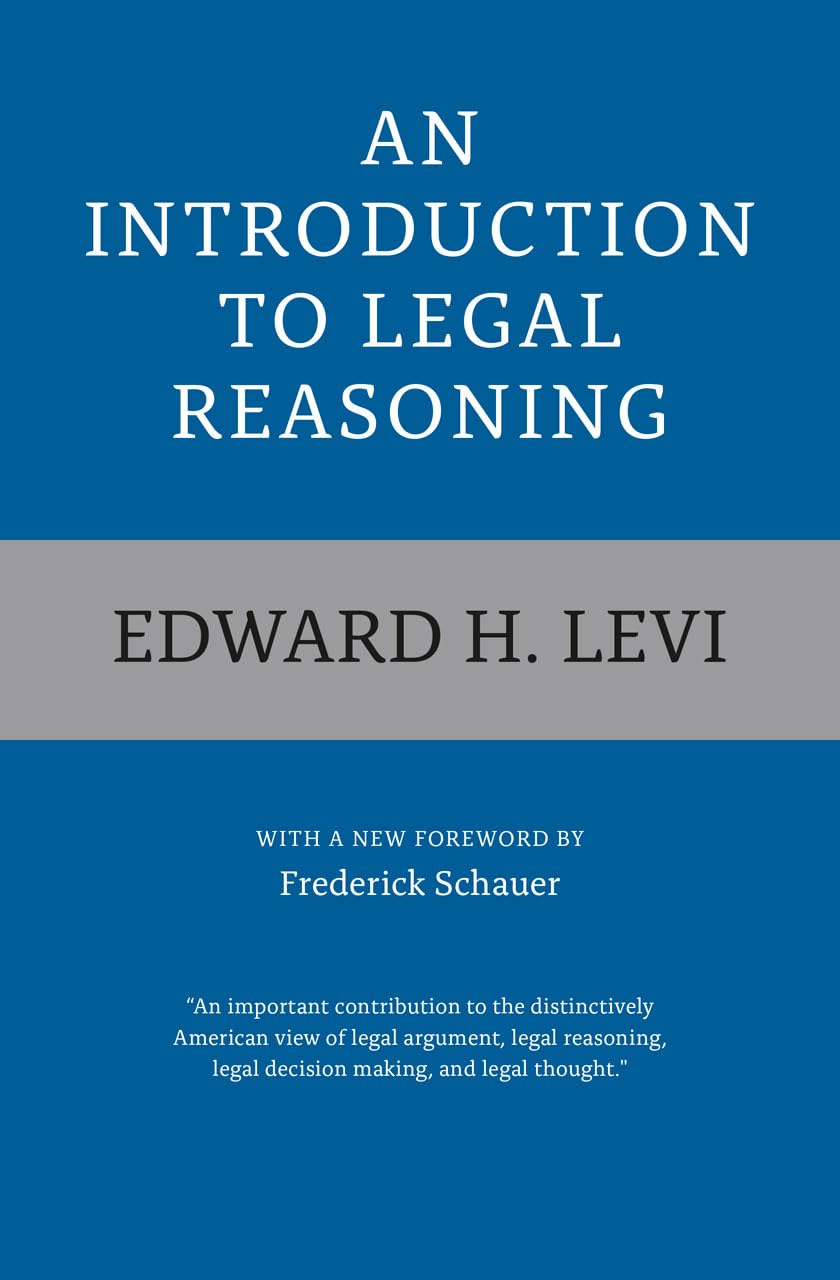
Title
An Introduction to Legal Reasoning,Used
Sold by Ergodebooks, an authorized reseller.
Returns accepted within 30 days | support@ergodebooks.com
Shipping Information
- Free Standard Shipping — United States only
- Processing Time: 3–5 business days
- Estimated Delivery: 6–10 business days after dispatch
- Double-boxed, fully insured & discreetly packaged
- Tracking number sent via email once dispatched
Returns & Refund
Returns accepted within 30 days of delivery.
Damaged or Defective Item
Free return shipping + replacement or full refund
Wrong Item Received
Free return shipping + replacement or full refund
Change of Mind
Return shipping at customer's expense · 25% restocking fee applies
Payment Option

Originally published in 1949, An Introduction to Legal Reasoning is widely acknowledged as a classic text. As its opening sentence states, This is an attempt to describe generally the process of legal reasoning in the field of case law and in the interpretation of statutes and of the Constitution. In elegant and lucid prose, Edward H. Levi does just that in a concise manner, providing an intellectual foundation for generations of students as well as general readers.For this edition, the book includes a substantial new foreword by leading contemporary legal scholar Frederick Schauer that helpfully places this foundational book into its historical and legal contexts, explaining its continuing value and relevance to understanding the role of analogical reasoning in the law. This volume will continue to be of great value to students of logic, ethics, and political philosophy, as well as to members of the legal profession and everyone concerned with problems of government and jurisprudence.
⚠️ WARNING (California Proposition 65):
This product may contain chemicals known to the State of California to cause cancer, birth defects, or other reproductive harm.
For more information, please visit www.P65Warnings.ca.gov.
- Q: What is the page count of 'An Introduction to Legal Reasoning'? A: This book has one hundred twenty-eight pages. It provides a concise exploration of legal reasoning and related concepts.
- Q: What are the dimensions of this book? A: The book measures eight point zero three inches in length, five point two eight inches in width, and zero point three two inches in height.
- Q: What type of binding does this book have? A: This book features a paperback binding. This makes it lightweight and easy to carry.
- Q: Who is the author of 'An Introduction to Legal Reasoning'? A: The author is Edward H. Levi. He is known for his contributions to legal scholarship since the book was originally published in nineteen forty-nine.
- Q: What is the genre of this book? A: The book falls under the reference genre. It is aimed at students and professionals interested in legal reasoning and jurisprudence.
- Q: How do I read 'An Introduction to Legal Reasoning'? A: Simply open the book and start reading. The text is structured to provide insights into legal reasoning processes.
- Q: Is this book suitable for beginners in legal studies? A: Yes, it is suitable for beginners. The book serves as an introduction to legal reasoning and is accessible to general readers.
- Q: What age group is this book appropriate for? A: This book is appropriate for high school age and above. It is designed for students and anyone interested in understanding legal concepts.
- Q: How should I care for this paperback book? A: Keep it in a dry place and avoid exposure to direct sunlight. This will help maintain its condition over time.
- Q: Can I store this book on a shelf? A: Yes, you can store it on a shelf. Ensure it is upright to prevent bending or damage to the pages.
- Q: What if the book arrives damaged? A: If the book arrives damaged, you should contact the seller for a return or exchange. Most sellers have policies in place for such situations.
- Q: Is there a warranty for this book? A: No, books typically do not come with warranties. However, check the seller's return policy for any guarantees.
- Q: How can I find more books like this one? A: You can search for books in the reference category or look for works by Edward H. Levi. Online bookstores often recommend similar titles.
- Q: Is there a digital version of this book available? A: It depends on the publisher. Check online retailers to see if a digital edition is offered.
- Q: What is the significance of the foreword in this edition? A: The foreword provides historical and legal context. Written by Frederick Schauer, it enhances the reader's understanding of the book's relevance.
- Q: Can this book help with understanding governmental issues? A: Yes, it addresses problems of government and jurisprudence. It is valuable for anyone interested in these topics.