
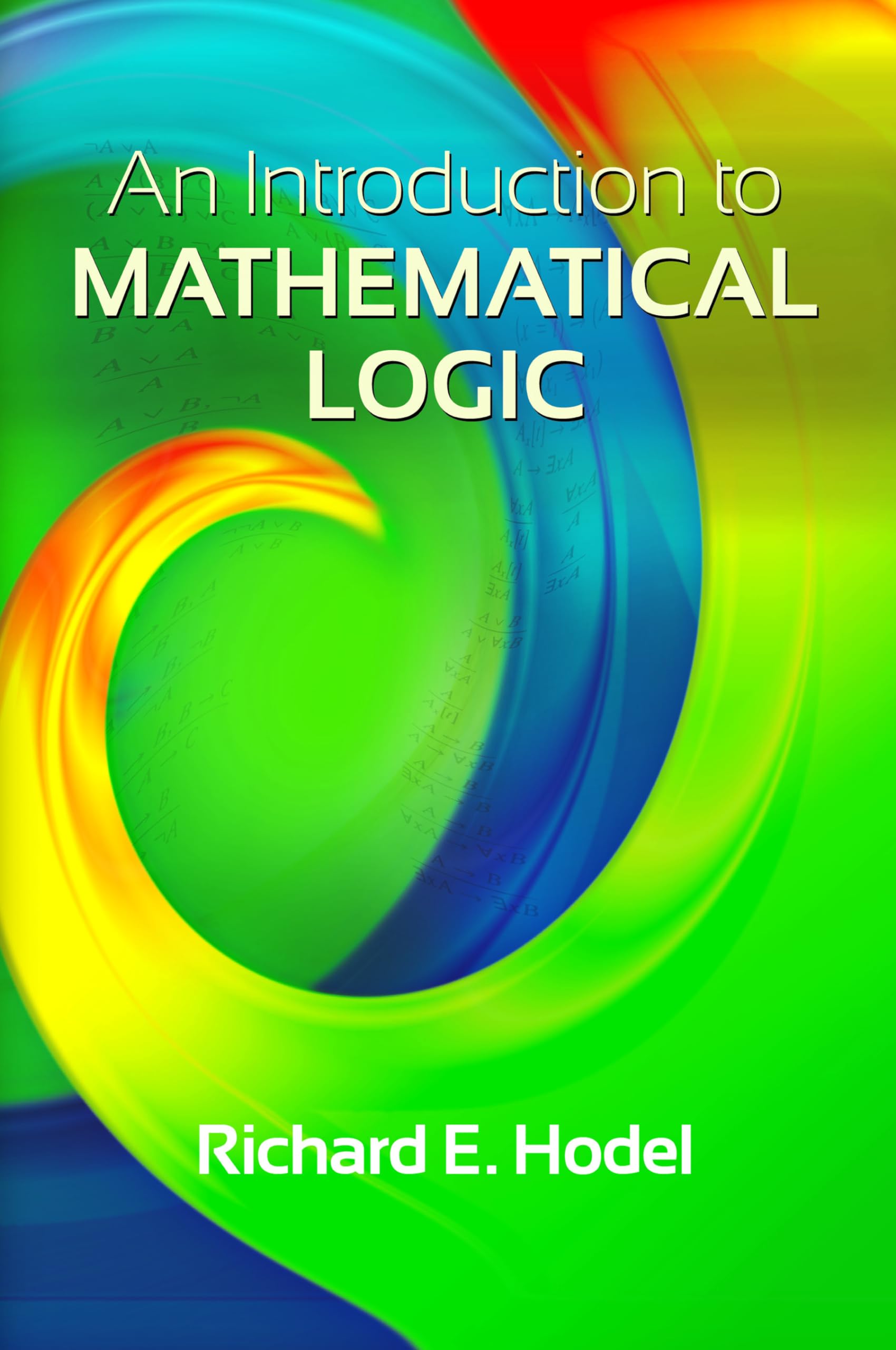
Title
An Introduction to Mathematical Logic (Dover Books on Mathematics),Used
Sold by Ergodebooks, an authorized reseller.
Returns accepted within 30 days | support@ergodebooks.com
Shipping Information
- Free Standard Shipping — United States only
- Processing Time: 3–5 business days
- Estimated Delivery: 6–10 business days after dispatch
- Double-boxed, fully insured & discreetly packaged
- Tracking number sent via email once dispatched
Returns & Refund
Returns accepted within 30 days of delivery.
Damaged or Defective Item
Free return shipping + replacement or full refund
Wrong Item Received
Free return shipping + replacement or full refund
Change of Mind
Return shipping at customer's expense · 25% restocking fee applies
Payment Option

Widely praised for its clarity and thorough coverage, this comprehensive overview of mathematical logic is suitable for readers of many different backgrounds. Designed primarily for advanced undergraduates and graduate students of mathematics, the treatment also contains much of interest to advanced students in computer science and philosophy.An introductory section prepares readers for successive chapters on propositional logic and firstorder languages and logic. Subsequent chapters shift in emphasis from an approach to logic from a mathematical point of view to the interplay between mathematics and logic. Topics include the theorems of Gdel, Church, and Tarski on incompleteness, undecidability, and indefinability; a rigorous treatment of recursive functions and recursive relations; computability theory; and Hilbert's Tenth Problem. Numerous exercises appear throughout the text, and an appendix offers helpful background on number theory.
⚠️ WARNING (California Proposition 65):
This product may contain chemicals known to the State of California to cause cancer, birth defects, or other reproductive harm.
For more information, please visit www.P65Warnings.ca.gov.
- Q: How many pages does this book have? A: This book has five hundred twelve pages. It provides comprehensive coverage of mathematical logic, making it suitable for advanced studies.
- Q: What is the binding type of this book? A: The binding type is paperback. This makes it lightweight and convenient for carrying around.
- Q: What are the dimensions of the book? A: The book measures five point nine one inches in length, one point one inches in width, and eight point nine inches in height. These dimensions make it easy to handle and store.
- Q: Who is the author of this book? A: The author is Richard E. Hodel. He has a strong background in mathematics and logic, contributing to the book's authoritative perspective.
- Q: What is the main topic of this book? A: The main topic is mathematical logic. It covers various aspects, including propositional logic and first-order languages.
- Q: Is this book suitable for beginners? A: No, this book is designed for advanced undergraduates and graduate students. It assumes a background in mathematics, making it less suitable for beginners.
- Q: Does this book include exercises for practice? A: Yes, numerous exercises are included throughout the text. These help reinforce concepts and enhance understanding of mathematical logic.
- Q: What kind of topics does the book cover? A: The book covers topics such as Gödel's theorems, Church's and Tarski's contributions to logic, and computability theory. It provides a rigorous treatment of these subjects.
- Q: Is prior knowledge of logic required to read this book? A: Yes, prior knowledge of mathematics is required. The book is aimed at those with some foundational understanding of logic.
- Q: How do I care for this paperback book? A: To care for this paperback book, keep it away from moisture and extreme temperatures. Store it upright on a shelf to prevent bending.
- Q: Can this book be used as a reference for computer science? A: Yes, it contains much of interest for advanced students in computer science. The interplay between mathematics and logic is particularly relevant.
- Q: What if my book arrives damaged? A: If your book arrives damaged, you should contact customer support for a return or replacement. Make sure to keep the original packaging for the return process.
- Q: Does this book contain an appendix? A: Yes, there is an appendix that offers helpful background on number theory. This provides additional context for the main content.
- Q: Is this book appropriate for philosophy students? A: Yes, the book is suitable for philosophy students interested in the foundations of logic. It explores philosophical implications of logical theories.
- Q: What makes this book different from other logic books? A: Its comprehensive treatment and clarity set it apart. It integrates both mathematical and philosophical perspectives on logic, appealing to a broader audience.