
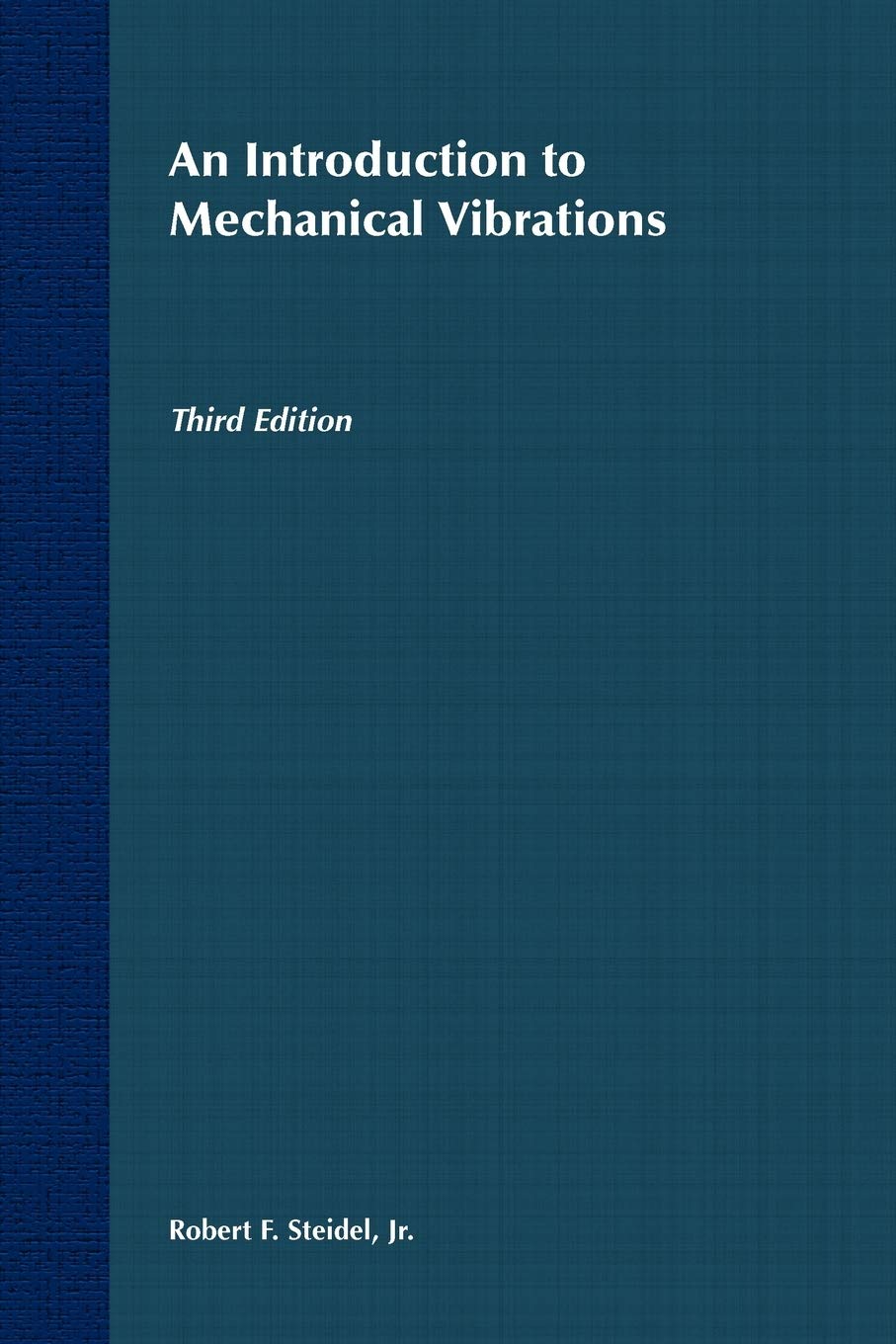
Title
An Introduction to Mechanical Vibrations,New
Sold by Ergodebooks, an authorized reseller.
Returns accepted within 30 days | support@ergodebooks.com
Shipping Information
- Free Standard Shipping — United States only
- Processing Time: 3–5 business days
- Estimated Delivery: 6–10 business days after dispatch
- Double-boxed, fully insured & discreetly packaged
- Tracking number sent via email once dispatched
Returns & Refund
Returns accepted within 30 days of delivery.
Damaged or Defective Item
Free return shipping + replacement or full refund
Wrong Item Received
Free return shipping + replacement or full refund
Change of Mind
Return shipping at customer's expense · 25% restocking fee applies
Payment Option

This Third Edition of the wellreceived engineering text retains the clarity of exposition that made the previous editions so popular, and contains the most widelyused problem sets in the business. Approach to vibration analysis is clear, concise, and simple, backed up by a wealth of problems and examples. Multidegreeoffreedom problems are wellprefaced with twodegreeoffreedom cases. There is a special treatment of damping, including nonviscous problems (standard texts make much use of viscous damping, but most practical examples are not viscous). Now includes an excellent development of Rayleigh's principle and an introduction to finite element vibration analysis. Contains 100 new problems.
⚠️ WARNING (California Proposition 65):
This product may contain chemicals known to the State of California to cause cancer, birth defects, or other reproductive harm.
For more information, please visit www.P65Warnings.ca.gov.
- Q: What is the binding type of this book? A: This book has a paperback binding. Paperback editions are known for their lightweight and flexible nature, making them easy to carry.
- Q: How many pages does 'An Introduction to Mechanical Vibrations' have? A: This book contains four hundred sixty-four pages. This length provides a comprehensive overview of mechanical vibrations with numerous examples and problems.
- Q: What are the dimensions of this book? A: The dimensions of this book are six point six one inches in length, one inch in width, and nine point seven two inches in height. These measurements make it a standard-sized textbook.
- Q: Who is the author of this book? A: The author of this book is Robert F. Steidel Jr. He is known for his expertise in mechanical engineering and vibrations.
- Q: What is the primary subject of this book? A: The primary subject of this book is mechanical vibrations. It covers various aspects of vibration analysis, including damping and finite element analysis.
- Q: Is this book suitable for beginners in mechanical engineering? A: Yes, this book is suitable for beginners. It offers clear explanations and is backed by a wealth of problems to aid understanding.
- Q: Does this book include practical problems for practice? A: Yes, this book includes one hundred new problems for practice. These problems enhance the reader's understanding of mechanical vibrations.
- Q: Can I use this book for advanced studies in mechanical engineering? A: Yes, this book can be used for advanced studies. It provides in-depth treatment of complex topics such as multi-degree-of-freedom problems.
- Q: Is there a special focus on damping in this book? A: Yes, there is a special focus on damping, including non-viscous damping. This approach is beneficial since most practical examples do not involve viscous damping.
- Q: Does this book cover finite element vibration analysis? A: Yes, this book includes an introduction to finite element vibration analysis. This topic is essential for modern engineering applications.
- Q: What level of expertise is required to understand this book? A: A basic understanding of mechanical engineering principles is recommended. However, the book is designed to be accessible to those new to the subject.
- Q: Are there any new topics introduced in this edition? A: Yes, this third edition introduces several new problems and a development of Rayleigh's principle. This enhances the overall learning experience.
- Q: Is this book suitable for self-study? A: Yes, this book is suitable for self-study. The clear exposition and problem sets allow learners to study independently.
- Q: What type of engineering does this book focus on? A: This book focuses on mechanical engineering. Specifically, it addresses the fundamentals of mechanical vibrations.
- Q: Where can I purchase 'An Introduction to Mechanical Vibrations'? A: You can purchase this book from various online retailers or local bookstores. It is published by John Wiley & Sons.